Biography
Simon Hwang Il-gwang
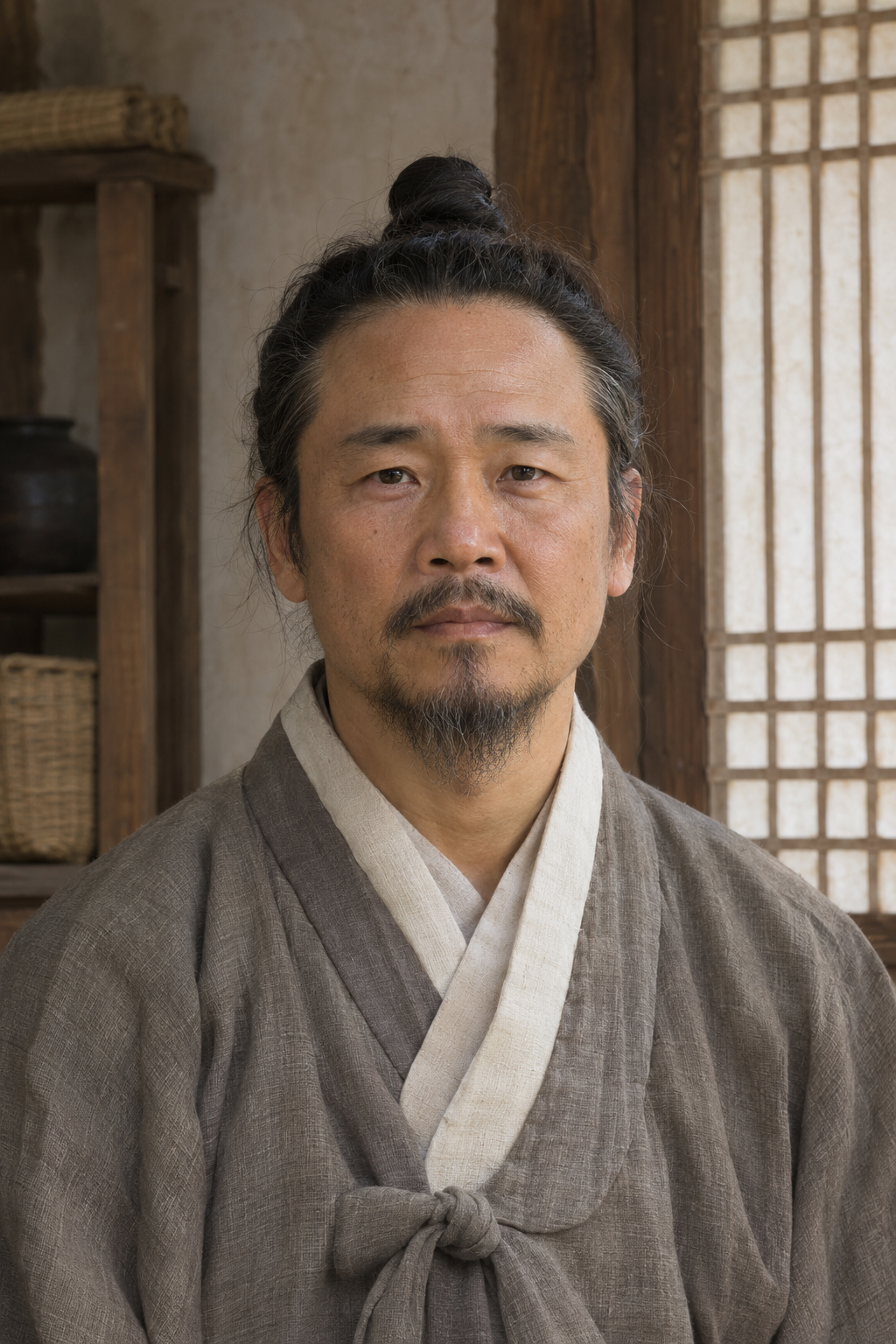
About Simon Hwang Il-gwang
Simon Hwang Il-gwang was born in 1757 in Hongju, in Chungcheong. He grew up in poverty in a family whose low social position exposed him to contempt. Catholic accounts remember him as intelligent, cheerful and direct in his manner. His later movements took him through several provinces, but his life in the Church remained closely connected with his younger brother, Hwang Cha-dol.
His family belonged to the baekjeong, a group treated as social outcasts. Historian Cha Ki-jin describes the restrictions that marked Hwang’s early life: he could not simply live among ordinary commoners, and entering a town exposed him to humiliating treatment. His eventual welcome into Catholic homes therefore involved a change in ordinary human relationships as well as the acceptance of religious teaching.
During the 1790s, Hwang sought out Louis Gonzaga Yi Jon-chang and learned Catholic teaching from him. He subsequently left his home region with Cha-dol and moved to Gyeongsang, hoping to practice his faith more freely. The brothers maintained contact with Catholics there. Their fellow believers knew their social background, but received them as members of the community. Cha places their meeting during a difficult period for the teacher himself. Yi had been arrested a second time at the end of 1795 and was living under confinement in Cheonan. In Cha’s account he nevertheless received Hwang, instructed him and entered his name on the list of believers.
The date of his first instruction is uncertain. The official biography places his move to Hongsan around 1792, while Cha Ki-jin’s 1997 account dates his instruction to 1798.
Yeo Jin-cheon describes even yangban families opening their homes to Hwang and his brother. These households belonged to the hereditary elite. Yeo connects the brothers’ welcome as fellow Christians with Hwang’s understanding of equality before God. Hwang joked that he had found heaven twice.
In 1800 he and Cha-dol moved to Bunwon, in Gwangju, where Augustine Jeong Yak-jong lived. Hwang associated with Catholics including Alexius Hwang Sa-yeong and Peter Kim Han-bin. Yeo describes Hwang running errands for Jeong at Bunwon. He later earned money carrying loads of wood for people in Seoul.
Shin Ui-sik interprets Jeong’s teaching of Hwang as an example of catechesis crossing social boundaries, and connects Hwang’s later endurance with the instruction received in that household.
Literary historian Lee Min-hui connects Hwang’s understanding of Christian equality with the teaching emphasized in Jeong Yak-jong’s Korean catechism, Jugyo yoji. Lee presents this as evidence of religious ideas reaching believers beyond the learned elite. The book was written in Korean. Lee argues that such books could reach women and people of low rank and shape the way they spoke about their faith. Hwang’s saying is his example; it does not tell us whether Hwang himself possessed a copy.
When Jeong moved to Seoul, the Hwang brothers helped carry his belongings. Jeong Min places Hwang’s baptism by James Zhou Wen-mo in the house occupied by Jeong in Cheongseok-dong, which belonged to Vivian Mun Yeong-in. The house was too small for all of them to live together, so the brothers took lodgings in Jeong-dong. There they earned their living by selling and delivering firewood. In later Catholic biographical writing, he is also called Alexius as well as Simon.
Baptism gave Hwang the opportunity to attend Mass with the Catholics around Zhou. Alongside worship, he continued working for his livelihood and helping with the needs of the Church.
He was arrested during the 1801 persecution while going out to obtain firewood. Police Bureau and Ministry of Justice questioning brought repeated punishment. Cha’s account remembers the respectful manner in which he answered officials and the religious understanding he displayed when questioned about doctrine. He punned on place names suggesting wood and prison.
Historian Bang Sang-geun explains what the examining officials wanted to know. When had a prisoner taken up the religion? Who had taught him? Whom else did he know in the Church? They also wanted an answer about his future conduct. Hwang’s answers survive among the examples Bang discusses. They distinguish two questions that the officials asked him: whether he would acknowledge his Catholic associations and whether punishment would make him renounce his faith.
Officials condemned Hwang for propagating forbidden teachings, and ordered provincial prisoners returned home for execution. The same record gives his baptismal name as Simyeon.
The punishment left one of his legs broken. After his death sentence, he could not walk to Hongju and had to be transported on a straw litter. His wife and son followed, wishing to care for him to the end. The Catholic account says that he asked them to keep their distance because he feared that seeing them might weaken his resolve.
He was beheaded at Hongju on January 30, 1802. The official Catholic biography remembers him retaining his cheerful character despite the injuries that prevented him from walking. He was forty-five.
Wondering how to weigh the stories and sources? Learn how to read a saint biography.