Biography
Solomonia
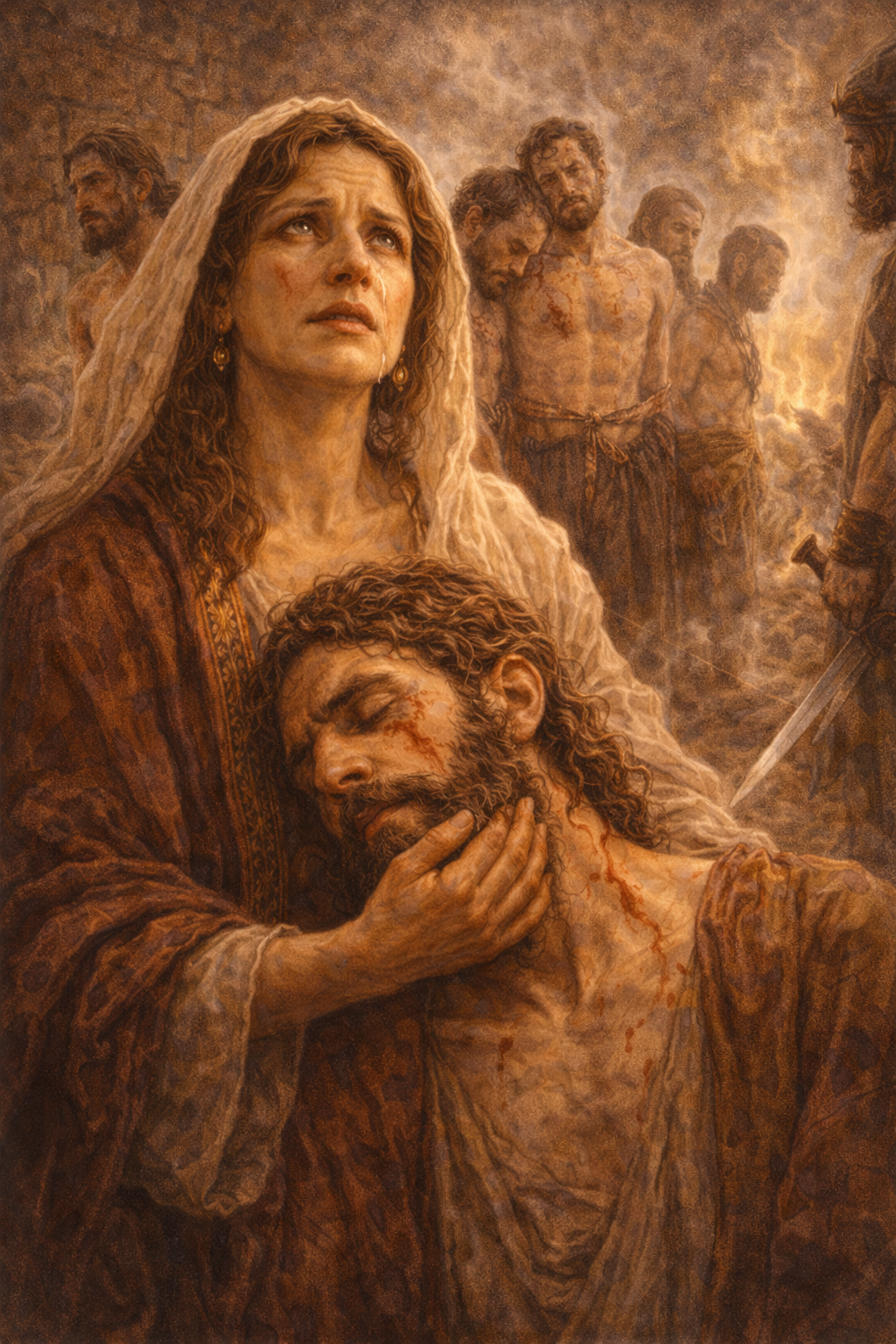
About Solomonia
Solomonia is the name used in Eastern Orthodox tradition for the unnamed mother of seven sons in 2 Maccabees 7. The biblical chapter never gives her personal name, the sons’ names, her birthplace, or her age. It follows the martyrdom of the elderly scribe Eleazar but does not call him the family’s teacher. Later Orthodox commemoration joins the stories, names the mother Solomonia, names the brothers, and calls them Eleazar’s disciples. A responsible biography therefore begins with two layers: the mother’s words and actions belong to a traditional scriptural narrative, while “Solomonia” and the expanded group identity are documented as later liturgical tradition rather than contemporary records.
The chapter places the family before a king who uses torture to force them to eat pork in violation of their ancestral law. One son speaks for the group and refuses. The ruler orders heated pans, mutilation, and execution while the mother and brothers watch. The account repeats bodily violence as each brother is killed. Its details should neither be hidden nor lingered over for spectacle. They portray state coercion seeking public surrender through terror. The family does not choose a contest from safety; they are prisoners denied freedom of conscience. Their courage never transfers moral responsibility from the ruler and torturers, and the story cannot justify abuse by religious or political authorities.
The mother remains present as her sons die one by one. The narrator calls her worthy of remembrance because she bears the day courageously through hope in God. It then describes her resolve through an ancient contrast between womanly reasoning and manly courage. That gendered formulation belongs to the narrator’s culture and should not become a claim that courage is masculine or that motherhood requires emotional silence. The text says that she encourages each son in their ancestral language. Her action combines solidarity, grief, and theological conviction: she does not abandon them to face coercion alone, even though she cannot stop the violence imposed upon them.
Her speech recalls pregnancy and creation. She tells her sons that she cannot explain how they came to life in her womb and that she did not herself give them breath or arrange their bodies. She entrusts them to the Creator, hoping that the one who formed life will restore it. The passage is a significant witness to resurrection hope within 2 Maccabees. It is not a denial of maternal care. The mother’s attention to conception, birth, and nurture intensifies the cost of the scene. She speaks from bodily memory while the state destroys the lives she has guarded, locating hope beyond the king’s power without pretending that torture is painless.
When only the youngest son remains, the king changes tactics. He offers wealth, happiness, friendship, and office if the boy abandons ancestral customs. When the son does not respond, the king asks the mother to advise him to save his life. She appears to agree, then speaks privately in their own language. Her response defeats the ruler’s attempt to turn parental love into an instrument of coercion. Yet this is also the episode’s hardest moral tension: she urges her child toward a death she believes faithful. Readers may honor her resistance while acknowledging the unbearable choice manufactured by tyranny and refusing to impose the same choice on victims in different circumstances.
Addressing her youngest, the mother recalls carrying him nine months, nursing him three years, and supporting his upbringing. She asks him to look at heaven and earth, trust the Creator, refuse fear, and remain worthy of his brothers so that she may receive them together in mercy. This is her most attributable speech. It grounds exhortation not in indifference but in intimate care and expected reunion. The son then refuses the king, offers his life for ancestral laws, and prays for mercy toward the nation. The king responds with greater cruelty. The narrative presents resurrection hope as a limit on imperial power: the ruler can kill but cannot define the family’s final future.
After the seventh son dies, the chapter states briefly that the mother is put to death. It gives no method, final speech, burial, or exact location. Orthodox tradition identifies the scene with Antioch and says that Solomonia raised her hands in prayer and died over her sons’ bodies, while its liturgical heading assigns the group to 166 BC. These are later traditional details and conflict in part with the chapter’s simpler ending. The catalog therefore leaves her birth and death dates empty and does not retain its former Jerusalem claims. Antioch can appear only as a traditional city-level association, never as a precise trial or execution coordinate.
Orthodox worship commemorates the seven Maccabee martyrs, their mother Solomonia, and Teacher Eleazar on August 1. The OCA Menaion names the group in a hymn and praises them as guardians of the Law. This provides provenance for the feast and titles; it does not prove that the name Solomonia was used in the second century BC. Nor does the selected evidence support the alternative name Hannah, sometimes applied in other retellings. Keeping those traditions separate prevents one community’s later naming from being presented as the language of 2 Maccabees. It also respects the scriptural mother’s anonymity while explaining why Christian readers encounter a named saint.
Solomonia’s virtues are visible in concrete actions. She remains beside all seven sons under terror, encourages them in words their captors cannot readily use, recalls the care she gave the youngest, and refuses the king’s effort to recruit her against him. Her solidarity is costly, her hope is articulated rather than sentimental, and her courage works through relationship. The chapter also preserves anger and threatened judgment in the sons’ speeches; it is not a serene family portrait. A mature remembrance centers the victims, condemns coercion and torture, and allows grief to remain grief. Faithful witness must never become permission to pressure suffering people into proving courage for an audience.
The evidence cannot furnish an ordinary cradle-to-grave biography. Solomonia’s parents, marriage, residence, occupations, and years of family life are unknown. Even her name comes from tradition after the unnamed biblical portrait. What survives is a concentrated account of a mother confronting an abusive sovereign alongside her children, interpreting creation as grounds for resurrection hope, and refusing to collaborate with forced apostasy. Later Orthodox memory gives that mother a name and a yearly place in worship. Remembered with historical humility, Solomonia represents solidarity under persecution and hope that violence does not possess the final word, while her story continues to demand honest reflection about parental love, coercion, trauma, and the ethical danger of romanticizing martyrdom.
Wondering how to weigh the stories and sources? Learn how to read a saint biography.