Biography
Spyridon
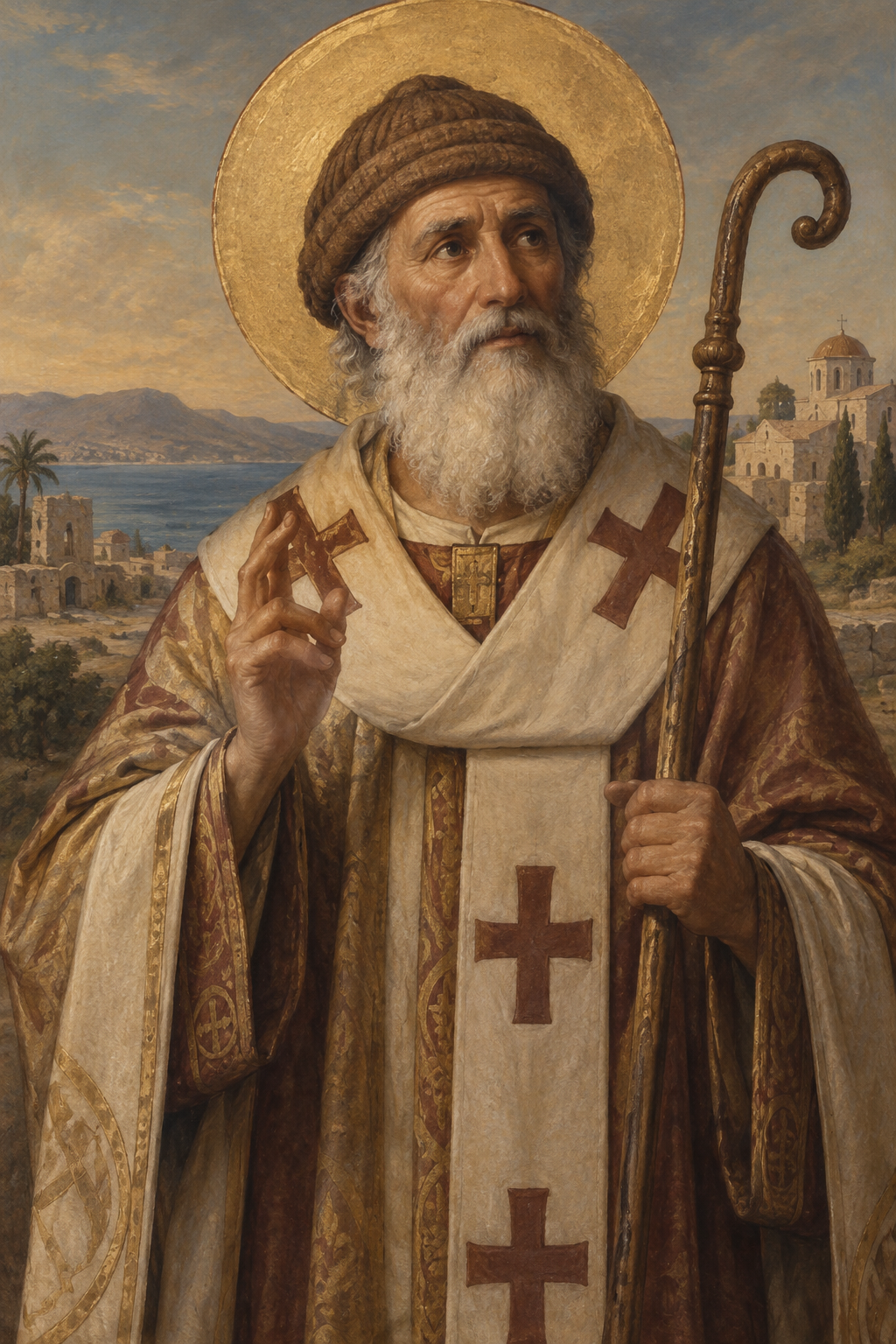
About Spyridon
The Orthodox Church in America places Spyridon's birth toward the end of the third century on Cyprus and describes him first as a shepherd who had a wife and children. Its account says he shared his resources with neighbors and people without shelter. These biographical details come through church tradition rather than surviving contemporary records, so this profile does not infer an exact birth date or family chronology.The same account says that, after his wife's death, Spyridon became bishop of Trimythous during Constantine's reign. It portrays his episcopal ministry as continuous with his earlier life: he remained simple in his habits while caring for his community. Stories of healing and exorcism accompany this portrait in the saint's later Life, but they are received religious narratives rather than independently documented events.Spyridon is traditionally associated with the Council of Nicaea in 325. The OCA cites church historians for his participation and recounts a debate with an Arian philosopher. The familiar episode in which a brick separates into fire, water, and dust is a theological illustration found in the saint's later tradition, not a verifiable transcript of the council. The historical value of the stories should be distinguished from the well-established importance of Nicaea as a gathering of bishops to address disputes about Christian teaching.The OCA's narrative also preserves accounts of hospitality, care for the poor, and generosity to people in debt, attributing some details to Sozomen and Socrates. These stories present a bishop who welcomed strangers and allowed needy neighbors to take grain without formal accounting. Because this profile relies on a modern church retelling rather than a critical edition of those historians, it summarizes these episodes as features of the received tradition and does not quote them as contemporary eyewitness testimony. The OCA commemorates Spyridon on December 12; this is an Orthodox observance, not an inherited Roman Catholic feast date.A second, more historically useful strand in the account concerns how Spyridon managed his resources. The OCA retells a passage from Sozomen in which the bishop kept his food store open to those in need. People could take grain when poverty or debt required it and later return what they could, without a ledger or a fixed allotment. This is not merely an image of private generosity: in the story, Spyridon makes relief accessible without making the recipient prove worthiness before him. Because the story reaches the draft through a church biography that cites a late antique historian, it is presented as a reported practice in the tradition, not an independently reconstructed administrative system.The hospitality account similarly places ordinary care at the center of his memory. The OCA retells a Lenten visit from a tired traveler and a meal shared despite the household's limited provisions. The narrative uses the encounter to describe hospitality across differences in fasting practice. It also shows why later writers could compare Spyridon with Abraham, the biblical host of strangers. These episodes cannot establish the exact words exchanged or the household's daily routine, but their repeated emphasis on welcoming strangers is consistent with the earlier portrait of a bishop whose resources were directed outward. The distinction matters: the Christian memory is well documented as a tradition, while the story's dialogue remains a literary report.Several other episodes in the saint's Life are explicitly miraculous. The OCA recounts healing, deliverance from demons, the rescue of a condemned friend during a flood, and a church service accompanied by an unseen choir. Such stories describe the way the community understood Spyridon's sanctity and his pastoral intercession; the sources do not make them verifiable observations by modern historical methods. This account therefore distinguishes the substance of his remembered role—bishop, host, and benefactor—from the miracle narratives through which later devotion expressed that role. No individual miracle is used to establish a structured life event or date.The council tradition also reflects a theological memory as much as a biographical detail. The story of a philosopher persuaded by Spyridon's plain speech and the brick that becomes three elements dramatizes a defense of Christian teaching about the Trinity. The OCA attributes Spyridon's participation at Nicaea to church historians, but the highly polished debate belongs to the later narrative. A modern reader should not mistake a didactic scene for minutes of the council. At the same time, the association links the bishop to a defining fourth-century moment in the formation of Christian doctrine and helps explain the place he occupies in Orthodox memory.Spyridon's cult also has a later geographical history. The OCA says that his relics repose on Corfu, in a church dedicated to him, while his right hand is in Rome. That statement concerns the veneration of relics, not the location of his life or death. It shows how his memory traveled beyond Cyprus and became tied to pilgrimage and public worship in later centuries. The profile leaves his death year and place blank because the source examined here supplies no sufficiently secure historical chronology for those fields. The December 12 Orthodox commemoration is likewise preserved as a church-calendar fact, separate from any claim about a precise death date.
Wondering how to weigh the stories and sources? Learn how to read a saint biography.