Biography
Stanislaus Kostka
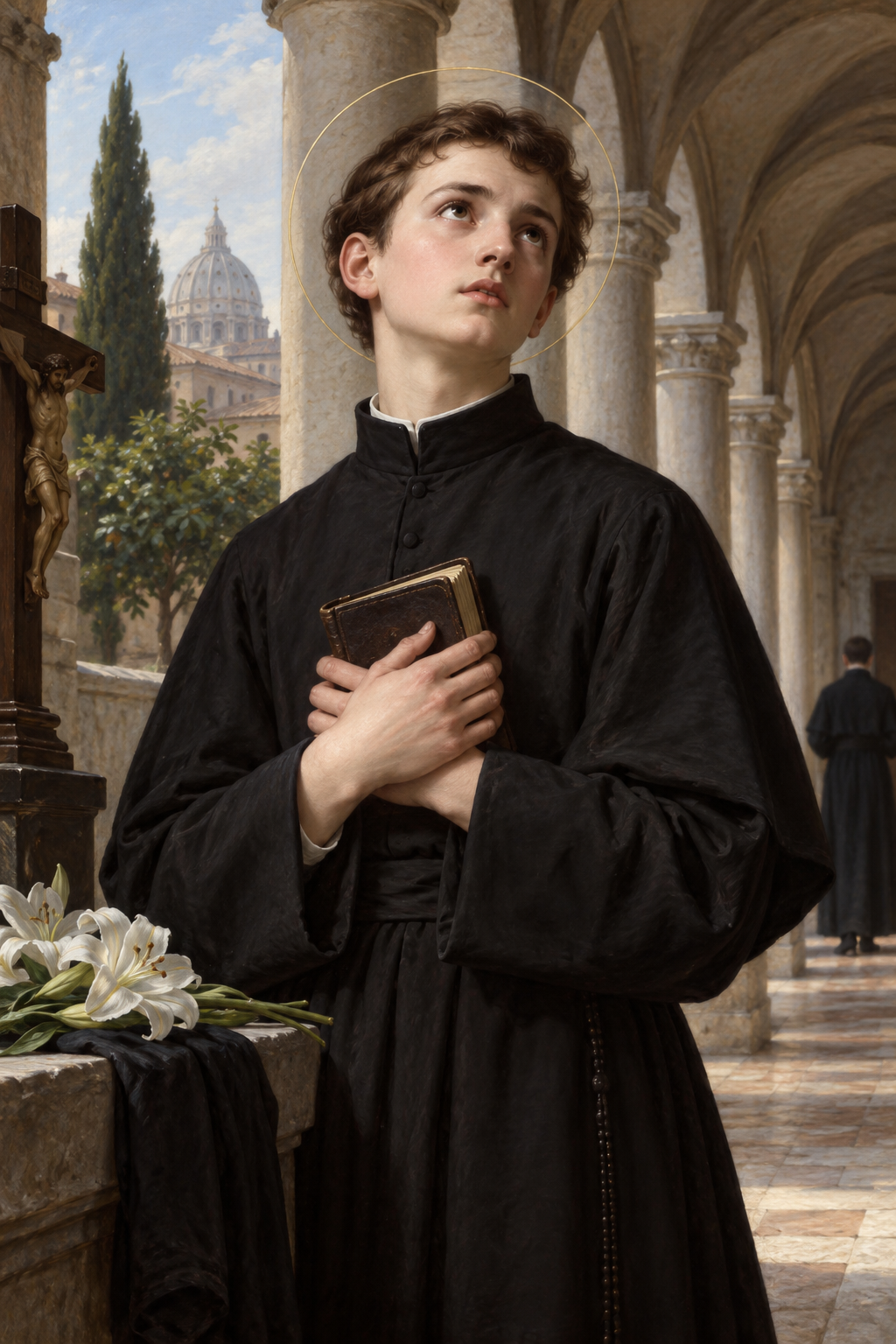
About Stanislaus Kostka
Stanislaus was born in Rostkowo in 1550. The Vatican Dicastery for the Causes of Saints gives his lifespan as 1550–1568 and identifies Rostkowo as his birthplace. The Jesuit account places his education in Vienna, where he studied with his older brother and a tutor. As a young man he became interested in entering the Society of Jesus, a choice that conflicted with his family's plans for him.Jesuit biographical tradition describes a serious illness during his time in Vienna and a religious experience that strengthened his resolve to become a Jesuit. The Dicastery recounts a vision of Saint Barbara and the Virgin Mary during the illness. Such visionary episodes belong to the spiritual testimony preserved by the tradition and are presented here as reported experiences, not independently verifiable events. The core historical point is that he sought admission to the Society despite opposition at home.In 1567, according to the Jesuit narrative, Stanislaus left Vienna and made his way to Dillingen, where Peter Canisius received him. Canisius sent him onward to Rome, where he began his novitiate under Francis Borgia. This route—Vienna, Dillingen, then Rome—is also recalled in the Vatican message marking the 450th anniversary of his death. The sources present the journey as a deliberate act of vocation; the exact conversations and private motives belong to the biographical tradition rather than independent records.Stanislaus died in Rome on the feast of the Assumption, August 15, 1568, aged eighteen. The Dicastery gives August 15 as his liturgical memorial and recounts his beatification in 1605 and canonization in 1726. The Society of Jesus's calendar separately lists a celebration on November 13; that Jesuit observance should not replace the Roman Catholic memorial already recorded in the catalog. His veneration remains especially connected with Jesuit formation and young people, while the short span of his life cautions against inventing a longer public ministry.The Jesuit account gives a more concrete setting for Stanislaus's Vienna years. In 1564 his parents sent him and his older brother Paul to the newly opened Jesuit college. The brothers first stayed at the Jesuit residence and later moved to the house of Senator Kimberker. The Jesuit biography identifies Kimberker as Lutheran and says he would not admit a priest bringing the Eucharist to a sick person. In December 1565, when Stanislaus fell seriously ill, he repeatedly sought viaticum. His brother and tutor did not secure it for him. These details come from Jesuit biography and should be understood as the Society's received account, but they clarify the practical circumstances behind the young student's religious decision.The same account says that Stanislaus prayed to Saint Barbara, a patron of his confraternity, during the illness. It relates that the Virgin appeared with the Christ Child and that Stanislaus interpreted the experience as a call to join the Jesuits. These visions are important to the devotional story of his vocation, yet they are not independently established historical events. The historical sequence is less dependent on accepting the vision: after recovering, he approached the Jesuit provincial in Vienna and asked for admission. The provincial was favorable but would not act without the family's consent, which Stanislaus believed he could not obtain. The conflict between parental plans and a young man's chosen vocation thus stands at the center of his remembered story.A Jesuit advised Stanislaus to seek Peter Canisius, then provincial in Germany. On August 10, 1567, he left Vienna in pilgrim clothing and traveled toward Augsburg. The Jesuit biography estimates a journey of about 450 miles to Augsburg and another stage to Dillingen, where Canisius was staying. His brother followed but did not recognize him in the coarse clothing, according to the account. These details present the journey as a deliberate break from a privileged household and a practical strategy for avoiding interference. Because they derive from institutional biography, the exact scene and motive are attributed to that source rather than treated as independently witnessed.Canisius accepted Stanislaus and arranged for him to travel to Rome with two Jesuits. They reached the city on October 25, 1567, and Stanislaus met the superior general, Francis Borgia. He spent an initial period at the Gesù, passed briefly through the Roman College, and then entered the novitiate at Sant'Andrea. This chain of placements matters because it locates his short Jesuit life in the ordinary structures of formation rather than in a public ministry. The Dicastery's recognition of the same route from Poland through Vienna to Rome confirms the broad itinerary, while the Jesuit source supplies the institutional details.Stanislaus's novitiate lasted about ten months. In early August 1568, the Jesuit account says he developed a fever and predicted that he would soon die, although those around him did not initially think the illness was grave. On August 14 he said he would die the next day. As his condition worsened, he received viaticum and prayed with the other novices and Jesuits. He died in the early hours of August 15, the feast of the Assumption. The Dicastery likewise associates his death with that feast and gives August 15 as his liturgical memorial. The short duration of his Jesuit membership is one reason his later importance rests on his formation and remembered vocation rather than on an extended career.
Wondering how to weigh the stories and sources? Learn how to read a saint biography.