Biography
Stephen of Perm
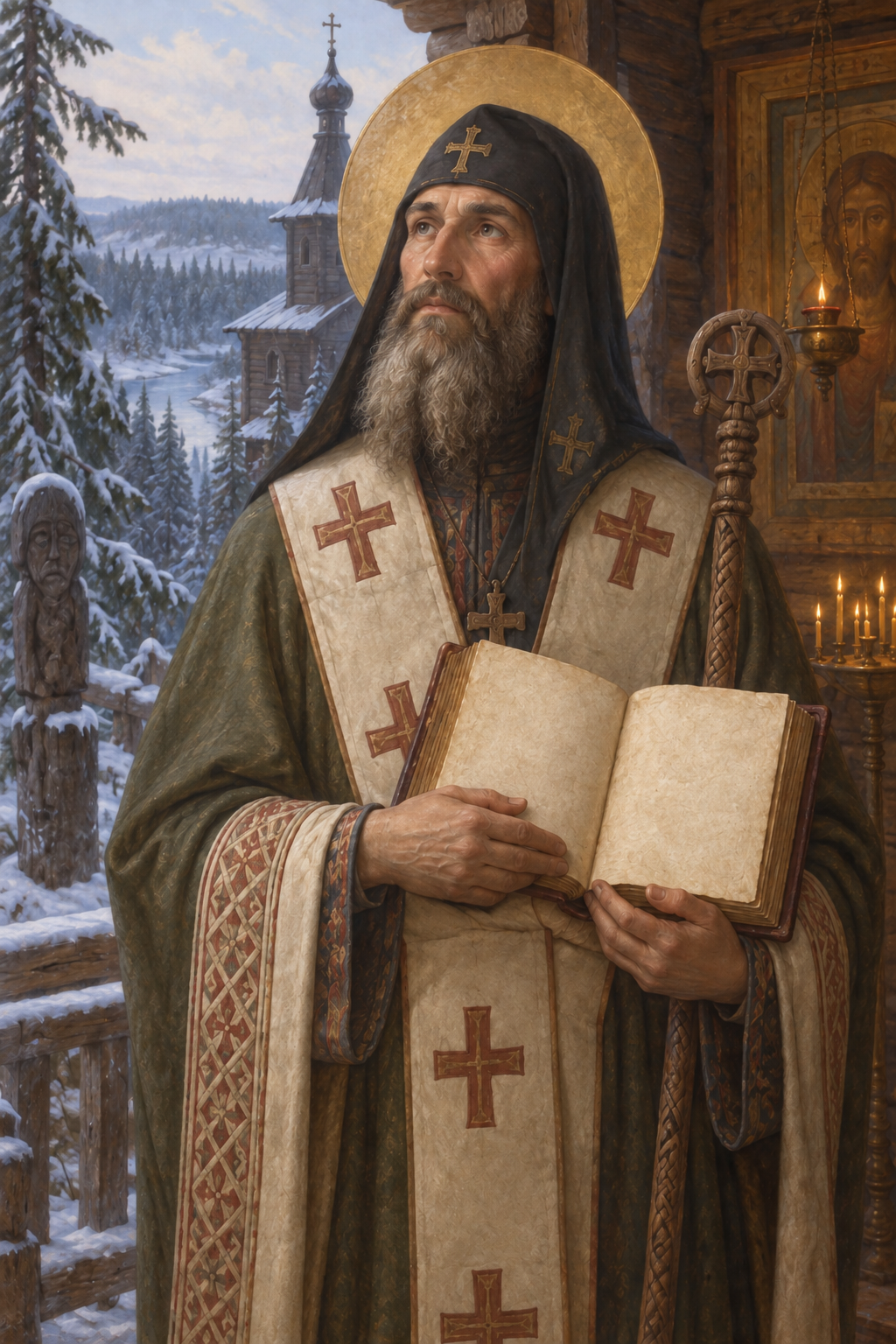
About Stephen of Perm
Stephen was born around 1340 at Ustiug into the family of Simeon, a cleric. The Orthodox Church in America recounts that he learned to read church books early and later entered the Monastery of Saint Gregory at Rostov. He studied Greek there so that he could read Christian writings in their original language. These details are known through his Life and later church history, rather than an extant contemporary autobiography.Stephen's missionary project required written language as well as preaching. The OCA account says he developed an alphabet for the Zyrian language and translated church books, including the Horologion and Psalter. This literary work provided tools for worship and instruction in a language used by the people he hoped to reach. The account places his preparation before his departure in 1379, when he traveled to Moscow for a blessing and ordination as a priest-monk.Stephen traveled north through the Dvina region to settlements along the Vychegda. The Life describes his efforts to establish churches, teach, and contest local religious practices. It also includes a dramatic story about the destruction of a sacred birch tree and a debate with a religious leader named Pama. These episodes are preserved in the saint's hagiography and should not be treated as neutral eyewitness reporting. They nevertheless show how the later church tradition understood the encounter between Stephen's mission and the religious life of the Permian communities.In 1383 Stephen was consecrated bishop of Malaya Perm. The OCA says he founded churches, opened schools, taught students to read and write in Permian, and translated services into the local language. It also describes his practical advocacy during crop failure and disputes with officials. The source presents these works as the basis of a durable church community, though its broad claim that all Perm converted is a devotional summary rather than a measurable census. Stephen died in Moscow while traveling on church business; the exact year is disputed in popular sources, so this profile leaves the structured death date unset. The OCA commemorates him on April 26.The OCA narrative emphasizes that Stephen prepared for the mission through both language study and ecclesiastical authorization. He went to Moscow in 1379 to seek permission from Gerasimus of Kolomna, who then managed metropolitan affairs. Stephen was ordained a hieromonk and received church books, chrism, and an altar cloth for the work ahead. Prince Dmitry also provided a safe-conduct document. These details show that the mission was not represented as an isolated personal venture: it depended on ordination, liturgical supplies, political passage, and a plan for worship. The source places the journey along the North Dvina toward Vychegda settlements, where Zyrian communities lived.Language work distinguished Stephen's mission in the account. He composed an alphabet for the Zyrian language and translated books used in worship. The OCA names the Horologion and Psalter among these translations and describes schools attached to churches where pupils studied scripture in their own language. Stephen also trained some students to write, and the church communities used Zyrian in services. The surviving Life is not a neutral administrative report, but the repeated emphasis on alphabet, books, schools, clergy, and liturgy points to an enduring cultural dimension of his work. The project involved creating local means for reading and worship, not simply transmitting instruction through interpreters.The OCA says Stephen's mission met religious practices he understood as incompatible with Christian worship. Its narrative tells of a sacred birch tree where people gathered and made offerings. The story says Stephen burned the tree and later built a church on the site. Since the account is hagiographic, this scene should not be generalized into a complete description of Komi religion or accepted as a securely witnessed event. It does, however, reveal the mission's conflictual memory: conversion is narrated through confrontation with existing sacred places, followed by the establishment of a Christian church.Another dramatic chapter concerns Pama, described as a religious leader who challenged Stephen's preaching. The Life stages a debate about the multiplicity of spiritual powers, after which Pama proposes a test involving fire and water. The story ends with Pama's banishment rather than execution, and the hagiographer portrays Stephen as refusing to have him killed. This episode is valuable as a text about how Christian writers framed argument and restraint, but its dialogue is literary and cannot be treated as a verbatim record. It also should not be used to reduce local people to passive converts: the source's own account depicts debate, resistance, and varied responses.The bishop's role extended beyond preaching. The OCA reports that Stephen organized churches and monasteries, trained local clergy, helped during a crop failure, and appealed to Moscow against corrupt officials and incursions. These statements come from the hagiographic Life, so the scale and outcomes cannot be independently quantified from this account alone. Still, they broaden the picture from a heroic conversion narrative to one of pastoral and administrative work. A bishop in a newly established region had to support worship, education, material aid, and the standing of communities before distant political authorities. Stephen's significance lies in this combination of linguistic, institutional, and pastoral labor.
Wondering how to weigh the stories and sources? Learn how to read a saint biography.