Biography
Sturm
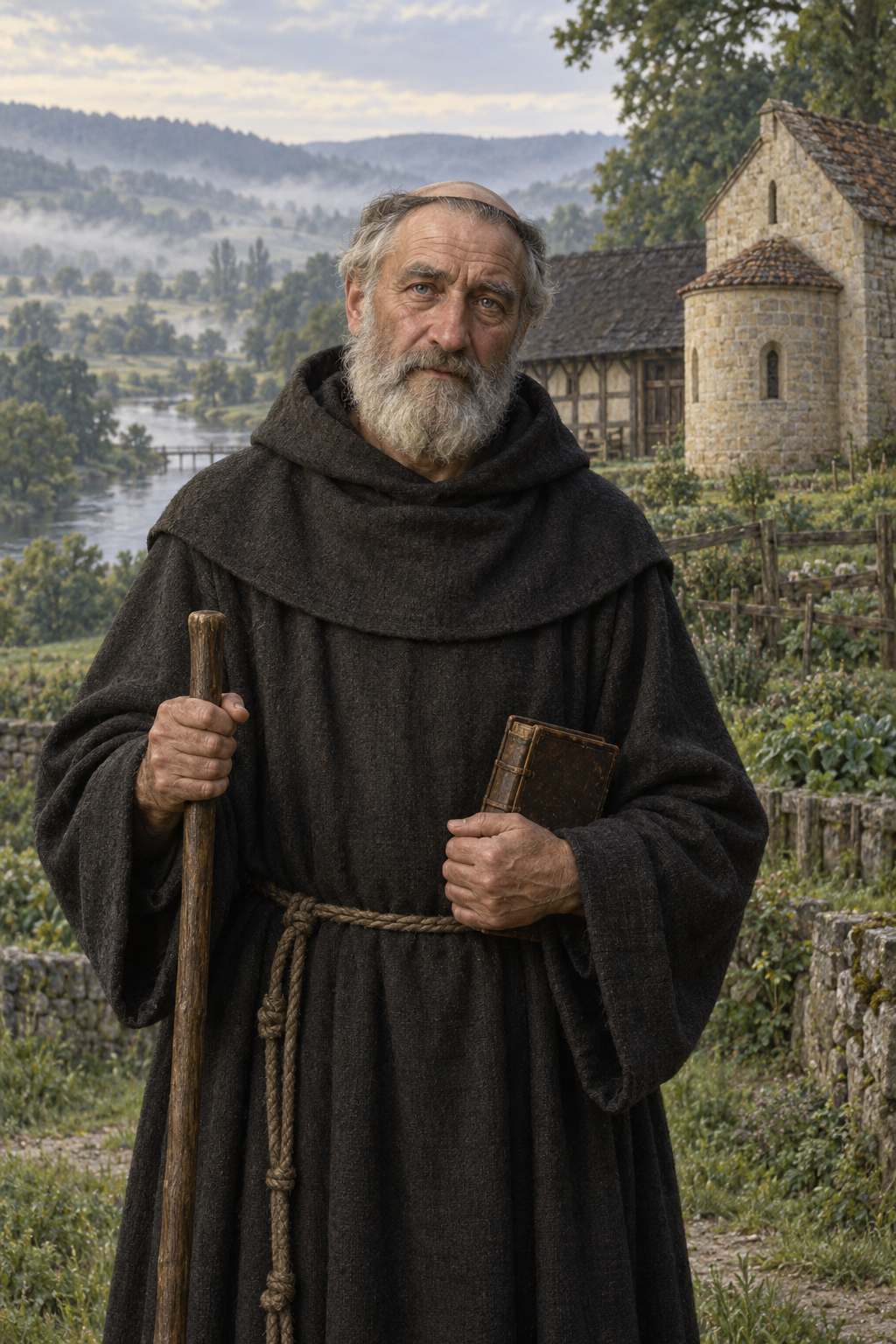
About Sturm
Sturm, also known as Sturmius, was the first abbot of Fulda. His work helped establish one of the most influential religious communities of early medieval Germany. He came from a Bavarian noble family, although the names of his parents are unknown. Modern scholarship places his birth in the early eighth century without fixing a secure year. Boniface entrusted him to the community at Fritzlar for education. He became a priest before taking up the search for a more secluded form of religious life.
The fullest early narrative was written by Eigil, a relative and disciple who says he lived under Sturm’s guidance for more than twenty years. Some events came from his own experience; others depended on reports. Eigil describes the young priest learning the Psalms and reading Scripture closely. He also recalls an insistence that people at enmity make peace. These details form a portrait of religious formation directed toward both worship and conduct. The author’s admiration is evident throughout the work, which is also a history of the community Sturm led.
Sturm first explored a hermit’s life near Hersfeld. Boniface encouraged the desire for prayer but also sought a suitable place for a larger foundation. The search belonged to an expanding network of churches and monasteries supported by aristocratic gifts. Christiane Schwarz’s diocesan account emphasizes the scriptural education provided at Fritzlar and the importance of these relationships. The eventual settlement was not simply the achievement of an isolated wanderer. It depended on teachers, companions, land and the cooperation of powerful patrons.
In 744 Sturm established the community at Fulda on land obtained through Boniface from the Frankish ruler Carloman. A stone church and wooden accommodation gave the monks a place for worship and daily life. Archaeological and historical study qualifies the Life’s image of an untouched wilderness: the district had earlier settlement, and the river provided access. Historian of architecture A. J. R. Rulkens places the foundation within this material setting. Religious withdrawal did not mean that the monks lived beyond the networks of travel, property and support around them.
Sturm traveled to Rome and Monte Cassino in 747 to learn monastic observance for his own house. Boniface secured a papal privilege for Fulda in 751, providing a foundation for its distinctive relationship with Rome. After Boniface’s death in 754, the arrival of his body at Fulda made the monastery a focus of pilgrimage and devotion. The Augsburg diocesan account recalls that this transfer took place amid competing claims to the remains. The monastery’s spiritual importance and its position among neighboring church authorities were closely connected.
That position brought conflict. Around 763 King Pippin sent Sturm into exile at Jumièges in Normandy. Possible explanations include hostility with Boniface’s successor Lull and Sturm’s ties to the Bavarian duke Tassilo. The precise balance of motives remains uncertain. He returned in 765 and resumed leadership. Later royal protection and grants strengthened Fulda’s position under Charlemagne.
Eigil tells the exile story from the viewpoint of a community attached to its abbot. He presents the accusations as false and describes the monks’ distress, their resistance to an imposed successor and their persistent efforts to obtain Sturm’s return. His account ends this episode with a joyful welcome. Its warmth preserves the community’s loyalty while also warning the reader that the narrative takes a side in the dispute.
Sturm’s restored leadership included work on the church, roofs and other monastic buildings. Canals supplied the workshops. Rulkens treats these practical arrangements as part of the monastery’s development as an organized economic community. The buildings and water systems made sustained common life possible. Their exact appearance cannot be reconstructed with complete confidence from the surviving evidence.
His later years were also connected with Charlemagne’s campaigns against the Saxons. This missionary work took place within military conquest, rather than peaceful preaching alone. The threat of attack forced the monks to withdraw in 778. Sturm fell seriously ill during the following year and returned to Fulda, where he died in 779.
The monastery continued to shape his memory. Raaijmakers interprets Eigil’s Life as an effort to unite a community divided by later disputes, drawing attention to its shared beginnings under its first abbot. Eigil strengthened Sturm’s liturgical remembrance, connecting his anniversary with the December 17 feast of Ignatius. The scholar therefore cautions that the actual day of Sturm’s death is unknown. The familiar date belongs to a history of commemoration as well as to received biography. Masses, Psalms and readings from the Life made that remembrance part of the monks’ shared routine, linking their founder with the community’s other departed members.
Fulda honors Sturm as a diocesan co-patron alongside its principal patron, Boniface. His remains and memorials keep the founder’s memory close to the community that grew from his work. The diocesan calendar now celebrates his feast on December 16.
Wondering how to weigh the stories and sources? Learn how to read a saint biography.