Biography
Symeon of Trier
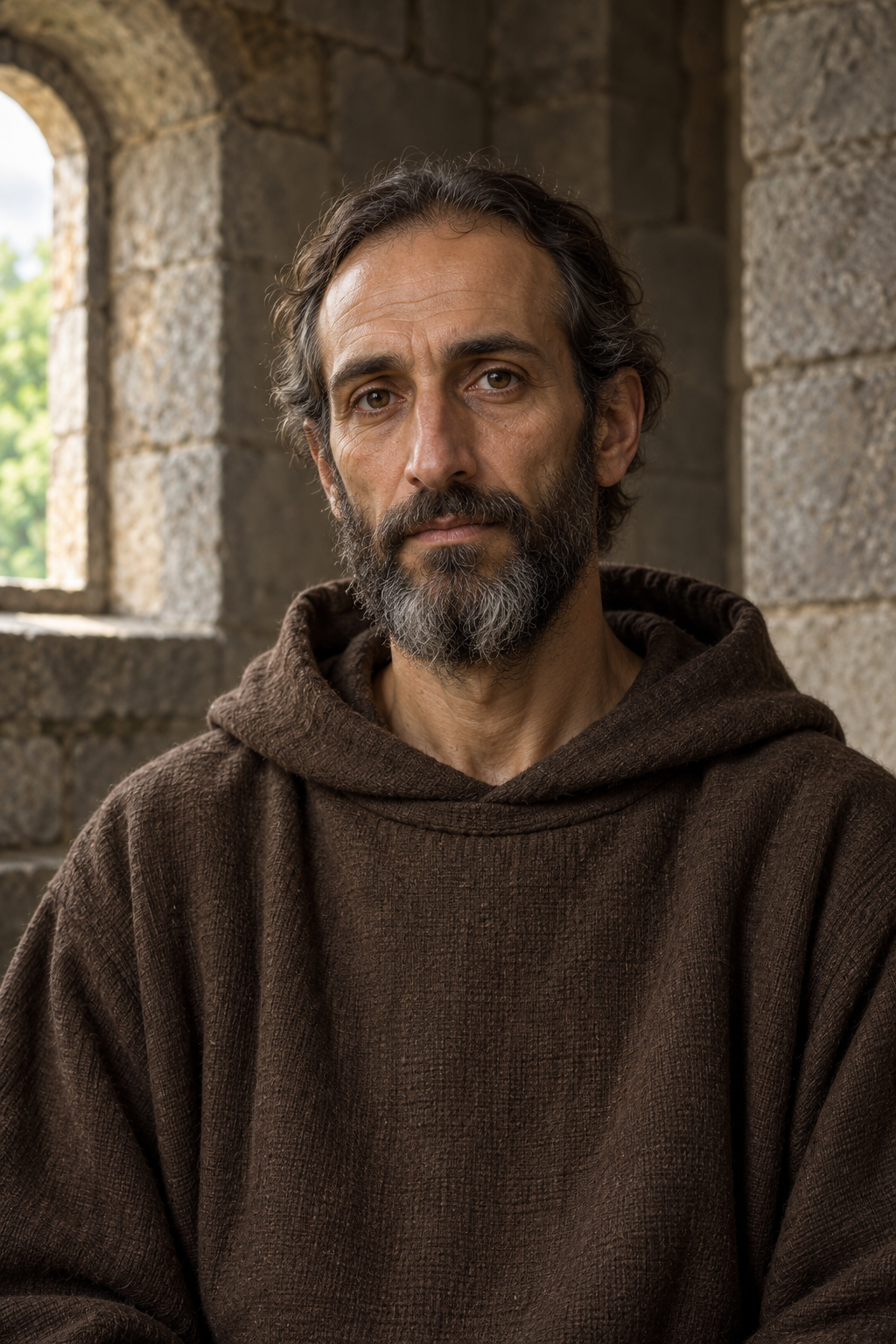
About Symeon of Trier
Symeon of Trier was a Greek monk whose travels ended in a deliberately confined life of prayer. After accompanying Archbishop Poppo on a pilgrimage to the Holy Land, he returned to Trier and entered a cell in the Porta Nigra in November 1030. The former Roman gateway became his home until his death.
His birth is conventionally placed around 990 in the Deutsche Biographie authority record. The city of Trier gives the broader estimate 980 or 990. These estimates belong to a poorly documented early life: the critical Byzantine prosopography explicitly questions the reliability of the family story.
The early Life portrays Symeon as a traveler before he became a recluse. As retold by the city of Trier, it describes education in Constantinople, work as a pilgrim guide in Palestine, and monastic life at Sinai. In that account, he repeatedly leaves the monastery to seek solitude in the desert. An assignment to seek financial support in Normandy sends him west.
The western mission did not achieve its intended result: the prosopography recounts that Duke Richard II had died and his successor would not honor the promised gift. Symeon then traveled through Verdun to Trier. His connection with Poppo led to another eastern journey, accompanying the archbishop to the Holy Land between 1028 and 1030 before both returned to Trier.
The journey brought him into contact with Abbot Eberwin, who later introduced him to Poppo. In the Porta Nigra, Symeon depended on others for food, raising their provisions in a basket. His enclosure was chosen; it was not a punishment imposed on an unwilling prisoner.
Eberwin’s account is unusually close to its subject. The Bavarian Academy’s critical bibliography identifies him as someone who knew Symeon personally. He wrote the Life in 1035 at Poppo’s request, with canonization in view. That purpose matters when reading its accounts of holiness and miracles. The text continued to develop: the bibliography identifies seven versions produced through 1086 and almost sixty surviving manuscripts.
That personal connection does not make every episode equally reliable. The Prosopography of the Middle Byzantine Period questions the account of Symeon’s early life, observing that independent confirmation begins only around 1027. It finds conventional patterns of saints’ lives in the earlier narrative and doubts details of the journey through Egypt. His education, desert experiences and early travels are therefore best understood as parts of the biography transmitted about him, rather than a fully verified itinerary.
Symeon died on June 1, 1035. A provincial synod that summer responded to requests from the population by asking Pope Benedict IX to canonize him. Poppo’s letter survives within the Gesta Treverorum. The Academy’s account places the canonization at a Roman synod later that same year.
His death changed the future of the building in which he had lived. The city museum explains that Poppo established a community of canons and converted the Porta Nigra into a church with two levels. Its new sacred use helped protect the Roman structure from dismantling for building stone. The community was dissolved in 1802, and Napoleon ordered the gate’s return to its ancient form. The adjoining former collegiate buildings later housed the Stadtmuseum Simeonstift, preserving Symeon’s name in a civic institution. Tree-ring dating places the oldest parts of the collegiate buildings around 1040, close to the foundation’s beginnings. The museum distinguishes this surviving medieval fabric from later alterations, giving visitors material evidence of the community that maintained the place of his veneration.
A more personal object also shaped his remembrance: a beehive-shaped cap of undyed wool associated with him. According to the museum, touching it was traditionally believed to relieve headaches. The cap became a recognizable attribute in images, appearing on a twelfth-century collegiate seal and in an eighteenth-century printed relic list. Such objects and representations document the history of his veneration; they do not establish the claimed healing effect.
His commemoration continues in the local church. Trier’s calendar for 2026 lists an optional memorial on June 2, identifying him as the hermit of the Porta Nigra. The directory also lists June 1 as Trier’s former observance, explaining the two dates readers encounter for this saint.
A recent use of his name connects that life with the preservation of memory. In September 2023, the diocese opened an archive depot in the former parish church of Saint Simeon. His grave remained in its crypt. At the blessing, Bishop Stephan Ackermann called him a fitting patron for the archive, linking his extensive travels and subsequent reflection with the archive’s work of gathering and reconsidering experience.
This patronal association belongs to the particular archive described by the diocese. The building’s main church space had been deconsecrated in 2019, while the sacristy was adapted as a place of worship. Its new archival purpose continued to place Symeon’s memory within the life of the local church.
Wondering how to weigh the stories and sources? Learn how to read a saint biography.