Biography
Teresa of Calcutta
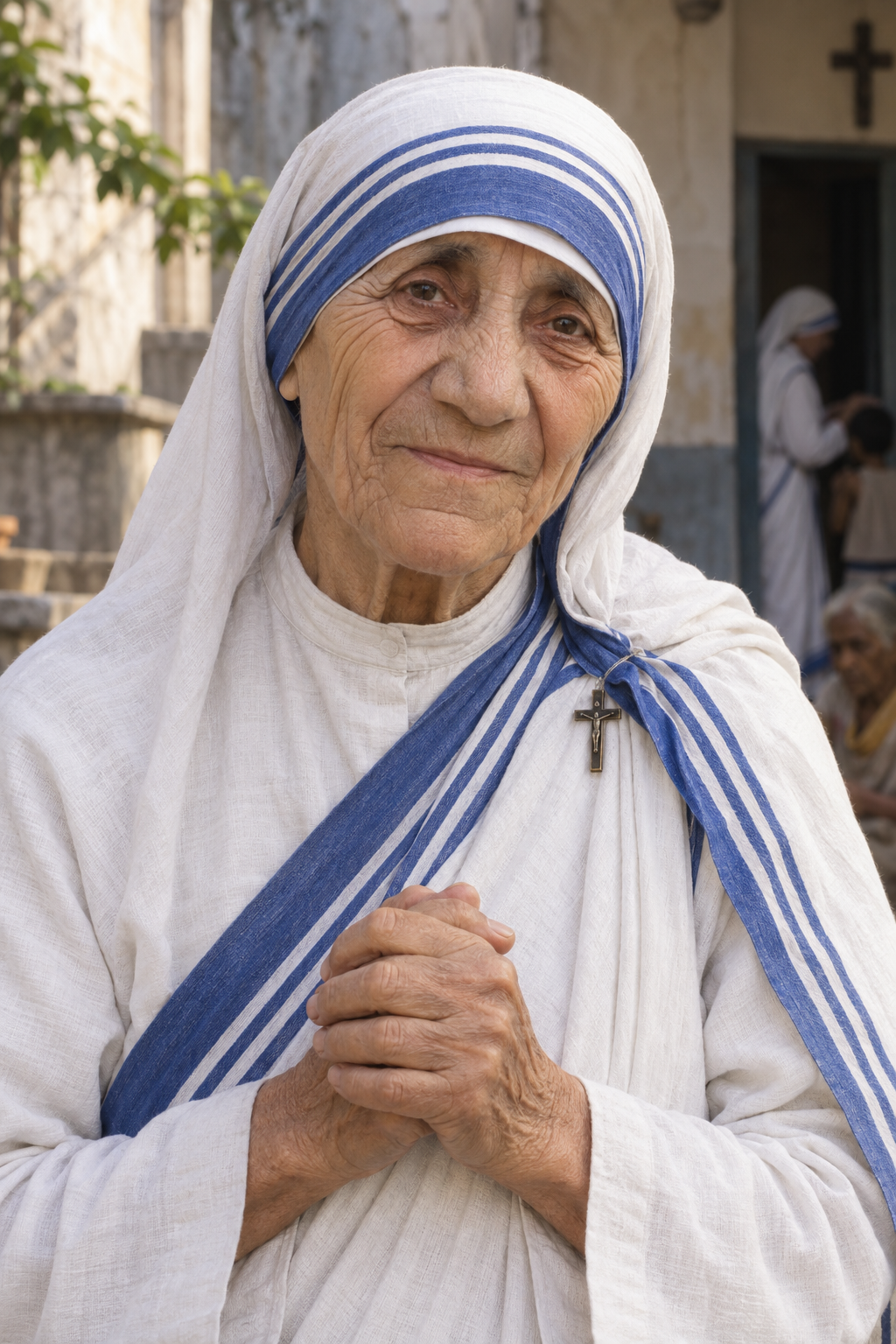
About Teresa of Calcutta
Teresa of Calcutta began her religious life as a teacher, long before her work among people living on the streets made her internationally known. Born on August 26, 1910, in Skopje to an Albanian family, she left home in 1928 to join the Sisters of Loreto in Ireland. She took the religious name Teresa after Thérèse of Lisieux and reached India in January 1929. At St. Mary's school in the Entally district of Calcutta, she taught girls and later became principal. Her final vows in 1937 marked a permanent commitment to religious life; the familiar title Mother Teresa belonged to that vocation, not to a biological family of her own.
The change in her work followed an experience she understood as a new call from Jesus. In a letter later included in the Church's office of readings, she recalled the 1946 summons to serve people in extreme poverty. She also described a very different experience after the work began: loneliness, spiritual emptiness, and an inability to feel God's presence. Yet she continued to pray and work, sometimes finding that love for God became more real in encounters with others. Her testimony records both the conviction that sent her outward and the interior desolation that accompanied her service.
In 1948 she received permission to leave the Loreto setting, took a short medical course in Patna, and began visiting poor families in Calcutta. The Missionaries of Charity became an officially established congregation there on October 7, 1950.
Finding somewhere to receive sick people required cooperation with the city. Teresa approached Calcutta's chief medical officer, who showed her a former pilgrims' hostel near the Kali temple. The building became Nirmal Hriday, a home for the dying, in 1952. Municipal assistance was part of the story from the beginning; this was not a solitary outsider accomplishing everything without local help.
She also sought help from B. C. Roy, the chief minister of West Bengal, bringing requests about water and electricity in neighborhoods she visited. Roy helped her reach the officials responsible. In 1955 she opened Shishu Bhavan for children, adding residential care to the education already offered by her sisters. Other charities and orphanages were working in Calcutta too. The scale of need prompted another institution; it did not mean that the city's people had been indifferent until Teresa arrived.
The congregation's work spread beyond India. By the time of the Nobel Peace Prize, its activities included homes for children, care for people with leprosy, and places receiving the terminally ill. A Nobel historical account lists work in countries including Peru, Tanzania, Ethiopia, Israel, Yemen, and the United States. Teresa used the occasion of the prize to redirect a ceremonial expense: she asked that the usual banquet be canceled. The committee agreed and gave her money intended for people in need of a meal. Public recognition could therefore provide both attention and practical resources for the work.
The Norwegian Nobel Committee awarded her the Peace Prize in 1979 during a year marked by war, refugees, and political violence. In his presentation speech, John Sanness placed her work within the prize's humanitarian tradition. The committee had honored negotiators and international organizations; this time it emphasized service to neighbors as a contribution to peace. That was the committee's judgment about the meaning of her work, rather than a claim that she had resolved those conflicts or a clinical assessment of the institutions she led.
Her Nobel lecture presented a religious mission, not simply a program of social assistance. She described service to vulnerable people as an encounter with Christ and urged listeners to begin caring within their families and neighborhoods. She also spoke forcefully against abortion, presenting adoption and support for mothers as alternatives. Those positions were integral to her public message, not incidental remarks that can be removed to make her a universally agreeable figure. In one story she told, a Hindu mother shared rice Teresa had brought with a Muslim family nearby. The point of the story was that a person receiving help could also recognize and respond to another household's hunger.
The care offered in her institutions also drew criticism. In a 2013 review, Serge Larivée and his coauthors challenged accounts that treated her work as beyond question. Drawing on published medical and volunteer reports, they raised concerns about pain relief, hygiene, and the adequacy of treatment in homes for the dying. Their study was a critical review of existing accounts, not a new clinical audit of every house. Its objections nevertheless identify a serious distinction: offering welcome and religious consolation does not by itself establish that patients received appropriate medical care. The reputation of the founder cannot substitute for examining that care.
Teresa died in Calcutta on September 5, 1997.
John Paul II beatified her on October 19, 2003. He recalled her visits to discuss her work and interpreted her service through the Christian conviction that care for a suffering neighbor is care for Christ.
Francis canonized her on September 4, 2016, commending her example to volunteers. At her canonization, he emphasized the dignity of people abandoned on the streets and her appeals to powerful people about poverty. The Catholic recognition invites imitation of her service; it does not remove the need to understand the choices, convictions, and disputed aspects of the life she actually lived.
Wondering how to weigh the stories and sources? Learn how to read a saint biography.
Explore similar vocations
Prayers for Teresa of Calcutta
Radiating Christ
Dear Jesus, help me to spread Your fragrance wherever I go. Flood my soul with Your spirit and Your life. Penetrate and possess my whole being so utterly, that my life may only be a radiance of Yours.
Shine through me, and be so in me that every soul I come in contact with may feel Your presence in my soul. Let them look up and see no longer me, but only Jesus!
Stay with me and then I shall begin to shine as You shine, so to shine as to be a light to others. The light, O Jesus, will be all from You; none of it will be mine. It will be you, shining on others through me.
Let me thus praise You the way You love best, by shining on those around me. Let me preach You without preaching, not by words but by my example, by the catching force of the sympathetic influence of what I do, the evident fullness of the love my heart bears to You. Amen.
Teresa of Calcutta: collect excerpt
grant us, we beseech you, by her intercession, to minister to Christ in our suffering brothers and sisters.