Biography
Theodore Graptos
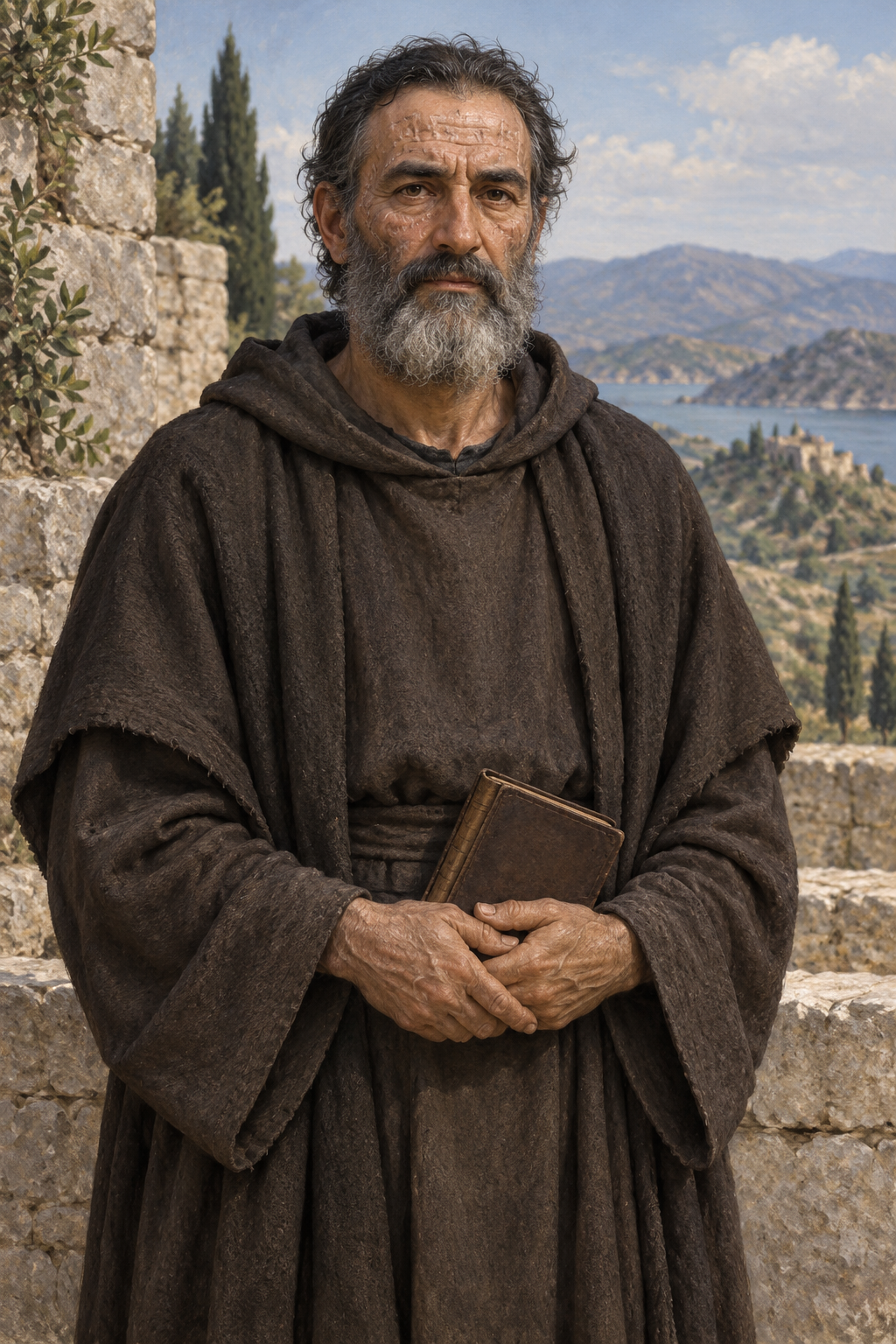
About Theodore Graptos
Theodore Graptos was a Palestinian monk and priest who resisted the Byzantine government’s rejection of religious images. His younger brother Theophanes shared his exile and punishment. The Orthodox Church in America remembers their refusal to abandon the veneration of icons, even when acceptance would have brought release. Theodore died before his brother, whose later life included service as bishop of Nicaea. The church account portrays his early childhood as devoted to worship rather than amusements, before his education alongside his younger brother.
The critical prosopography places Theodore’s origins in Moab and connects him with the monastery of Saint Sabas. Accounts of the brothers’ education and journey west belong to a complicated group of related biographies. Their exact itinerary and the purpose of their arrival in Constantinople are less secure than their later opposition to iconoclasm. Theodore was a priest; a source calling him bishop of Sardis is treated as mistaken.
The brothers faced repeated confinement rather than a single confrontation. The received church account describes beatings and banishment under Leo V, renewed pressure under later emperors, and a demand that they change their religious allegiance. Its story of an offer of freedom in exchange for communion with the iconoclasts presents the issue as one of conscience. The words attributed to Theodore in that encounter should be read as part of the devotional narrative.
Chronicles preserved a particularly cruel punishment under Theophilos. Verses hostile to the brothers were inscribed on their faces, marking them publicly as offenders. Their epithet Graptoi refers to that inscription. The surviving accounts make the punishment an attempt to disgrace them as well as to hurt them. Although later English usage often calls them the Branded, the evidence also describes tattooing. The verses themselves are accusations made against the brothers, not a reliable account of their earlier conduct. Pseudo-Symeon extends the inscription to their chests, differing from other accounts.
The preferred reconstruction places the facial marking in 836. Theodore then died in exile, probably in 841, at Apameia in Bithynia. Other accounts place his death later or describe imprisonment in Constantinople; the critical reference explicitly weighs those conflicting traditions. His remains were subsequently taken to Chalcedon, although the narratives disagree about who arranged the transfer. A precise death year cannot be treated as certain.
The dating problem extends to the interrogations. The prosopography compares conflicting days in Michael’s Life with the letter preserved by the later biographer, which places the imperial hearing on July 14 and the inscription four days later. Its preference for that sequence does not remove the contradictions elsewhere in the narratives.
Theodore’s resistance also had a literary form. The source record associates him with a work called Kynolykos, which used biblical passages against iconoclasm. A letter addressed to John of Cyzicus survives within his later Life and describes the brothers’ ordeal. The record remembers a writer as well as a prisoner.
Later writers reshaped that memory. Lev Lukhovitskiy’s study compares an earlier Life of Michael the Synkellos with Nikephoros Gregoras’s fourteenth-century retelling. In the earlier narrative, the dramatic confrontation with Theophilos centers on the brothers while Michael remains in prison. Gregoras reused elements of their story in an encounter between Michael and Leo V. The change gave his narrative a different center and stronger dramatic unity. It also means that similar scenes in these works cannot automatically be counted as independent confirmation of an event.
The study shows Gregoras drawing on a wider collection of accounts about the brothers, probably including the Life associated with Symeon Metaphrastes. He could borrow a scene or argument without reproducing its original setting. Theodore’s later reputation therefore survives through texts shaped by the interests of their authors as well as by memories of persecution. Their literary relationships matter when reconstructing his life.
Lukhovitskiy also identifies shared theological arguments in these rewritten encounters. The defenders distinguish icons from idols by the nature of those represented; the emperors reply that image veneration encourages pagan practices. Such parallels help trace a writer’s sources, while leaving open which words, if any, reproduce an actual hearing.
Theodore continues to be commemorated in Byzantine Catholic worship on December 27. The Metropolitan Cantor Institute’s service places hymns for him alongside those for Stephen within the days following the Nativity. Its stanzas recall prison, exile, hunger and wounds, interpreting the marks intended to shame him as signs of faithfulness. This is liturgical remembrance rather than a separate contemporary report of each hardship. Three Vespers stanzas honor his memory.
The same service honors Theodore as a teacher and monk. Its emphasis joins his endurance to his defense of the faith, preserving more than the manner of his suffering. The church’s remembrance gives the imposed inscription a meaning opposite to that intended by his persecutors: the marked face belongs to a confessor whose testimony remains part of its worship.
Wondering how to weigh the stories and sources? Learn how to read a saint biography.