Biography
Theodosius of Tarnovo
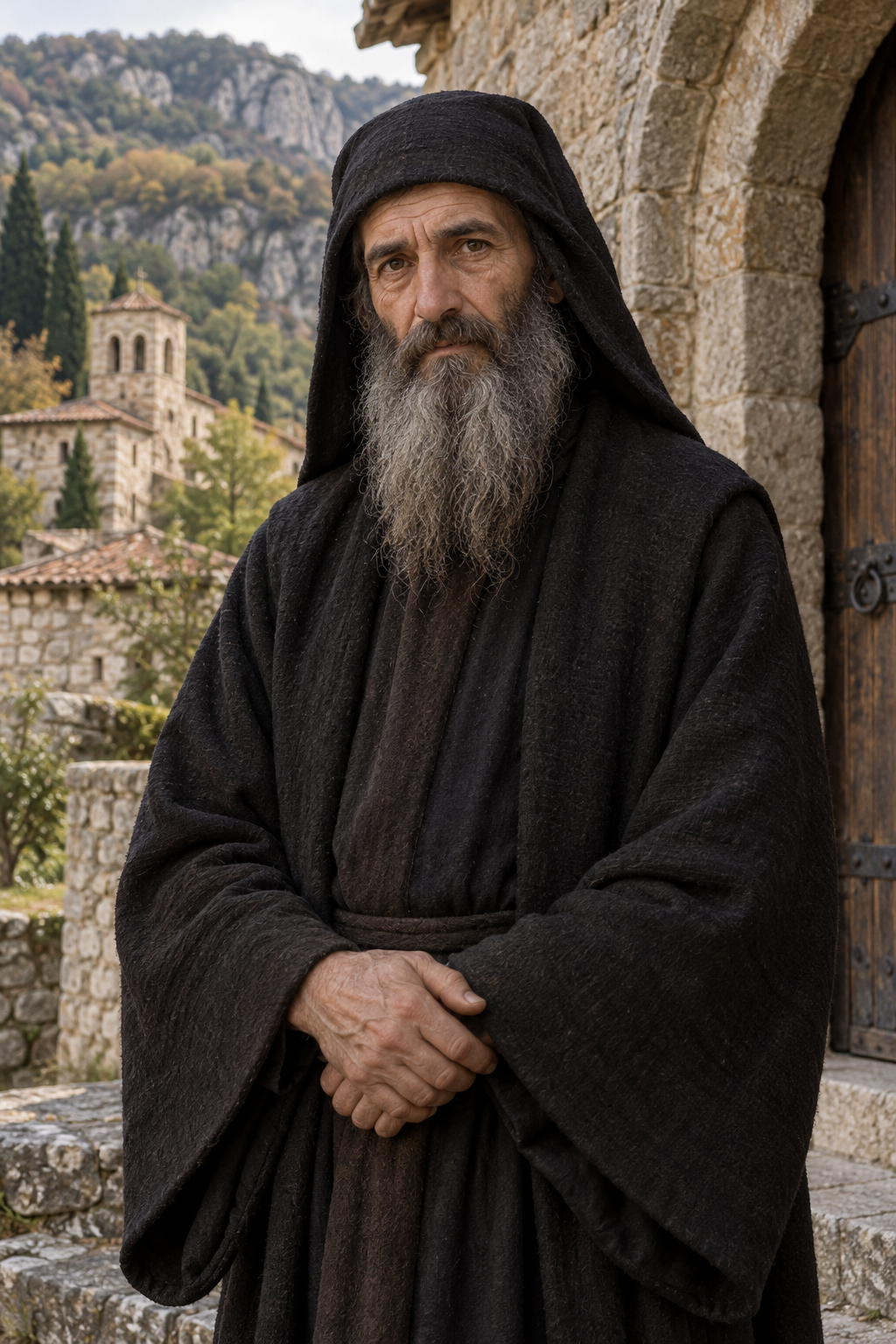
About Theodosius of Tarnovo
Theodosius of Tarnovo was a Bulgarian monk who brought the teaching of Gregory of Sinai into a community near the Bulgarian capital. His path began at the monastery of Saint Nicholas at Archar, near Vidin, under an abbot named Job. After Job’s death he moved between monasteries, eventually hearing about Gregory while staying near Sliven. He joined Gregory at Paroria and became one of his trusted disciples.
Theodosius also acted as an intermediary with the Bulgarian ruler John Alexander. On two journeys to Tarnovo he obtained help for Gregory’s community. The support strengthened the monastery against the dangers surrounding it. Following Gregory’s death, Theodosius traveled again before establishing a community at Kilifarevo. Pavlov dates that foundation to 1350 and describes a brotherhood of about fifty monks, supported by the ruler.
The surviving story is not a straightforward administrative record. Kallistos, who had known Theodosius at Paroria and later became patriarch of Constantinople, wrote his Life. Pavlov identifies its surviving Slavonic witness as a copy made by Vladislav the Grammarian in 1479. Its account must be read with the conventions of a saint’s biography in mind.
The teaching was associated with hesychasm, a tradition of attentive prayer and inward stillness whose religious claims were contested in this period.
At Kilifarevo, teaching was central to the community’s life. Euthymios, later patriarch of Tarnovo, received his monastic education there under the spiritual tradition of Gregory of Sinai. He in turn became a teacher of younger monks. Theodosius’s influence thus passed through relationships within the monastery, joining the formation of a pupil to the continuing instruction of others.
Marco Scarpa’s study connects Slavonic manuscript collections with both Kilifarevo and Paroria. They bring together recent teaching on prayer and older Christian writings. Works associated with Gregory of Sinai and Nikephoros of Athos appear alongside texts by such earlier authors as Ephrem the Syrian, Evagrius and Pseudo-Macarius. The collections place the monastery’s intellectual setting within a long tradition of reflection on ascetic life. They provide evidence for the world in which Euthymios was educated, without establishing that Theodosius personally translated every work.
The Life also presents Theodosius as an active opponent of religious dissent. In its account, he questioned men accused of heresy at a council. Two who refused to recant, Cyril Bosota and Stephen, were ordered by the ruler to be branded on the face and expelled. The narrative praises the defeat of error, but the punishment it describes was physical violence backed by royal authority.
That portrayal requires critical care. Maja Angelovska-Panova notes that accusations of moral corruption were common in hagiographic descriptions of heretics. Her discussion also shows how charges of dangerous religious association circulated among opposing participants in the hesychast controversies. Kallistos himself could be accused through his relationship with another monk. Such polemics cannot simply be treated as transparent reports of the conduct or beliefs of everyone they condemn.
In a separate episode, the Life says Theodosius and his companion Roman urged John Alexander to convene a council against Jews accused of insulting Christianity. It describes death sentences commuted to other punishments and explicitly says that one man sought baptism from fear. These claims belong to the Christian narrator’s account. They nevertheless complicate a portrait of Theodosius concerned only with secluded prayer: the Life celebrates his involvement in a coercive religious campaign.
The evidence for that council is contested. Dimitrios Gonis identifies the Life as its sole narrative source and notes that scholars disagree over the authenticity of its reports. His article examines the assembly’s composition. The council is therefore not an episode that can be reconstructed confidently by combining several independent contemporary descriptions. Even its dating differs between discussions: Gonis calls it the synod of 1359, while the church’s published translation gives 1360.
Late in life, Theodosius became seriously ill. According to the Life, he appointed Roman to lead the monastery and sailed to Constantinople with four disciples, including Euthymios. Kallistos received him and provided a cell at the monastery of Saint Mamas outside the city. The account places his death there in November 1363. Its final instructions stress hospitality and love, alongside fidelity to Orthodox teaching.
Theodosius’s memory remains attached to Kilifarevo, although its surviving buildings are much later than his community. The monastery was destroyed and rebuilt more than once. During its nineteenth-century reconstruction, an older church was converted into a chapel dedicated to him. The present complex therefore preserves his commemoration through a changed physical setting, rather than an untouched medieval foundation.
The Orthodox Church in America commemorates him on November 27.
Kilifarevo’s significance extended beyond the life of its founder. The Bulgarian Ministry of Tourism describes the medieval monastery as a center for saints’ lives and translations of religious texts. That work gives a concrete setting to Theodosius’s remembrance: a community where monastic teaching and the production of books developed together.
A Bulgarian Patriarchate report of a monastic profession in 2014 names Theodosius as one of the patrons of Bulgarian monasticism.
Wondering how to weigh the stories and sources? Learn how to read a saint biography.