Biography
Theophanes Graptos
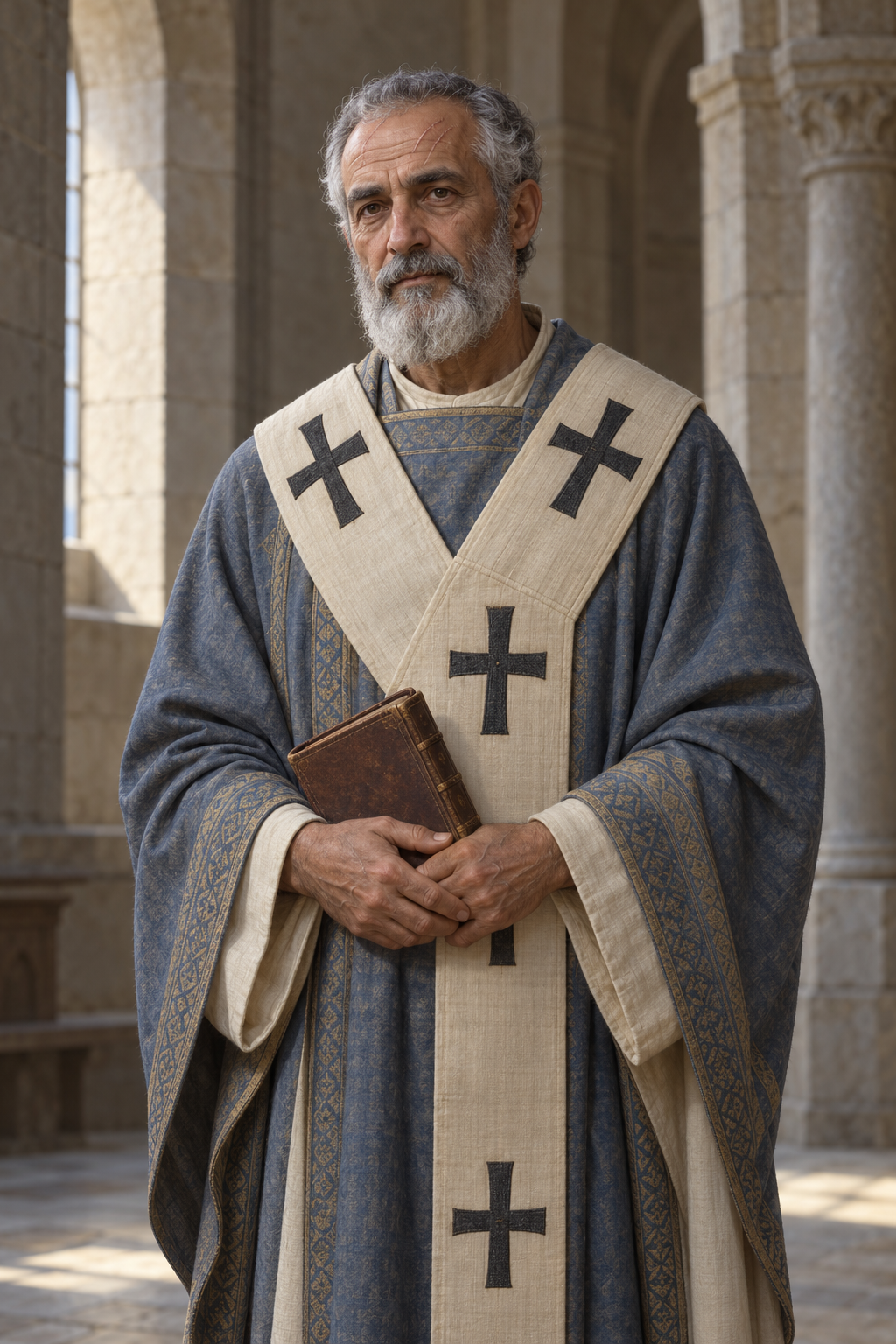
About Theophanes Graptos
Theophanes Graptos is remembered with his brother Theodore as a defender of the veneration of icons. The Orthodox Church in America describes him as a monk of the Lavra of Saint Sabas who later became a priest, endured persecution and eventually served as bishop of Nicaea. It commemorates him on October 11 as both a confessor and a hymnographer. These titles recall two different parts of his legacy: the suffering associated with his religious commitments and the poetry used in worship.
Theophanes came from Moab. The detailed chronology of his early life depends heavily on the Life of Michael the Synkellos, whose account presents the brothers as Michael’s pupils. Its ages and sequence of events should not be treated as an independently verified calendar. Theophanes must also be distinguished from the chronicler of Sigriane, another saint commonly called Theophanes the Confessor. The shared name does not make their careers interchangeable.
The brothers experienced more than one period of banishment. The critical account distinguishes imprisonment near the Bosporus from their later confinement on Aphousia under Theophilos. It places their return to Constantinople and the punishment of their faces in 836. Accounts of their movements are not fully consistent, so the sequence is more secure in outline than in every location and date.
Byzantine chronicles describe the brothers’ confrontation with Emperor Theophilos and the punishment that gave them their name, Graptoi: verses were inscribed on their faces. The verses accused them of wrongdoing and rejected their religious position. Their insulting character belongs to the persecutors’ portrayal of the brothers, not to a neutral judgment about them. The accounts differ in details of the setting and the extent of the inscription. Theodore died in exile, while Theophanes survived to become metropolitan of Nicaea under Patriarch Methodios.
The episode has also prompted disagreement among modern historians. Warren Treadgold, reviewing Claudia Sode’s study, accepts her criticism of parts of Michael’s Life but rejects her case against the letter describing the brothers’ tattooing. This leaves a distinction between the broad memory of persecution and the reliability of every detail in its surviving narratives.
Later pictures show how unevenly that memory could be transmitted. Christopher Walter examines three scenes of the brothers in the Madrid Skylitzes manuscript. Their clothing changes between scenes, and Theophanes appears as a bishop during an episode preceding his episcopate. The manuscript’s caption mentions the tattooing, but its illustrated sequence omits the act itself. These discrepancies mean that the images are witnesses to later storytelling rather than exact visual records of the brothers’ lives.
Walter compares the scene with the Theodore Psalter, where confessors appear before an emperor to defend the veneration of icons. Theophanes holds a book and extends one hand in a gesture of speech, repeating a visual pattern also used for Theodore of Studion and Patriarch Nikephoros. The comparison helps explain the bishop’s clothing: the painter used an established way of showing a religious defender. A separate image in the Theodore Psalter depicts the tattooing beside a verse from Psalm 88 about the reproach borne by God’s servants. Walter suggests that this picture may derive from an illustrated account of Theodore Graptos’s suffering.
Theophanes’s reputation as a hymn writer is well established, but individual attributions remain difficult. The modern prosopography cautions that collections under his name include works that may belong to Theophanes of Sicily or to later authors of the same name. A large traditional total should therefore not be mistaken for an authenticated list of compositions.
The Life of Michael places Theophanes’s final illness at the Chora monastery during a visit to Constantinople. In that account he asked Michael to pray for him and arrange his burial. The prosopographical entry dates his death to October 11, 845. His resting place was remembered near the tomb of Patriarch Germanos at Chora. These final scenes come through the devotional narrative, whose details require the same care as its account of his earlier life.
One modern study offers a more specific view of the poetry associated with him. Chrysovalantis Ioannidis identifies a canon of the Prophets under Theophanes’s name in manuscripts connected with the first Sunday of Lent. The study situates it within an older celebration of the prophets that remained alongside the later feast of the restoration of icons. This gives his remembered work a setting beyond the story of persecution: it belonged to communities singing biblical remembrance through the church year.
The manuscripts did not all use the canon in the same way. Ioannidis notes its placement at Compline in some witnesses and at Matins in another. In the latter, opening stanzas of each ode were adapted to the feast rather than keeping the older prophetic subject. Such changes preserve evidence of continued liturgical use and revision. They also explain why a surviving service cannot automatically be treated as an unchanged composition from Theophanes’s lifetime.
Wondering how to weigh the stories and sources? Learn how to read a saint biography.