Biography
Thérèse Couderc
About Thérèse Couderc
Thérèse Couderc was born Marie-Victoire Couderc on February 1, 1805, at Mas de Sablières in the Ardèche region of France. The public page can keep the existing birth date and Ardèche place because the reviewed sources support them.
Her early life should be written as a rural French Catholic vocation, not as a romantic countryside scene. The place matters because it roots her in Ardèche, near the pilgrimage setting that later shaped the Cenacle mission.
The biography should not overfill the childhood years with invented atmosphere. The safer movement is from birth and family setting to vocation, then to the pilgrim house at Lalouvesc where the sources give firmer detail.
As a young woman she came under the guidance of Father Jean-Pierre Terme and entered the religious community associated with his work. She received the name Thérèse and became part of a mission that joined prayer, hospitality, and formation.
The page should name Father Terme because the foundation was not Thérèse's private project. It should also make clear that her holiness did not depend on personal control of the institution she helped begin.
This keeps the founding story honest. Thérèse can be honored as foundress while also being placed inside a wider pastoral effort serving pilgrims, women in formation, and people seeking a renewed life of prayer.
The mission at Lalouvesc began with service to women pilgrims who came to the shrine of Saint John Francis Regis. From that setting grew the Congregation of Our Lady of the Cenacle, a community dedicated to retreats, prayer, and spiritual renewal.
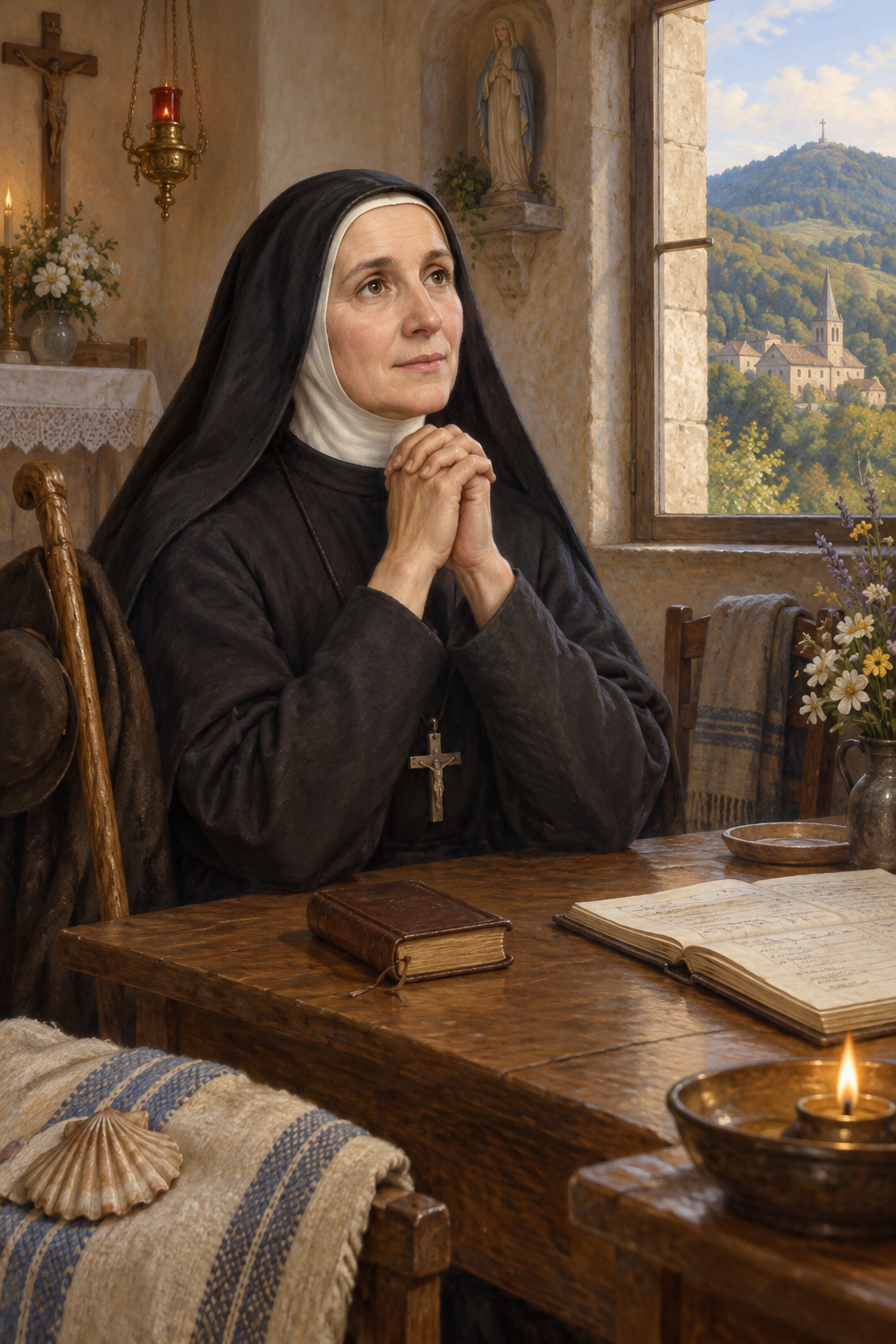
Lalouvesc should appear in the biography as a place of welcome and conversion. The artwork can therefore show a retreat-house interior, a prayer book, a pilgrim guest ledger, and a quiet hillside view rather than a formal founding ceremony.
The page should describe the Cenacle mission in ordinary language. Retreats, prayer, and spiritual accompaniment will be clearer for readers than technical institutional language, and those terms match the congregation's public memory of its origins.
Thérèse became a foundress of the Cenacle sisters, but her mature witness is not only the act of founding. The sources remember her for a spirituality of surrender, especially a willingness to belong wholly to God's action.
That theme must be handled carefully. Surrender should not be presented as passivity or as approval of injustice. In Thérèse's life, it names spiritual freedom, trust, and obedience lived through difficult community circumstances.
The word surrender is useful only if the page explains it as active trust. It should point to a person giving herself to God's work, not to a person erased by hard circumstances or by the decisions of others.
She lost positions of authority in the congregation and spent long years in hidden service. The final page may state this soberly, but it should avoid turning internal conflict into melodrama or assigning motives that the reviewed sources do not prove.
Her humility after loss of office is essential because it shows the cost of her spiritual teaching. She continued to serve the community she had helped found, allowing the Cenacle mission to matter more than her public recognition.
That hidden fidelity gives the biography its center. A reader should come away seeing that Thérèse's authority became spiritual before it became visible again in later church recognition.
The public biography should also avoid implying that later vindication erased the difficulty of those years. The more faithful emphasis is that Thérèse's interior life deepened in obscurity and made her teaching on surrender credible.
Thérèse died in 1885. Sources support September 26, 1885, in Lyon, but this deferred draft preserves the catalog's existing death year and blank death place until the final consolidated approval decides whether to normalize those fields.
The memorial date of September 26 can remain because it matches the existing catalog field and the source-supported death date. If the final packet updates the death date to a full signed partial date, the test should change in the same approval step.
The same caution applies to death place. Sources support Lyon, but this draft does not change the blank catalog field during preparation. A single final approval should handle all field normalization for the 421-500 batch.
Pope Paul VI canonized Thérèse Couderc in 1970. The final page can mention the canonization as official recognition while keeping the spiritual center on her life of retreat ministry, prayer, surrender, and humble service.
Her witness belongs especially to people who serve spiritual renewal without owning the visible results. The Cenacle setting lets readers see holiness in hospitality, prayer, hidden perseverance, and the hard freedom of letting God work beyond one's control.
That final emphasis should be pastoral rather than institutional. Thérèse's life can invite readers to offer good work, step back from possession of it, and trust that prayerful service may bear fruit outside their own visibility.
Artwork should show a nineteenth-century French religious sister in simple dark habit, with a retreat-house or chapel interior, prayer book, pilgrim ledger, Ardèche hillside cue, and a calm expression of surrender. Avoid modern retreat branding, institutional logos, administrative conflict imagery, halos, exact likeness claims, and rendered text.
Wondering how to weigh the stories and sources? Learn how to read a saint biography.