Biography
Thomas More
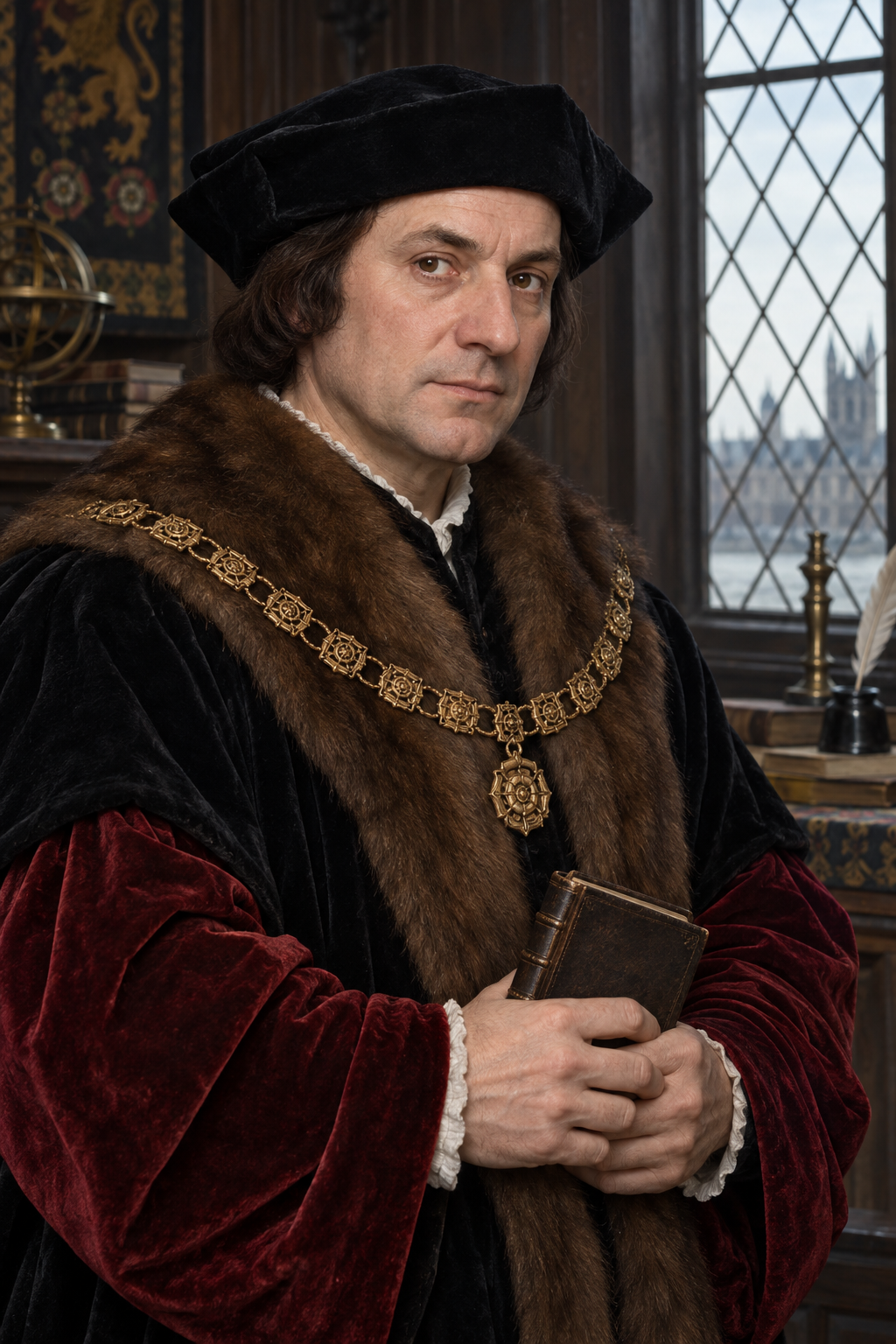
About Thomas More
Thomas More was born in London on February 7, 1478, into a family whose standing was rooted in the law rather than hereditary nobility. As a boy he entered the household of John Morton, Archbishop of Canterbury and Lord Chancellor, an early encounter with both church leadership and royal government. He studied law at Oxford and in London while also pursuing Greek, theology, classical literature, and the wider learning of Renaissance humanism. Scholars have debated whether the birth year was 1477 or 1478, but a modern study defends the family memorandum's date of February 7, 1478.
More considered how best to live his religious commitments before choosing marriage, family life, and public service as a layman. He married Jane Colt in 1505, and they had four children before her death in 1511; he then married the widow Alice Middleton. His household joined prayer and study with conversation, hospitality, and careful attention to the education of daughters as well as sons. The official commemoration places this sustained family responsibility beside his work as a husband, father, and statesman.
More built a successful legal and civic career, representing Westminster in Henry VIII's first Parliament and becoming an under-sheriff of London in 1510. His best-known book, Utopia, appeared in 1516 as a dialogue about an imagined island whose institutions expose questions about property, virtue, counsel, and government. Its internal arguments do not yield a simple program, yet the work circulated widely and gave later languages the enduring word 'utopia.' Two years after the book's publication, he entered Henry's council and moved more fully from civic office into royal service.
The House of Commons chose More as Speaker in 1523, placing a working lawyer and humanist at the center of parliamentary negotiation with the Crown. He also undertook diplomatic work and served the king as an adviser during a period when government, religion, and dynastic policy were becoming inseparable. In 1529 he succeeded Cardinal Thomas Wolsey as Lord Chancellor of England, the kingdom's highest judicial office. The official biography presents More's public service together with his continuing attention to study, family life, and his children's education.
More was also a forceful Catholic controversialist who regarded the spread of Protestant teaching as a grave danger to church and society. As chancellor he took an unusually active lay role in enforcing heresy law, and people were burned for heresy during his tenure. Recent scholarship rejects sensational claims that he personally tortured suspects, but that correction does not remove his defense of coercive prosecution or its lethal consequences. The papal document that later named him a patron likewise acknowledges that his actions against heretics reflected the limits of his historical culture.
The decisive break with Henry VIII grew from the king's effort to end his marriage to Catherine of Aragon and establish royal authority over the Church in England. More did not lead every stage of resistance, but he would not recognize claims that displaced papal authority or validated the new marriage on the king's terms. He resigned the chancellorship on May 16, 1532, after Parliament and the clergy had been pressed toward the king's program. Out of office, he continued writing against Protestant doctrine and stayed away from Anne Boleyn's coronation, deepening the king's suspicion of him.
In April 1534 commissioners required More to swear to the new succession settlement and to wording that rejected papal authority. He was willing to accept Parliament's order of succession but refused the religious preamble, seeking to preserve conscience without openly attacking the monarch. Henry ordered his arrest on April 17, and More spent about fourteen months in the Bell Tower within the Tower of London. Loss of office, family contact, and freedom narrowed his choices, yet the later church commemoration remembers him as placing conscience above honors and life.
More was tried in Westminster Hall in 1535, returning as a prisoner to the institution where he had once served as Speaker. The court convicted him of high treason after he denied that Parliament could make the king supreme head of the Church in England. On July 6, 1535, he was led from the Tower to Tower Hill and executed by beheading. Later accounts remembered his composure, humor, forgiveness, and declaration that service to the king remained subject to service to God, though the exact phrasing is not stored here as a verified quotation.
Catholic authorities beatified More with other English martyrs in 1886 and canonized him with John Fisher under Pope Pius XI in 1935. The Roman Catholic calendar in the United States keeps Thomas More and John Fisher together on June 22 as an optional memorial of martyrs. The Church of England commemorates Thomas More as a scholar and John Fisher as a bishop on July 6, naming both Reformation martyrs. In 2000 John Paul II formally declared More the patron of statesmen and politicians, emphasizing integrity of conscience in public office. His enduring significance lies in the demanding conjunction of scholarship, family life, government, coercive religious policy, and a final refusal to let political authority command his conscience.
Wondering how to weigh the stories and sources? Learn how to read a saint biography.