Biography
Ubald
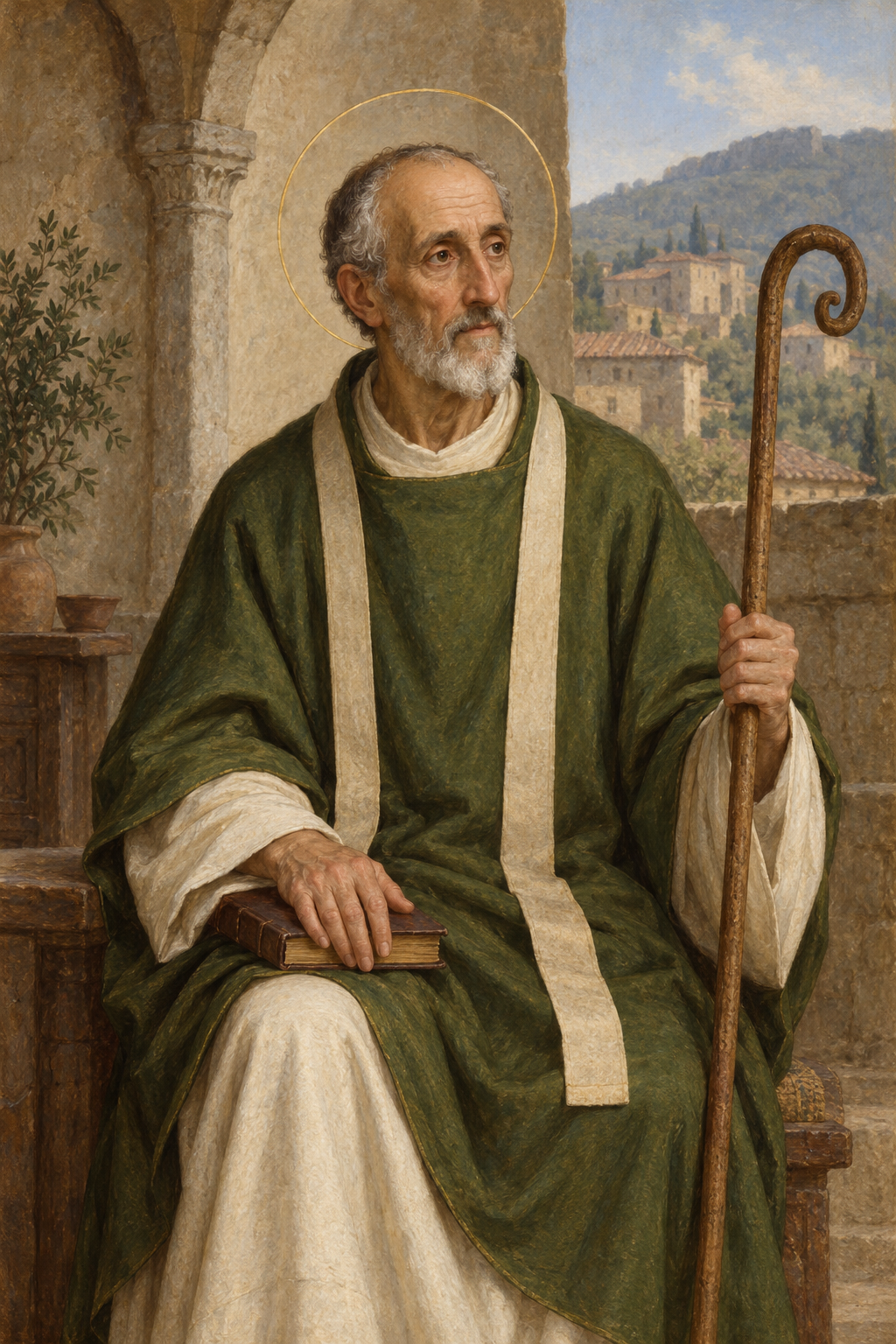
About Ubald
Ubald served Gubbio as a canon, a reforming prior and eventually its bishop. He was born around 1085, although his exact birthplace is unknown. The familiar surname Baldassini belongs to a much later reconstruction of his ancestry, rather than secure evidence about his family. His life is unusually well served by two biographies written close to his death and by surviving documents. Together they show a church leader whose care for a religious community became part of the wider life of his city.
The diocesan account describes a priest concerned with how his fellow canons actually lived. As prior, he introduced an observance associated with Santa Maria in Porto near Ravenna. It required shared discipline, silence in church and the dormitory, daily reading of the Bible and hospitality to people in need. He divided much of his inheritance between the community and the poor. At first, only a few companions accepted the reform.
Jordan’s early Life gives this undertaking a concrete setting. Ubald spent three months at the Ravenna community, studying its rule and way of life. He brought back a written account for the canons at Gubbio. The biographer remembers the book itself as a treasure recovered after it was accidentally left behind during the journey. The story expresses the value placed on a shared rule. Reform required something the community could learn and practice, as well as the example of its prior.
A severe fire damaged the canonry during the 1120s. Ubald helped restore its buildings and religious life. The later diocesan account remembers his discouragement and the encouragement he received to remain with the community. His responsibilities then widened: Pope Honorius II chose him as bishop of Gubbio in 1129. The new office continued a life already formed by prayer, common observance and responsibility for the people around him.
Jordan also recalls an earlier attempt to make him bishop of Perugia. Ubald withdrew rather than accept and appealed personally to Honorius II. The pope allowed him to refuse that appointment, but later required him to take responsibility for Gubbio. The narrative presents reluctance to seek rank alongside obedience when leadership became unavoidable.
The documents add an administrative dimension to the biographies. Ubald supported the cathedral chapter with property, sought to recover rights that had been taken from it and participated in settling ecclesiastical boundaries. Religious reform involved the material arrangements that sustained churches and their communities. His episcopate also coincided with the emergence of Gubbio’s communal institutions. His public role belonged within that changing civic order.
Teobaldo, his successor and another early biographer, emphasizes patience under provocation. In one episode, building work damaged the bishop’s vineyard. When Ubald objected, a builder pushed him into the wet construction material. People threatened severe punishment for the insult. Teobaldo says that the bishop instead summoned the man, forgave him and ended the demand for revenge. The episode is preserved as an example of the restraint his community remembered in him.
The same Life describes an intervention in a violent street battle. Unable to stop the fighting by speaking, Ubald threw himself down among the combatants. Believing their bishop dead, they abandoned the struggle and began to mourn. He then rose and showed that he was unharmed. Teobaldo tells the story to portray a shepherd willing to risk himself for his people. Its dramatic form belongs to the devotional biography through which that memory was transmitted.
Ubald died on May 16, 1160. Pope Celestine III canonized him on March 5, 1192. In September 1194 his body was transferred from the cathedral to the height of Colle Ingino, where his shrine became a place of pilgrimage. Devotion remained especially strong in Gubbio and the surrounding Umbrian region. The New Catholic Encyclopedia also records a traditional invocation of his help against demonic possession. This is a description of devotional patronage, rather than a medical account.
The Ceri festival gives that local memory a distinctive public form. On May 15, the eve of his feast, three large wooden structures bearing saints’ figures are carried in his honor. The museum account associates Ubald’s Cero with the masons and stonecutters, Saint George’s with merchants and Saint Anthony’s with workers connected to the countryside. The objects combine a wooden structure, a supporting stretcher and the saint’s figure. Their present form developed over time, reaching its familiar shape in the eighteenth century. Family traditions continue to connect participants with the different Ceri.
Gubbio continues to honor him as patron of both city and diocese. During the 2021 patronal celebration, Bishop Luciano Paolucci Bedini connected Ubald’s prayer with active responsibility for his neighbors. He emphasized gentleness, courage and reconciliation, and asked the community to continue that care. This local reflection draws together the prior’s concern for common life and the bishop’s remembered efforts to restrain violence. The saint remains part of a living community’s understanding of its responsibilities.
Wondering how to weigh the stories and sources? Learn how to read a saint biography.