Biography
Ulrich of Augsburg
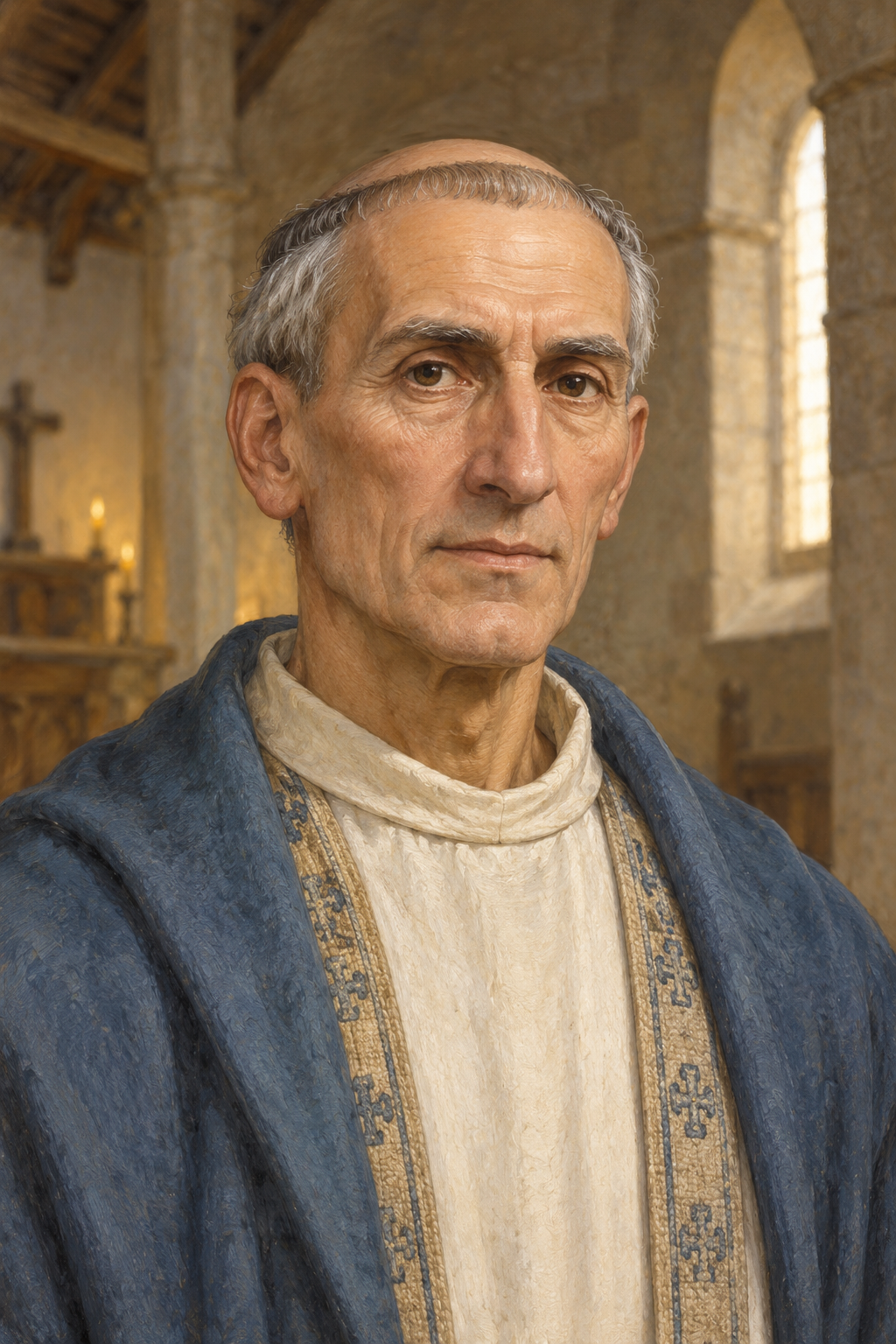
About Ulrich of Augsburg
Ulrich served as bishop of Augsburg from 923 until 973. Educated at St Gallen, he combined responsibility for his diocese with involvement in the political conflicts of his time. The Historical Dictionary of Switzerland remembers him as a mediator loyal to Otto I, a defender of Augsburg and a restorer of monastic and church life. His veneration spread beyond Augsburg into Switzerland, where several communities continued to honor him.
He was born around 890, but his birthplace is uncertain: modern scholarship lists Augsburg, Wittislingen, Dillingen and Sulmetingen as possibilities. He came from an aristocratic family and entered the household of Bishop Adalbero after his schooling. Jörg Bölling’s biography notes a less admirable aspect of his early career: he refused to serve Adalbero’s successor because he considered that bishop’s social standing beneath his own. In 923 King Henry I appointed Ulrich to Augsburg, and he received episcopal consecration on December 28. His rise therefore belonged to a world in which noble family connections and church office were closely linked.
Ulrich’s pastoral work required him to travel throughout the diocese. The Catholic Encyclopedia describes his regular visits, his efforts to improve clerical discipline and his building of churches so that worship would be more accessible. His expectations of clergy were demanding. He also traveled to Rome to obtain relics, an important part of the devotional life of the churches entrusted to him.
His building work changed Augsburg itself. Soon after becoming bishop, he arranged for the rebuilding of its ruined cathedral. He also replaced inadequate earthworks and wooden fencing with a ring of walls around the city. After the destruction of St Afra’s church in 955, he initiated another church on the site and prepared a burial place there for himself.
Peter Rummel’s diocesan biography gives a more personal picture of this ministry. Ulrich visited communities in the difficult terrain of the Allgäu, attended to the training of future priests and gathered his clergy in diocesan synods. He placed particular emphasis on the liturgy of Holy Week and Easter. His concern for people in poverty included feeding them at the episcopal residence and remembering them in the distribution of his remaining possessions.
His concern for monasteries included the observance of the Benedictine rule. After restoring discipline and appointing suitable superiors at Kempten and Ottobeuren, he gave up their further direction. In 968 he confirmed the foundation of the community of canonesses at St Stephan in Augsburg.
His political loyalties also placed him in danger. When Otto I and his son Liudolf were in conflict, Ulrich supported the king. The Catholic Encyclopedia credits Ulrich and Bishop Hartbert of Chur with helping to reconcile father and son in 954. In the following year Ulrich helped Augsburg withstand a Hungarian siege until Otto’s forces arrived. The account distinguishes this defense of the city from the subsequent battle on the Lechfeld; it does not place Ulrich among the combatants in that battle. His personal role in the fighting remains debated: historian Georg Kreuzer considers participation likely, contrary to the later image of a wholly nonviolent bishop.
In his later years, Ulrich hoped to hand over responsibility to his nephew Adalbero. That plan met resistance at the synod of Ingelheim in 972 and ended with Adalbero’s early death. Ulrich died on July 4, 973. Bölling also cautions readers about the familiar description of him as the first saint canonized by a pope: the document dated February 3, 993 survives only in much later copies and early printed editions.
The diocesan account describes Bishop Wolfgang of Regensburg conducting his burial at the church of St Afra. Pilgrims soon came to his grave. Over later centuries churches, chapels and altars carried his name, while people invoked his intercession in sickness, before dangerous journeys and against floods. These practices belong to the history of devotion to Ulrich; they are not evidence of medical or physical protection.
The earliest biography was written by Gerhard of Augsburg between 983 and 993. The Bavarian Academy’s repertory values it because Gerhard witnessed many of the events he described. Its second book contains thirty miracle narratives. In the following century, Berno of Reichenau reshaped Gerhard’s account into a more explicitly edifying saint’s life at the request of Abbot Fridebold of St Ulrich and Afra. Berno’s version circulated widely, surviving in more than seventy manuscripts.
The Diocese of Augsburg commemorates him on July 4 and continues the Ulrichswoche, a week of pilgrimage and worship held annually since 1955. From the sixteenth century, pilgrims brought back Ulrich crosses from his shrine, according to the diocesan calendar. These objects expressed devotion to him and hopes for protection against misfortune. Its calendar also records traditional patronage of fishermen and weavers. These associations remain part of the devotional memory of a bishop whose life involved both the care of communities and the exercise of power.
Wondering how to weigh the stories and sources? Learn how to read a saint biography.