Biography
Varnava Nastić
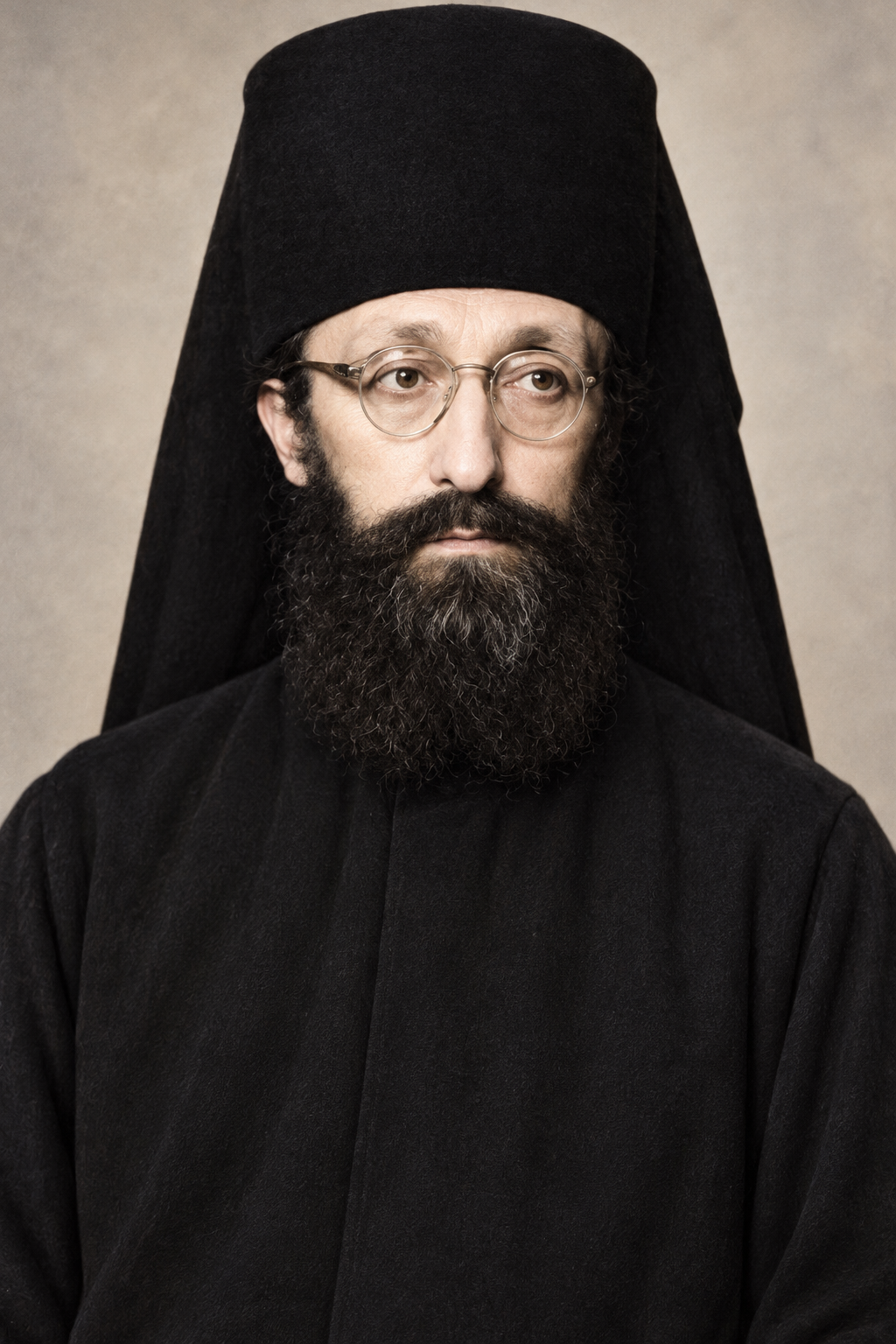
About Varnava Nastić
Varnava Nastić was born in Gary, Indiana, in 1914 and spent his early childhood in the United States. His family moved to Sarajevo, where he continued his schooling. Before entering theological studies in Belgrade, he and his father visited Bishop Nikolai Velimirović to seek his blessing.
His father, Atanasije, supported the Bogomoljci religious movement. The diocesan account, citing Nikolai’s testimony, describes him helping to pay for its preachers’ journeys. During the visit to Nikolai, Atanasije also explained that his son wanted to become a monk. The bishop welcomed that wish but advised the young man to begin his studies first, promising to pray for his monastic vocation.
His American childhood remained part of his community’s memory. In a later newspaper interview, Father Thomas Kazich recalled that Varnava attended Froebel Elementary School in Gary. He also served at Saint Sava Church, whose congregation later moved to Merrillville. The account describes his father as an important influence on his religious upbringing.
A later biography draws on his fellow student Lazar Milin’s recollections of a young man interested in music and sport. Milin remembered his knowledge of music, his cello playing and his command of several languages. These recollections add a personal dimension to the schoolteacher who became a monk.
Known as Vojislav before his monastic life, he graduated from the theological faculty in 1937. He taught religion in Sarajevo and became a monk in 1940.
During the Second World War, he refused an offer from Ante Pavelić to become a bishop in the Croatian Orthodox Church. This refusal is described in Velibor Džomić’s historical study, which cites a published collection of materials about Varnava’s life.
In 1947 he was consecrated a bishop with the title of Hvosno. As a vicar of the Serbian patriarch, he was appointed to assist Bishop Nektarije, who was then administering the Dabro-Bosnian metropolitanate; his role was that of an auxiliary bishop. Later that year the Communist authorities arrested him. He was sentenced to imprisonment in 1948 and held at Zenica. He suffered serious injuries during a railway collision while being transferred to another prison.
Among his fellow prisoners was the Catholic bishop Petar Čule, with whom he shared a cell for a time. Džomić’s study cites Čule’s written recollections, published in a collection edited by Pavle Kondić. The two bishops remained friends after leaving prison. Čule also described the railway transfer in which both men were injured. According to the account, prisoners had been bound in pairs, and Varnava was tied to a Catholic priest. Both bishops sustained serious injuries and were hospitalized. Čule believed the collision had been arranged deliberately; the surviving account of that belief does not by itself establish the cause of the crash.
His recovery brought him into close contact with the Catholic Sisters of Mercy of the Holy Cross at the hospital in Sremska Mitrovica. Letters preserved in the sisters’ archive record the friendship that followed. Writing in December 1951, Varnava thanked the sisters for their care and recalled their farewell meal. He saw their kindness to an Orthodox bishop as a sign of the love that should unite Christians. A second letter thanked them for inviting him to convalesce at their convent in Đakovo, although he could not accept. At Easter 1952, he compared their care with the welcome he received in an Orthodox monastery. Later that year he wrote to Mother Amadeja Pavlović about the damage Christians caused when national or personal ambitions displaced their faith. The correspondence preserves both his gratitude for practical nursing and his concern about divisions between churches.
After prison, Varnava lived under supervision in monasteries, including Gomionica, Vavedenje, Krušedol and Beočin. He was not allowed to resume the leadership of his diocese. He died at Beočin Monastery on November 12, 1964, and was buried there.
His imprisonment also received attention in the United States. A 1965 Senate committee publication included Varnava among its examples of religious persecution in Yugoslavia. Prepared by the Library of Congress Law Division, the study described charges of treason, hostile propaganda and spying for Anglo-American interests; these were accusations against him, not findings adopted here as established conduct. It also reported restrictions on his movement after prison. The chapter acknowledged that its accounts came from private sources that could not be checked against official Yugoslav publications. The report therefore documents how his case was presented to American lawmakers, while leaving important questions about the underlying proceedings open.
The Serbian Orthodox bishops recognized Varnava as a saint in 2004, followed by a public celebration at Žitomislić Monastery in 2005.
His childhood parish continued to honor him. A 2010 report announced a service at Saint Sava in Merrillville and described the interest of local clergy in making his story better known. Their remembrance linked his later life in Yugoslavia with the Indiana congregation where he had grown up.
Wondering how to weigh the stories and sources? Learn how to read a saint biography.