Biography
Venantius Fortunatus
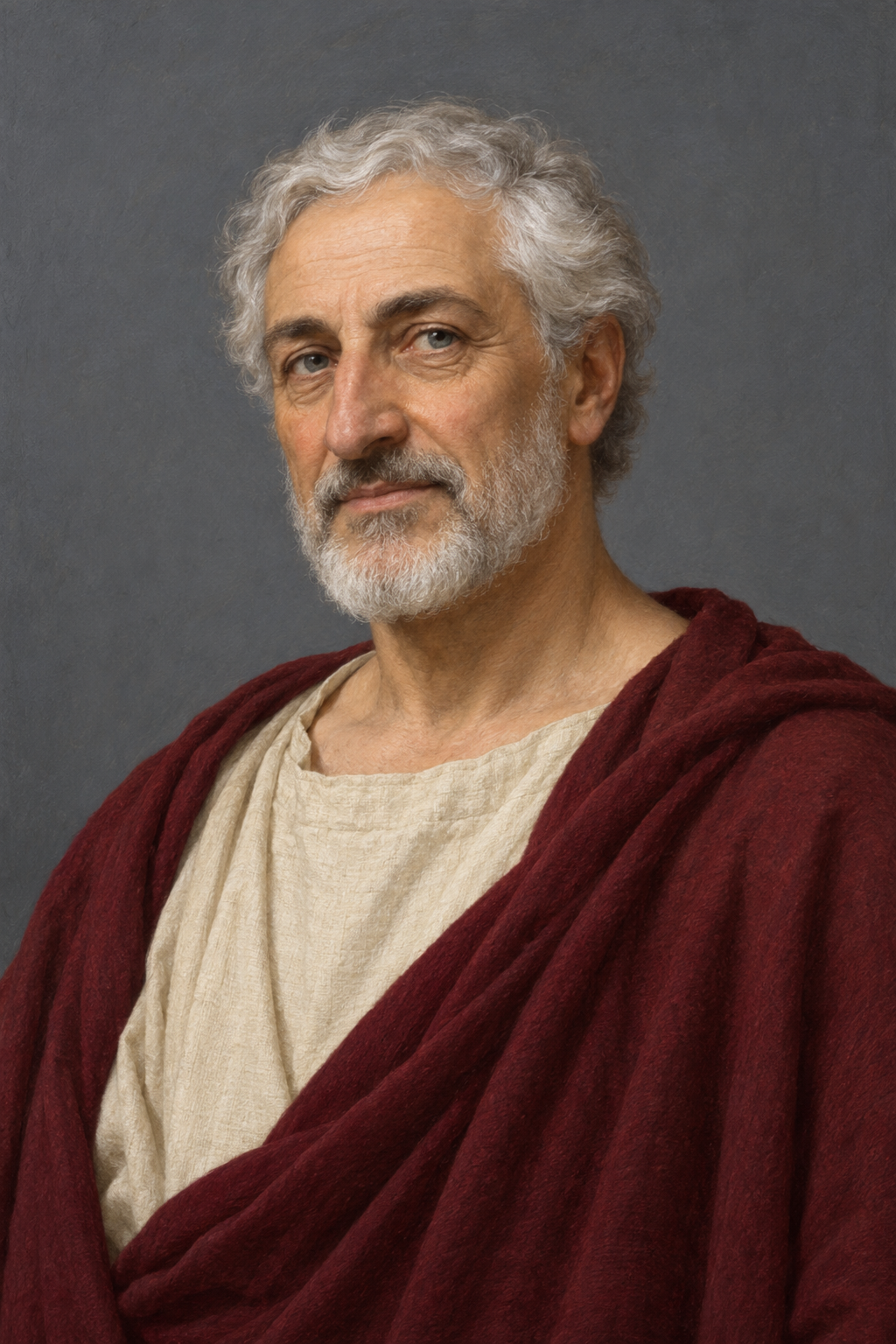
About Venantius Fortunatus
Venantius Fortunatus was born at Duplavenis, identified with present-day Valdobbiadene, shortly before 540. He studied at Ravenna and left Italy in 565 for the Frankish kingdoms. His own accounts give more than one emphasis to that journey: pilgrimage to Martin’s tomb at Tours appears alongside the ambitions of a young writer seeking a place in a new society.
At Metz he celebrated the marriage of King Sigebert and Brunhild in verse. At Poitiers, friendship with Radegund drew him into the service of her monastic community. She entrusted him with its external affairs. His writing and travels helped sustain relationships beyond the monastery, placing literary skill at the service of both religious life and the wider political world.
Writing for rulers placed him within a world of competition and family alliances. Dóra Kintli reads his wedding poem as more than ceremonial flattery: the praise of Sigebert also presents expectations of lawful marriage, justice, and care for his people. Classical imagery helped communicate those ideals to a court that valued Roman culture. His consolation for Galswinth, Brunhild’s sister, faced a different task. It gave room to mourning and Christian hope while leaving the troubling circumstances of her death unspoken. The identity of its commissioner and the timing of its composition remain uncertain. These poems show both the possibilities and the constraints of addressing powerful patrons. Although royal commissions mattered to his livelihood, Kintli notes that he did not hold an official position in any of the Merovingian courts.
His relationship with Radegund also included Agnes, the first abbess of her community. Hope Williard describes their friendship as a network of shared interests and responsibilities, sustained by the women’s patronage as well as the poet’s service. Radegund and Agnes were active participants in these relationships, bringing Fortunatus into their own circles. Their religious commitments did not exclude the exchange of greetings or the cultivation of friendships beyond the convent. Williard connects this activity with their interpretation of the community’s rule and with Radegund’s efforts to obtain relics.
Some exchanges were modest: poems accompanied gifts of food or flowers. Stephen D’Evelyn argues that these small offerings should not be dismissed as trivial. They provide evidence of friendship and invite questions about generosity, obligation, and the balance between giver and recipient. The ordinary gifts belong to the story alongside royal celebrations.
His surviving poetry ranges across hymns, elegies, epitaphs and occasional verse. The collection known as the Carmina preserves a writer attentive to particular people and occasions. Friendship with Gregory of Tours belonged to this wider circle of relationships. Fortunatus also composed lives of saints, including Radegund, whose community had become central to his own life.
Fortunatus’s attention also extended to churches and the people who built or restored them. Williard interprets these poems as praise for both religious generosity and public standing. Bishops were prominent donors, but other patrons included aristocratic families and local communities. Building projects offered occasions for friends to meet and exchange recognition. In this setting, describing a church could honor its benefactor while placing that gift within a wider social and religious community.
The variety of his work also appears in its forms and voices. Alongside hymns and public praise, his collection includes poems arranged into figures, short pieces about miracles, and elegies spoken in the voices of women experiencing abandonment or exile. The editorial account of Michael Roberts’s translation draws attention to his imaginative comparisons and humor at his own expense. These qualities complicate the picture of a poet concerned only with formal honor: his writing could also be playful, intimate, or attentive to grief.
Two of his best-known hymns, Pange lingua and Vexilla regis, arose in connection with the arrival of a relic of the Cross sent to Radegund by Emperor Justin II. Their adoption into Roman worship gave his words a life far beyond their original occasion. His literary inheritance therefore includes public praise and personal friendship as well as poetry sung in prayer.
Michael Roberts organizes his study of Fortunatus around praise, saints’ lives, and personal poetry. That range reflects the meeting of classical literary training with Christian subjects in his work. The poems belong to a changing society, but they also preserve continuities of language and education. Their survival has made Fortunatus an important figure for understanding the movement from late antique Latin literature into the early medieval world.
He eventually became bishop of Poitiers. The dates of his episcopate and death remain uncertain, although his death falls within the opening decade of the seventh century. Padua’s proper liturgical book remembers him as a bishop whose learning accompanied generous care for the poor. That local remembrance holds together the scholar and the pastor.
The Diocese of Padua celebrates his memorial on 15 December. A 14 December observance is also recorded in French and Italian dioceses.
Wondering how to weigh the stories and sources? Learn how to read a saint biography.