Biography
Vicenta María López y Vicuña
About Vicenta María López y Vicuña
Vicenta María López y Vicuña was born in Spain in 1847. The current catalog stores March 24 and Navarre, while a congregational source gives a different date and more specific place. This draft preserves the existing fields and marks the conflict for final approval review.
That restraint is important. The slow-vetted packet should not silently replace one official-looking date with another when the source family disagrees. The final approval packet can decide whether to keep the Causes profile, adopt the congregational data, or preserve uncertainty.
The same method applies to the death date. The current catalog has a year-only field. Sources point toward December 26, but this draft does not convert the runtime field before the single approval review.
Vicenta's vocation took shape around young women working away from home. The page should describe them with dignity, not as a social problem or decorative background for the foundress.
Those young women should be treated as agents with futures. The point of the mission was not only rescue from danger, but accompaniment toward formation, faith, stable work, and personal dignity.
The mission served young women who needed formation, shelter, protection, and spiritual support in urban working conditions. This context belongs in the page, but exploitative imagery and modern labor slogans should be avoided.
That means the text can name vulnerability without making vulnerability the whole identity of the people served. The young women were not problems to be managed; they were persons to be accompanied.
In Madrid, Vicenta founded the Religiosas de María Inmaculada. The founding should be described as a religious response to concrete need: education, household formation, moral protection, prayer, and a safe place to grow.
Madrid should appear as more than a location. It was the urban setting where young workers could become isolated, and where Vicenta's congregation built a house of welcome, formation, and religious support.
The page should not turn domestic training into a narrow gender stereotype. Vicenta's work was about dignity and protection for young women whose labor and housing made them vulnerable in her time.
The public biography should therefore speak carefully about domestic skills. Sewing baskets, books, and work tables can be visual cues of formation, but the core theme is dignity, not a reduced vision of women's work.
Paul VI's canonization homily provides official recognition of her holiness and mission. This draft uses it without long quotation, keeping the biography focused on the life and the people she served.
The homily also helps locate her work inside the church's memory of charity. That recognition supports the page without requiring ceremonial language or lengthy quotation.
The existing catalog stores death as year-only `+1890` and place as Madrid, Spain. Sources support more exact death timing around December 26, but this deferred draft keeps the year-only field until final review.
This is a deliberate editorial guard, not a failure to research. The exact date can be accepted later with the birth conflict, so all related field changes are reviewed together.
The feast day of December 26 can remain because it aligns with the source tradition and current catalog. If the final packet normalizes death date, the test should change in the same approval step.
That preserves consistency between text, tests, and data. The draft can explain the source-supported day while the importer continues to protect the current runtime field.
Vicenta was canonized in 1975. The public page can mention canonization, but the center should be her durable work for young women, not ecclesiastical ceremony.
Her witness belongs wherever work, housing, and vulnerability overlap. The page can speak of protection and education without implying that the young women were passive. They should appear as persons being accompanied toward dignity.
This makes the reflection contemporary without forcing modern politics into the saint page. The issue is Christian accompaniment: practical help that does not erase agency.
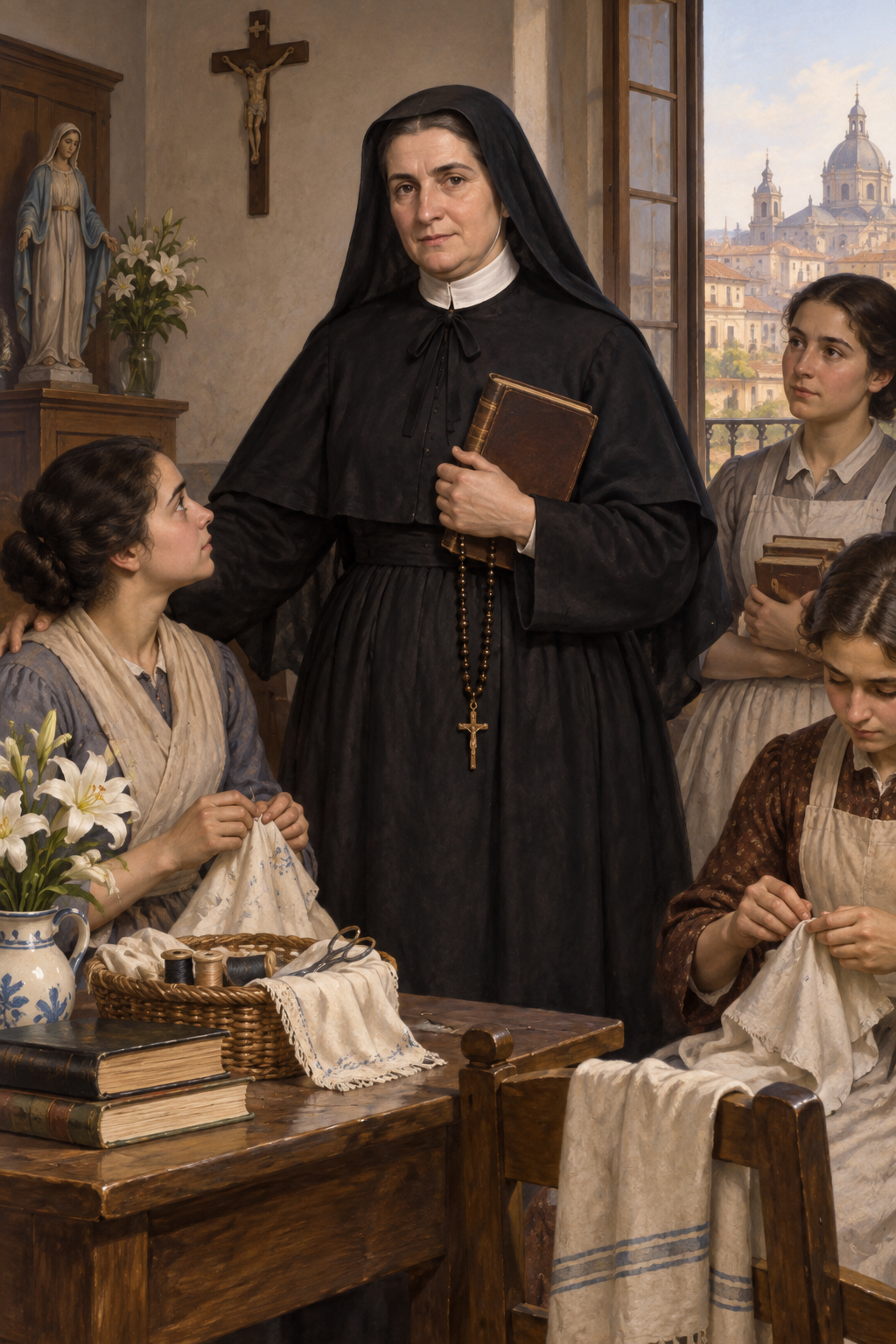
The artwork can show Vicenta in black habit with book, rosary, sewing basket, and formation-house setting. Young women may appear as students or workers with dignity, never as exploited bodies or anonymous labor symbols.
The badge should keep Vicenta's face, book, and rosary visible, with only enough of the formation house to explain her mission. It should not become a crowded genre scene.
The final page should end with the mercy of formation. Vicenta's holiness made a house where vulnerable young women could be taught, protected, and honored as persons loved by God.
That ending lets the source conflict sit in the background where it belongs: important for data integrity, but secondary to the spiritual shape of the life.
Her witness is practical charity with a schoolroom door, a safe house, a prayer book, and patient accompaniment.
Artwork should show a nineteenth-century Spanish foundress in black habit in a Madrid school or domestic-training house with book, rosary, work table, and sewing basket. Avoid modern objects, logos, readable text, halos, exact-likeness claims, and exploitative labor imagery.
Wondering how to weigh the stories and sources? Learn how to read a saint biography.