Biography
Victor of Capua
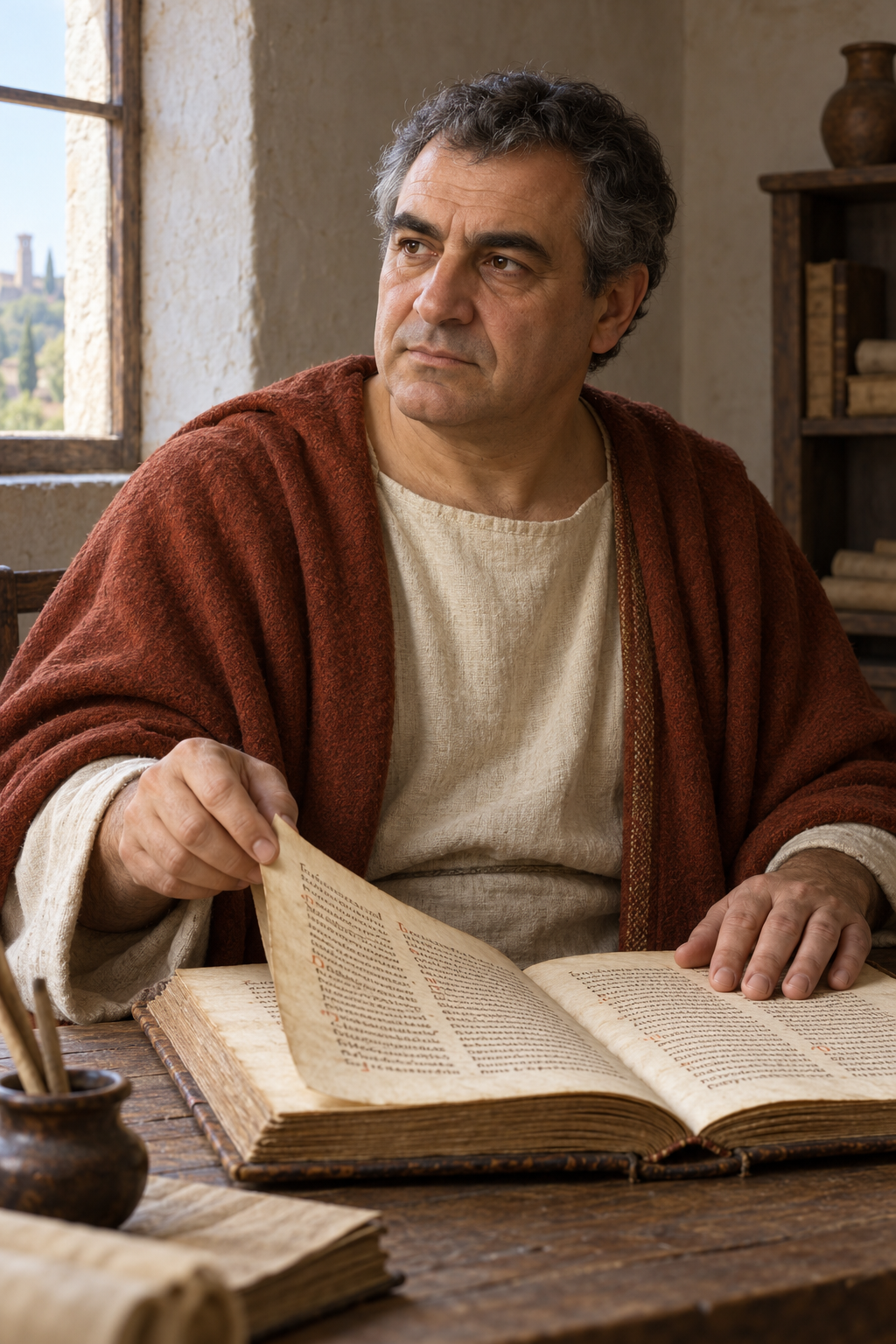
About Victor of Capua
Victor of Capua was a sixth-century bishop whose surviving work reveals more about his reading than about his private life. Patrick Healy’s account draws on the preserved text of Victor’s epitaph, which records an episcopate of thirteen years ending in April 554. The tomb itself no longer survives.
His most substantial legacy is the manuscript now called Codex Fuldensis. It brings the four Gospels together into a continuous account, followed by the other books of the New Testament. Houghton describes it as the earliest surviving Latin manuscript to contain the complete New Testament. The book also includes the noncanonical Letter to the Laodiceans. Victor personally corrected the manuscript in 546–547, leaving evidence of close attention to its text.
Victor’s own preface explains the beginning of the project. A book combining the four Gospels came into his hands without an author’s name. He searched earlier Christian literature for its origin, considering both Ammonius of Alexandria and Tatian. His reasoning led him toward Tatian, though he acknowledged uncertainty. He also distinguished the Gospel words he valued from the errors he believed Tatian had later taught.
Victor added numerical references so readers could compare the combined narrative with the complete Gospels and check a doubtful passage. He wanted the volume to be usable without unease. His closing prayer asks for understanding and discernment in reading Scripture.
Its Gospel narrative has 182 numbered sections, with indications of the source Gospels in the text and margins. Houghton notes that the readings largely follow the Vulgate and that later Gospel harmonies continued this approach.
How much Victor changed the wording remains debated. Nicholas Zola’s recent study challenges the familiar assumption that Victor systematically replaced an earlier Latin version with Vulgate readings. In the published abstract, Zola argues that Victor may already have inherited a Vulgate harmony. He points to the preface’s detailed account of adding numerical references, alongside its silence about such a large rewriting task.
His interests extended beyond this manuscript. Healy lists a work on the calculation of Easter, biblical commentaries, and an allegorical treatment of Noah’s ark among writings associated with him. Much of this material survives only in fragments.
The Fulda library now preserves the book as the Victor Codex, catalogued as a Latin parchment manuscript of 546–547. Its record treats ownership by Boniface as probable, rather than certain.
He is commemorated as a saint in the Catholic calendar, with 2 April listed by Nominis.
Wondering how to weigh the stories and sources? Learn how to read a saint biography.