Biography
Victricius of Rouen
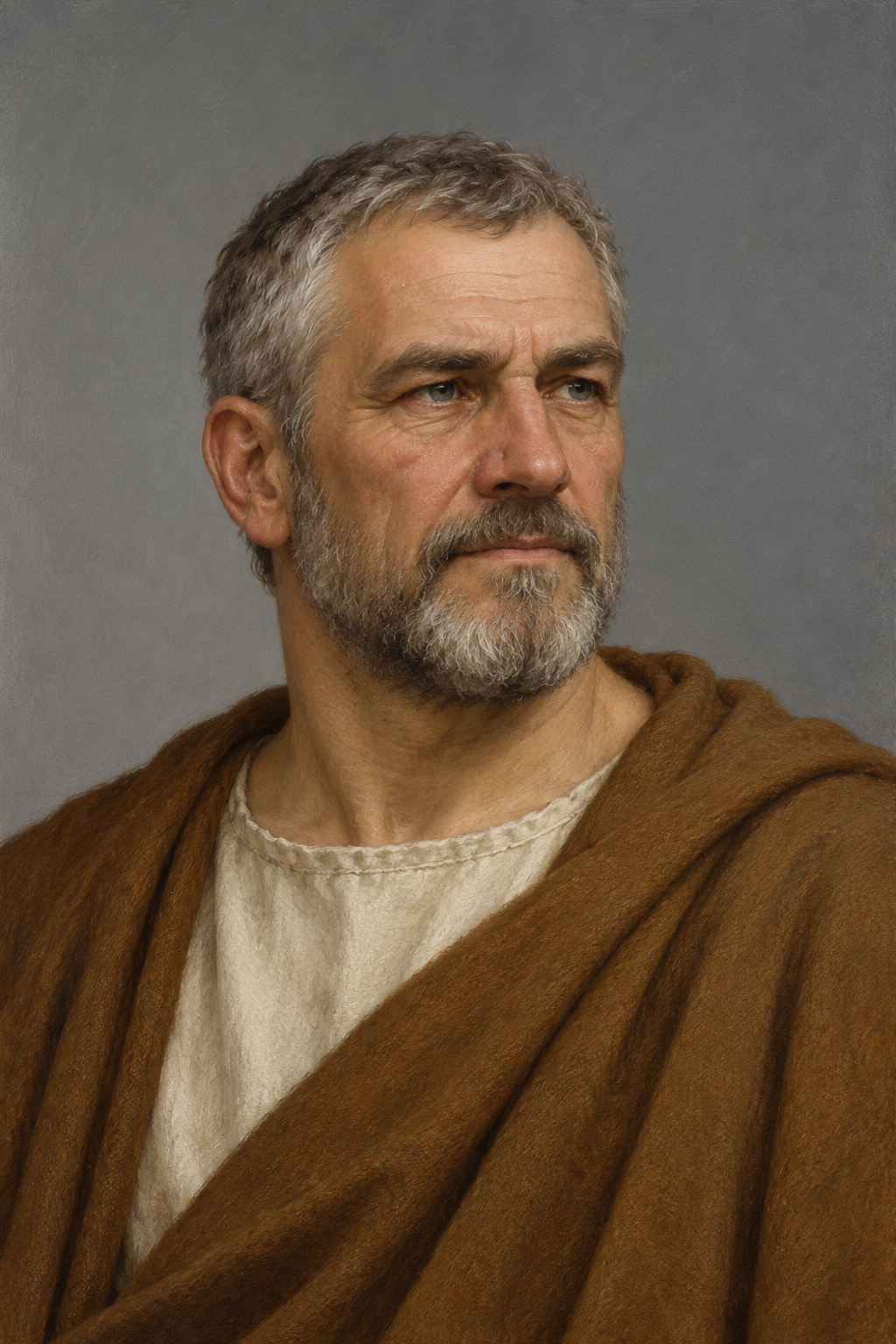
About Victricius of Rouen
Victricius was bishop of Rouen in the late fourth and early fifth centuries. Much of the account of his earlier life comes through letters of Paulinus of Nola. Paulinus describes a soldier who abandoned military service for Christ and endured punishment for his decision. The narrative includes miraculous deliverance, while its precise setting and date remain debated.
As bishop, Victricius worked among the peoples known as the Morini and Nervii. His relationships connected Rouen with Christian leaders elsewhere in Gaul and Italy. A letter addressed to him by Pope Innocent I in 404 discusses church discipline, including the recruitment and conduct of clergy. It offers evidence of practical concerns within his episcopal ministry, even though the circumstances of his journey to Rome are not fully clear.
Rouen also remembers him as the author of De laude sanctorum, a work associated with the reception of relics of Gervasius and Protasius. The text preserves an important part of his religious teaching.
This is his only known surviving work. Gillian Clark explains that it reached later readers in three manuscripts, attached to writings by Ambrose. That arrangement helped obscure its authorship, even though the text names Victricius and Rouen. Clark suggests that he may have sent Ambrose a written version in thanks for the relics, which then remained among the Milanese bishop’s papers. She explicitly treats this reconstruction as unprovable. The work also combines a welcome to the saints with demanding theological argument. Its movement between celebration and explanation has led scholars to ask whether an earlier sermon was joined to a separate discussion. The surviving text therefore offers a distinctive voice, but not a straightforward record of one occasion. One manuscript even listed the work as another book alongside Ambrose’s writings. A reader who noticed Victricius’s name proposed an alteration, illustrating how the manuscript setting could shape interpretation of its author. The accompanying writings concerned the Holy Spirit and the incarnation of the Lord.
For Victricius, the saints’ union with Christ explained why their remains mattered. As Rebecca Keller describes his teaching, their participation in divine life came through adoption and gift, rather than through being divine by nature. Their presence was not confined to a single place. He understood relics as bearing healing power and the saints as advocates for the living.
Scholars disagree over whether this teaching prompted Vigilantius’s criticism of relic devotion. Keller notes a competing explanation centered on Toulouse and Bishop Exuperius; a direct confrontation with Victricius cannot simply be assumed. Historian David Natal interprets the work’s discussion of relics and its account of a journey to Britain as connected arguments about Christian unity and legitimate authority. In this reading, the movement of holy remains helped Victricius explain Rouen’s place within a wider church.
Natal places these concerns within the tensions of the late Roman world. He reads the contrast between Britain and Italy as a way of describing the risks of isolation from the empire’s Christian centers. Connections with Ambrose, Paulinus, and Melania offered Victricius a wider circle of support. The ceremonial welcome given to relics could also recall the reception of an emperor. In Natal’s interpretation, this imagery supported unity across regions at a time when rival political loyalties divided Gallic elites. This is a historical reading of the bishop’s rhetoric, rather than a complete account of his journey or its results.
The physical setting is less certain. Olivier Chaline’s parish history distinguishes the church Victricius was building from an earlier sanctuary, while leaving their identification unresolved. Archaeological discoveries near the cathedral do not settle every question about where he received the relics. At Saint-Gervais, later paintings remember him carrying a church, an image of his place in Rouen’s Christian memory.
Luigi Lafasciano’s archaeological study helps explain the uncertainty. An excavated basilica beside the present cathedral had once been identified with Victricius’s building. Study of the coins instead placed its construction around the middle of the fourth century, earlier than the bishop’s recorded work. An adjoining courtyard was dated much nearer his time. Lafasciano therefore proposes that the new church lay beneath the present cathedral, linked to the older building by that courtyard. Its precise remains have not been established. He also suggests that the arrival of relics attracted visitors from surrounding regions and encouraged the enlargement of Rouen’s church complex. The suggested burial of relics beneath an altar remains a reconstruction, not an excavated discovery. These distinctions matter because the sermon describes a building project, while the material evidence preserves only parts of the setting in which it took shape. Coins and pottery also reveal Rouen’s connections across the Channel. Lafasciano uses these finds to place the bishop’s activities within an existing network of travel and exchange, rather than an isolated frontier settlement.
He is commemorated locally on 7 August under the French name Victrice.
Wondering how to weigh the stories and sources? Learn how to read a saint biography.