Biography
Bruno the Great
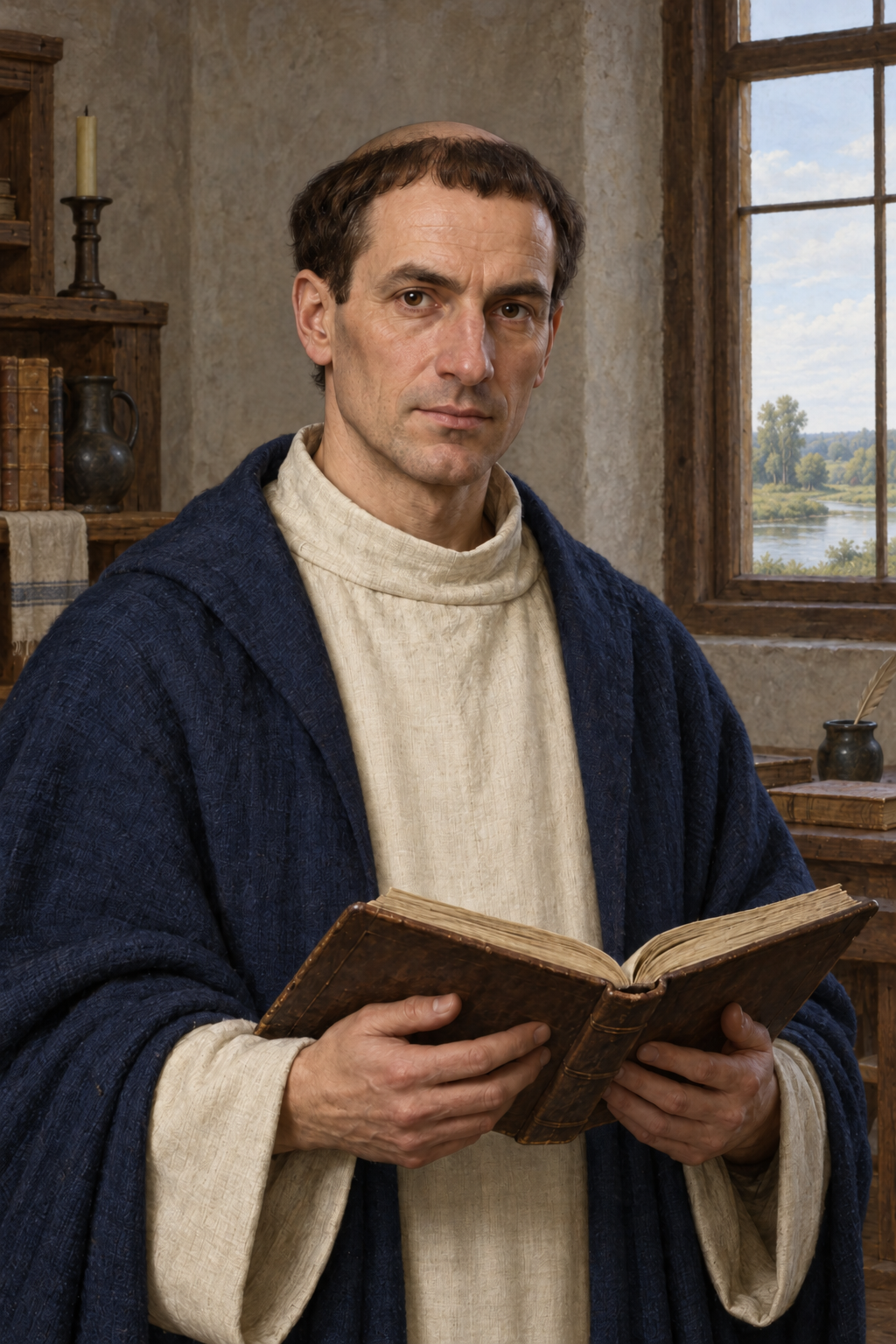
About Bruno the Great
Bruno the Great was a cleric whose life joined study, royal service and the government of a major church. The youngest son of Henry I and Mathilde, he was educated at Utrecht before entering the court of his brother Otto I. He became chancellor and later archchaplain. In 953 he was elected archbishop of Cologne and entrusted with authority in Lotharingia during a period of rebellion and conflict within the royal family.
Ruotger’s early biography gives particular attention to his learning. It remembers his enjoyment of Prudentius, his care for books and his willingness to learn from scholars with different backgrounds. Bruno appears as both a teacher and a student, improving the Latin expression of others while continuing his own studies. Books traveled with him when the royal court moved. The account treats religious reading and wider literary learning as connected parts of his vocation, rather than activities abandoned when administrative work became demanding.
Political responsibilities nevertheless shaped his episcopate. Oediger’s study describes attempts at reconciliation alongside armed interventions and difficult relations with powerful families. Bruno also reorganized religious communities and supported foundations, especially St Pantaleon. Some projects remained unfinished at his death, and changes imposed on existing communities could provoke resentment. His service cannot be reduced either to court administration or to an uninterrupted sequence of harmonious reforms.
Thomas Bauer examines the purpose of Ruotger’s account. Written at the request of Bruno’s successor, it presents spiritual and political duties as closely connected. Its repeated emphasis on peace is part of that construction. Bauer identifies an apologetic concern: the descriptions of penitence and attentive reading help defend a bishop whose public responsibilities could seem to compete with pastoral obligations. The work therefore preserves valuable information while also making an argument about what an exemplary bishop could be. Its relative lack of miracle stories distinguishes it from many conventional saints’ lives. These features encourage attention to how the narrative praises Bruno, as well as to the events it records. Bauer also observes that Ruotger does not explicitly call Bruno a saint, although the account presents him as exemplary.
Jarosław Sochacki’s study considers the military responsibilities that this favorable portrait can obscure. He distinguishes providing troops, directing campaigns and mediating disputes from personally taking part in combat. His comparison of sources finds substantial involvement in military affairs, extending beyond Cologne into Lotharingia and western politics. It does not justify depicting Bruno simply as an unarmed observer of every conflict. Nor does the evidence establish every detail of his personal conduct in battle. The study also questions attempts to divide his forces neatly into separate ecclesiastical and ducal contingents. In a career that combined both offices, sources do not always make that distinction. This assessment places his peacemaking efforts alongside the coercive power available to him, rather than treating the two as mutually exclusive. Sochacki also notes that historians dispute whether the so-called imperial church system was a deliberate creation of Otto I. Bruno’s offices cannot by themselves settle that wider question about kingship and episcopal service.
Bruno’s testament gives another view of the uses he intended for his resources. It directs that valuable church vessels remain in ecclesiastical service and names gifts for St Pantaleon, including funds for completing the cloister and enlarging the church. It also makes provision for a care institution near the monastery and assigns property to support it. Other bequests include money, cloth, vessels and support for religious houses and their communities, including St Gereon and St Severin. The document distinguishes gifts to altars from gifts to those serving in the churches. Its concrete provisions preserve more than a general reputation for generosity: they identify projects and continuing needs to which he wanted assets directed. As an instrument transmitted through the biography, it requires care about textual preservation, but it supplies a direct record of his stated intentions.
Ruotger describes his final journey toward Compiègne and his illness at Reims. Bruno arranged his testament, received the Eucharist and remained among bishops and companions during his final days. The narrative’s speeches express its religious understanding of dying; they are not verbatim transcripts. After his death, his body was returned to Cologne and buried at St Pantaleon according to his wishes. Visitors remembered his teaching and conduct, with Ruotger emphasizing the significance of his life rather than demanding signs at the grave.
Cologne Cathedral’s present historical account places the reading of Bruno’s testament among the important acts performed before the altar of Peter in the old cathedral. This remembrance connects his final provisions with the city’s ecclesiastical history. The archdiocese’s current calendar honors him as a saintly bishop on 11 October. His record remains distinctive for the conjunction of learning, family politics, episcopal government and concrete provisions for religious communities. It also retains the tensions that arose when a church leader exercised substantial secular authority.
Wondering how to weigh the stories and sources? Learn how to read a saint biography.