Biography
Vitus
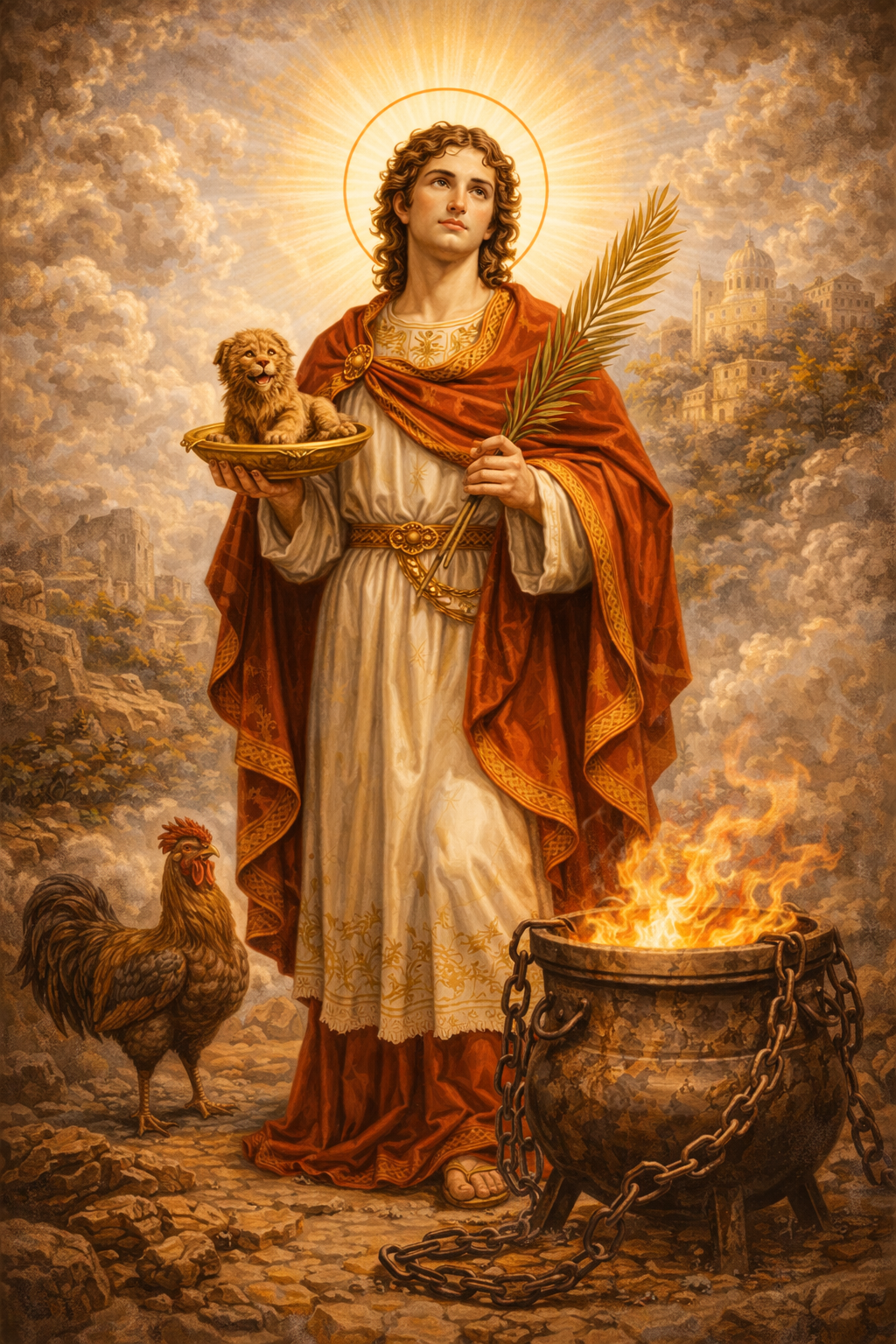
About Vitus
Vitus is remembered as an early Christian martyr, but the evidence preserves his cult more clearly than his life. His name appears with Modestus and Crescentia in the Martyrologium Hieronymianum, whose common fifth-century exemplar provides the earliest surviving witness to their veneration. Entries connect the group with Sicily and also name a Vitus among martyrs in Lucania, a Roman province of southern Italy. This is meaningful evidence that a martyr cult existed early. It does not reveal Vitus's family, age, occupation, education, words, or precise circumstances of death. A responsible biography therefore begins with an honored name and an early community of remembrance, not with the detailed childhood story that later generations supplied.
The catalog formerly dated Vitus's birth to 290 and death to 304, assigning January 1 to both. No cited source establishes those years, and the first day of January was merely placeholder precision. Those dates are removed. The association with persecution under Diocletian may preserve a genuine late-third- or early-fourth-century setting, but it comes through the later passion rather than a contemporary trial record. June 15 is securely documented as a day of commemoration in later calendars; it cannot be converted into the historical day of death. Historical restraint leaves the parent dates empty while explaining the broad traditional period in prose.
A developed passion portrays Vitus as the young son of a wealthy Sicilian pagan named Hylas. In that story, the Christian Modestus teaches him and Crescentia cares for him. Vitus accepts Christianity while still a boy, refuses his father's demands that he worship the gods, and withstands punishment and pressure. The narrative makes youthful conviction its central theme, but it was written too late to establish his noble birth, his father's name, his exact age, or private conversations in the household. Calling Vitus a child martyr is a strong received tradition. It should not become a claim that historians possess a childhood dossier.
The same legend sends Vitus away with Modestus and Crescentia after danger from his father and a local official. The OCA version says they find a boat, are guided by an angel, and reach Lucania, where they hide while Vitus heals sick people and attracts converts. These scenes connect all three saints as a small community of protection, teaching, and companionship. They also create a dramatic voyage that surviving early evidence cannot confirm. Sicily and Lucania may be named as regions within the tradition, but no route, landing place, travel date, or coordinate belongs on a historical map. The companionship itself remains traditional rather than documented biography.
Imperial episodes enlarge the passion further. Vitus is brought before Diocletian because the emperor's son is said to be tormented by a spirit. The boy heals him, yet refuses the reward of sacrificing to Roman gods. Authorities then torture Vitus and Modestus; Crescentia steps from the crowd, condemns the cruelty, and shares their suffering. Other versions add a furnace or a cauldron of boiling oil, a lion that will not attack, thunder, and shattered temples. These images shaped later art and devotion, but they are legendary motifs rather than corroborated proceedings. The violence should be acknowledged as coercion and bodily abuse without presenting an escalating catalog of torment as eyewitness history.
The received conclusion says an earthquake interrupts the torture and an angel returns the three companions to Lucania. Vitus prays for those who will keep their memory, and they die after their suffering. A woman named Florentia is added in Western versions as the person who finds and buries the bodies. None of these details supplies a verified execution site or medical account of death. What the legend consistently honors is refusal to purchase safety by abandoning faith and companionship maintained under threat. Those themes can inform virtues of steadfastness and solidarity, while the miracle, named burial witness, and exact sequence retain legendary confidence.
The growth of Vitus's cult is better documented. A shrine dedicated to him existed at Rome by the time of Pope Gelasius in the late fifth century, and Gregory the Great mentioned a Sicilian monastery bearing his name. A Roman deaconry chapel followed. These institutions show that veneration was established beyond one local community, although they do not verify the passion's narrative. In the eighth century relics said to be his reached Saint-Denis, and in 836 a translation to Corvey made that abbey an energetic center of devotion in German-speaking lands. Relic identity is traditional; the dates and institutional role in spreading the cult belong to reception history.
Medieval devotion counted Vitus among the Fourteen Holy Helpers, a group invoked during sickness and danger. He became associated especially with epilepsy, convulsive movement, and the condition once called Saint Vitus's dance. Communities also invoked him amid storms, animal bites, and threats to livestock. These patronages document how later people sought aid; they do not tell what Vitus did during life. The boiling vessel often shown beside him comes from the passion, not from an archaeological record of his death. Modern medical language should avoid turning a neurological disorder into a picturesque devotional label or implying that illness reflects deficient faith.
Vitus remains significant precisely because careful memory can hold conviction and uncertainty together. The secure record is spare: his name belonged to an early martyr cult, his feast entered medieval martyrologies, and communities across Europe built institutions and practices around his remembrance. The story of a courageous boy protected by Modestus and Crescentia is cherished tradition, not recoverable contemporary biography. Honoring him need not depend on asserting the furnace, lion, imperial healing, or angelic voyage as documented events. His legacy can instead direct attention toward young people facing coercion, companions who protect them, and communities that tell difficult stories without confusing devotion with proof.
Wondering how to weigh the stories and sources? Learn how to read a saint biography.