Biography
Vivian Mun Yeong-in
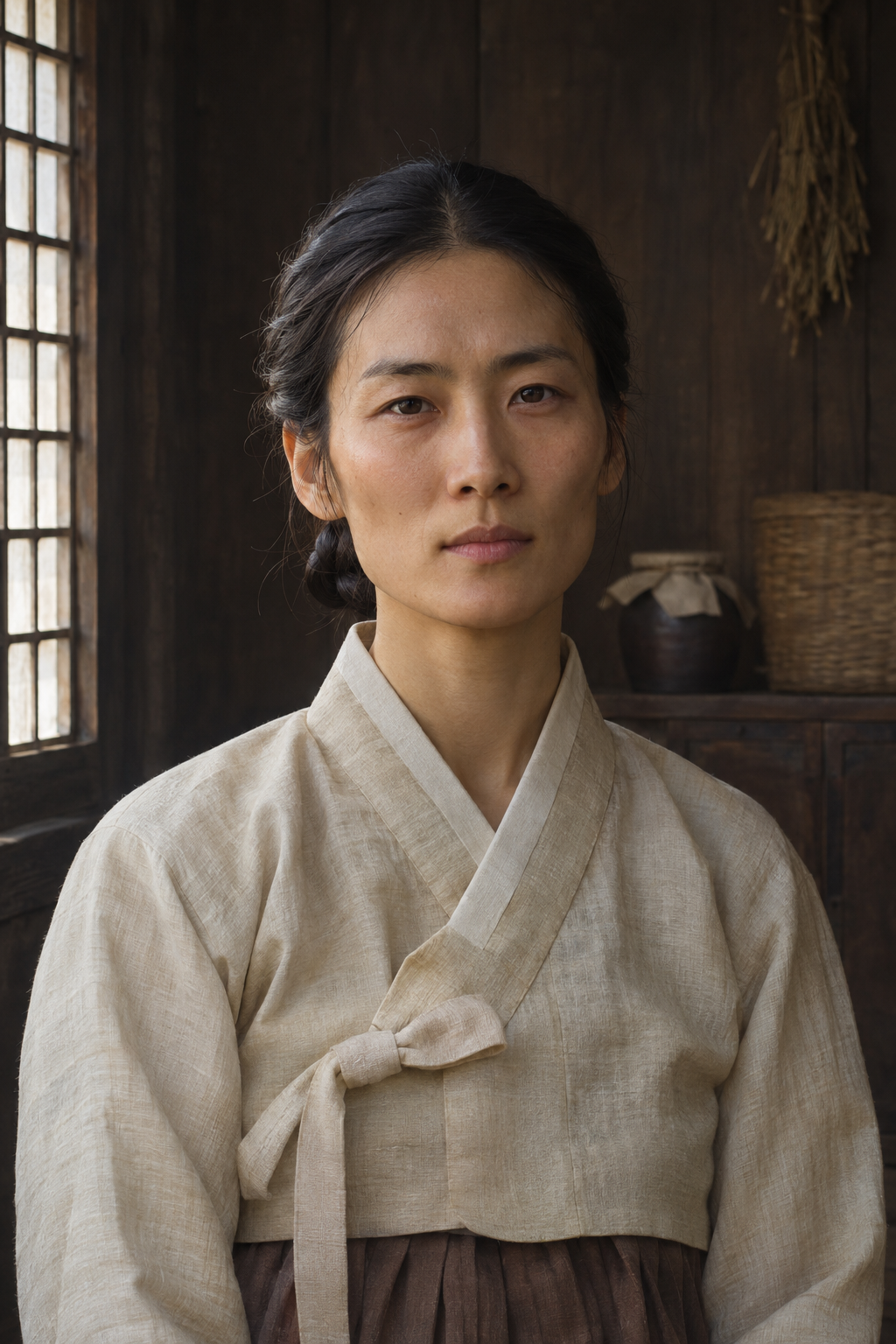
About Vivian Mun Yeong-in
Vivian Mun Yeong-in grew up within the royal household before becoming part of the small Catholic community around the priest James Zhou Wen-mo. She was born in Seoul in 1776, the third of five daughters in a family belonging to the jungin, or middle ranks. Her father held a minor government post. In 1783, officials selecting girls for palace service chose Vivian, then seven years old. The official biography recounts that her father had hidden her older sisters elsewhere, but had kept Vivian at home because of her youth. Her uncle also held a minor government position.
Her early palace education included court etiquette. Palace service shaped her education and work. She learned to write and was assigned to prepare documents. Cha Ki-jin’s biographical account describes her hair being put up according to palace custom when she was fifteen, even though she was unmarried. She spent her early years among the women of the palace, while her mother and older sisters were beginning to practice Catholicism outside it. When she visited home, they urged her to join them. Vivian answered that she would practice the faith when she eventually left the palace.
A serious illness brought that departure much earlier than an ordinary retirement. In 1797, she was allowed to leave the palace to recover at her family’s home. Bang Sang-geun’s account identifies an elderly thread seller who visited the house as the person from whom Vivian began learning Catholic teaching. She subsequently went to the home of Columba Gang Wan-suk for further instruction and, in 1798, received baptism from Zhou. Her new religious relationships therefore included both the older woman who first instructed her and the household that sheltered the priest. At baptism she received the name Vivian.
Later Catholic accounts describe an illness that did not follow a straightforward course: Vivian reportedly improved at home, but became unable to move when people from the palace arrived. Jeong Min recounts the visits of palace physicians and attendants and the return of her symptoms in their presence. After recovering, she returned to the palace. Religious duties were difficult there, but she continued to pray. In 1798, after her Catholic belief became known among the palace women, she was removed from palace service.
Once outside the palace, she could attend more closely to Catholic prayer and instruction. The official biography describes her reading the lives of saints and trying to follow their examples. Her relations with her family were also strained, and she rented a separate house in Cheongseok-dong. When Augustine Jeong Yak-jong moved to Seoul, Vivian allowed him to use that house. The arrangement placed her home at the disposal of a Catholic leader who needed accommodation in the capital. She sometimes expressed a wish to follow the saints to martyrdom for God’s glory.
She also traveled to Yanggeun to learn Catholic teaching from Jeong Yak-jong. Cha Ki-jin places these visits alongside her assistance to Gang Wan-suk, showing that her instruction involved more than the gatherings near her Seoul home.
Bang Sang-geun dates the loan of her house to 1800 and says it lasted two months, at Gang Wan-suk’s request. He also places Vivian alongside Kim Seom-a in service to Zhou. Kim Seom-a was the mother of the catechist Kim Seung-jeong.
Historian Kim Jeong-suk sees a connection between Vivian’s palace education and her later assistance to Zhou. She argues that training acquired within the royal household could be put to use in the women’s community around Gang Wan-suk, where the priest lived and worked.
Jeong Min’s account places Simon Hwang Il-gwang’s baptism in the Cheongseok-dong house occupied by Jeong Yak-jong. Hwang and his brother helped carry Jeong’s belongings there. Vivian’s house was too small for all of them to live together, so the brothers took lodgings in Jeong-dong. Her provision of a home formed one part of this practical network of accommodation.
During the 1801 persecution Zhou went into hiding elsewhere, and Vivian returned to her family’s home. Kim Jeong-suk recounts Kim Seom-a visiting Vivian and forgetting a piece of paper bearing prayers beneath a floor mat. Police subsequently discovered the paper and took Vivian into custody.
Taken to the Police Bureau, Vivian was subjected to severe punishment. She initially said that she would abandon Catholicism, but withdrew that statement and again professed her belief. After transfer to the Ministry of Justice, she maintained her position under further punishment.
The royal annals describe the accused Yeong-in as a former palace woman associated with Gang Wan-suk who had received baptism from Zhou. Officials recorded these relationships as evidence against her, alongside the cases of other Catholic prisoners.
Vivian was executed outside Seoul’s Small West Gate on July 2, 1801, with Gang Wan-suk and other Catholic prisoners. Cha’s account describes her speaking up when soldiers tried to push back the crowd on the way to the execution place.
Wondering how to weigh the stories and sources? Learn how to read a saint biography.