Biography
William of Gellone
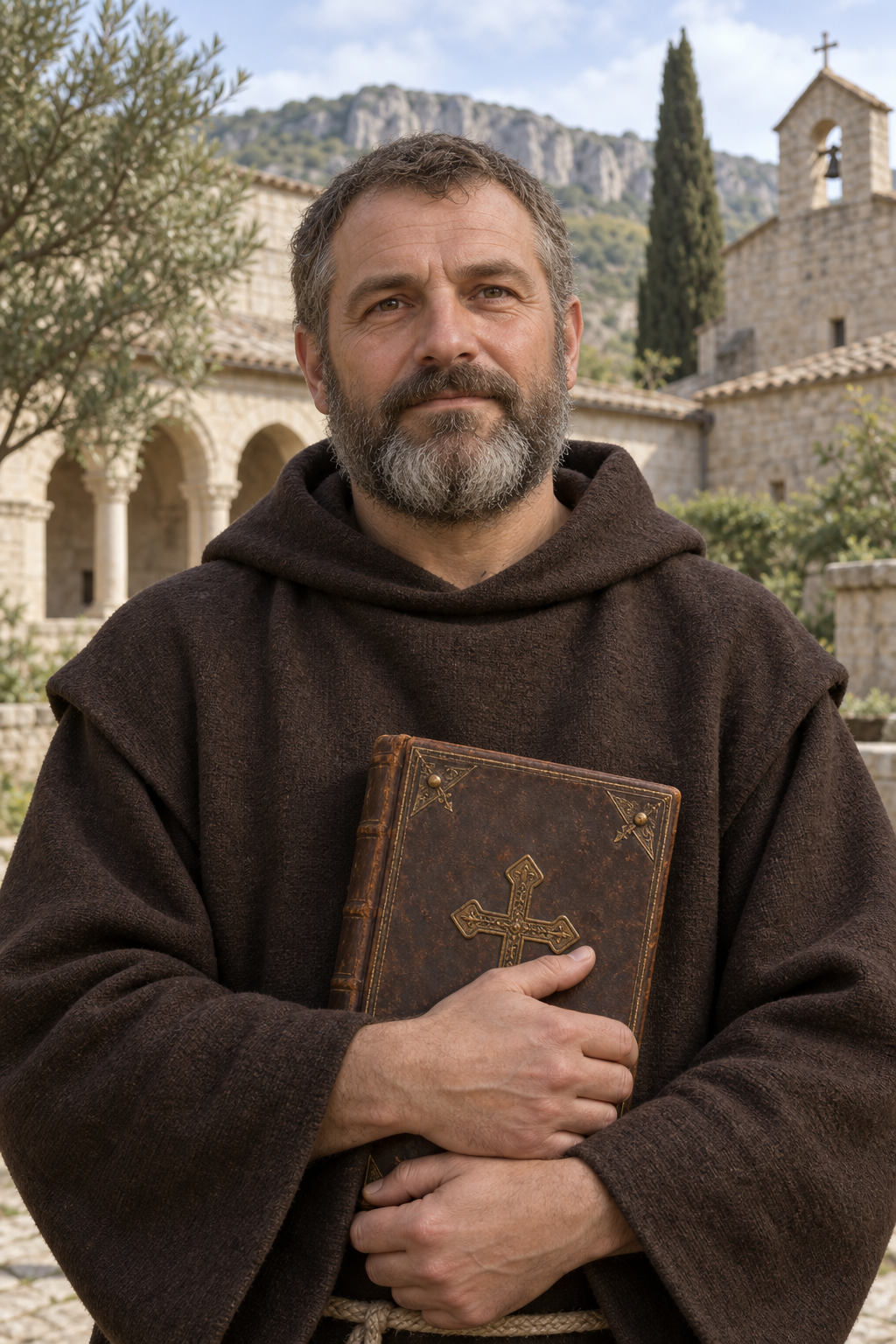
About William of Gellone
William of Gellone served Charlemagne as a count and later became a monk. His career joined military responsibility to the foundation of a Benedictine community. In 790 Charlemagne appointed him count of Toulouse. The monastery he endowed became the setting of his final years.
Larousse dates his birth to about 755 and his death at Gellone to 812. It remembers military service in Spain before his withdrawal to the monastery. The medieval poems about Guillaume d’Orange belong to his later literary reputation; they are not a reliable record of every battle, conversation or motive in his life.
William belonged to the Frankish aristocracy, a small circle of families entrusted with governing the Carolingian realm. His parents were Thierry and Aldana, although the precise family relationship linking him to Charlemagne remains disputed. His appointment at Toulouse followed the dismissal of Chorson, whose submission to a Basque leader had compromised his authority. The new count therefore entered a troubled frontier, not a settled hereditary possession. A count represented the ruler in matters of justice and military command. William’s campaigning did not bring uninterrupted success: in 793 his forces suffered defeat against a Muslim army in the region of the Aude. Michel Zimmermann places this fighting within a wider struggle over the southern frontier of the Frankish kingdom. Military service, local resistance and the demands of royal government formed the setting in which William first exercised responsibility.
At Barcelona, William took part in a campaign that ended in the city’s capture in 801. The account known as the Astronomer’s Life of Louis describes an army divided into three bodies. One remained with Louis, another besieged the city, and a third guarded against an approaching relief force. William appears among the leaders of that covering force, together with Hademar. When the relief army turned elsewhere, their soldiers joined the siege. The same account describes severe hunger inside Barcelona and the besiegers building shelters that signalled their willingness to remain through winter. The defenders eventually surrendered after Louis had joined the army. The narrative celebrates the royal victory, but its description also preserves the suffering of the people enclosed within the walls. William’s military reputation arose from warfare with consequences for civilians as well as for the rulers who contested the frontier.
The published historical outline dates William’s endowment of Gellone to 804 and his reception of the monastic habit to 806. It places his final years and death at Gellone.
The endowment was more than a promise to build: it provided resources for a community already taking shape. Pierre Chastang’s comparison of the surviving documents distinguishes the original gift from later rewritten versions. The document he identifies as the original is dated December 15, 804, rather than December 14. It describes a foundation made with Benedict of Aniane’s advice and help. Its provisions asked Benedict to support the brothers and supply what their resources lacked. Chastang interprets this arrangement as a practical guarantee of the new community’s survival. The familiar date of 806 for William’s monastic entry rests on later textual tradition; the earlier account does not establish the year. The endowment and his personal withdrawal should therefore remain distinct moments, rather than a single precisely dated conversion.
The Roman Martyrology notice reproduced by Nominis associates him with Benedict of Aniane. It remembers him choosing the ordinary position of a monk and accepting humble duties. This is the tradition’s clearest practical image of his religious life: a man who had held authority taking his place among other members of a community. His local Catholic commemoration is May 28.
William’s burial became a focus of devotion after his death. The historical outline published by Chédozeau discusses competing suggestions about the first resting place, rather than establishing an unquestionable location. It describes the later movement of the remains into the church and the growth of devotion around them. During the eleventh century, the church and monastic buildings were rebuilt on a larger scale in the Romanesque style. These changes belonged to later generations who cared for the community and its founder’s memory, not to buildings William himself necessarily knew.
The abbey stands at Saint-Guilhem-le-Désert in the Hérault valley. Its later history includes devotion at William’s tomb and the arrival of pilgrims. The present name recalls the Occitan form of his name, Guilhem, which became associated with the abbey in the twelfth century. The heritage account connects the rearrangement of his tomb with the need to receive growing numbers of visitors. Devotion to William was also associated with a relic of the Cross, traditionally said to have been given by Charlemagne. That account of the gift remains a tradition, not a verified episode of his career. At this site, his memory endured through a community, a shrine and the journeys of pilgrims long after his own travels had ended.
Wondering how to weigh the stories and sources? Learn how to read a saint biography.