Biography
William Pinchon
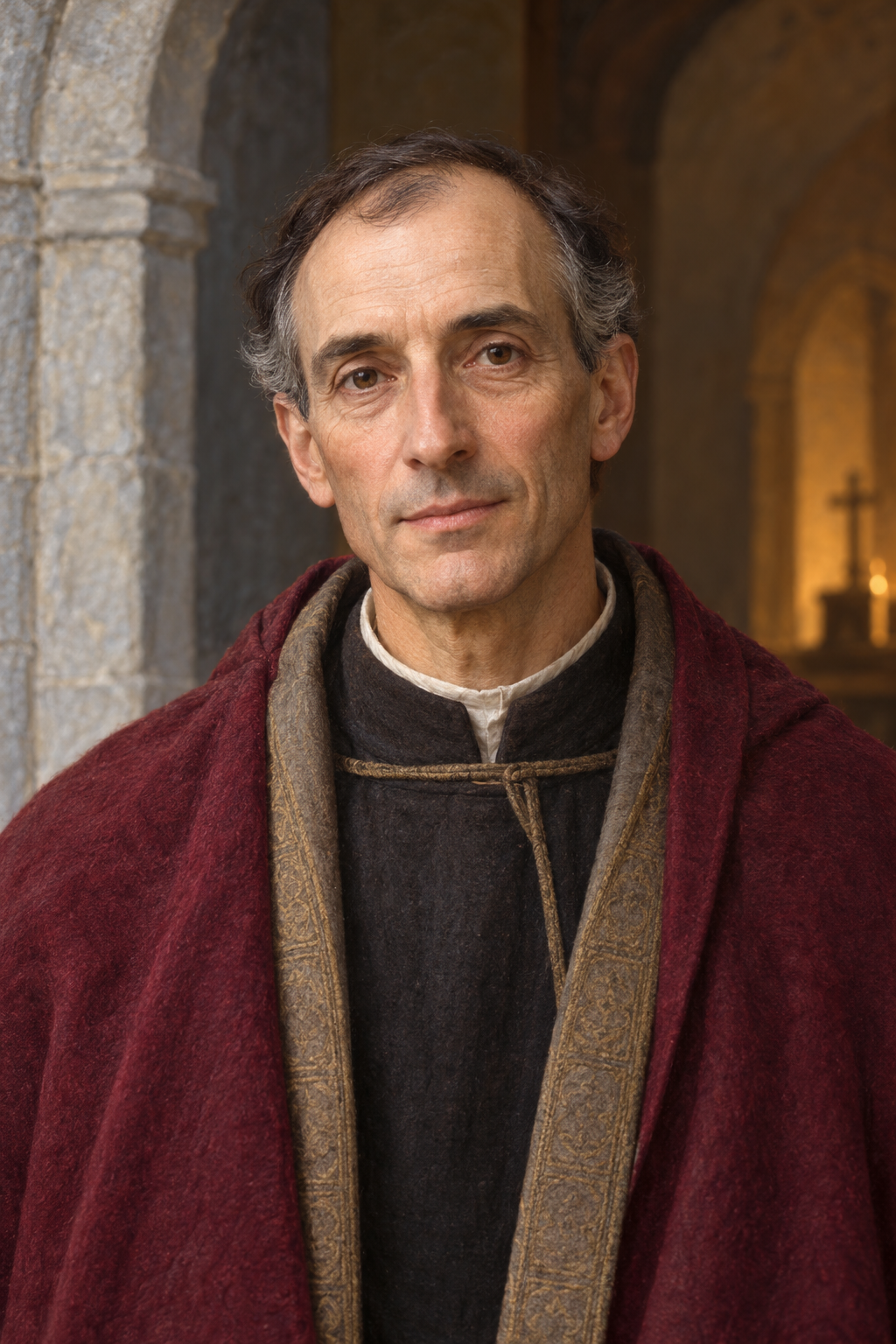
About William Pinchon
William Pinchon, known in French as Guillaume, was bishop of Saint-Brieuc from 1220 to 1234. The local parish history places his episcopate between those of Sylvestre Rolland and Philippe. It describes cathedral construction continuing in the Gothic style during all three episcopates. William’s work was therefore part of a building project that extended beyond his own lifetime.
Nominis remembers William’s defense of church rights against the duke of Brittany and the exile he endured. Its account of his charity draws on an older narrative associated with Albert Le Grand: during the famine of 1225, he fed people at his residence, borrowed grain when his stores ran out and sought bread around the city. These details express the received tradition of his care for the poor.
Francis Mershman’s account places William’s exile in Poitiers, where he reportedly assisted an ailing bishop, and dates his return to 1230. Mershman also reports that William’s relics were burned during the French Revolution.
The Poitiers story is disputed. André-Yves Bourgès finds no local corroboration and points instead to papal documents placing William in Rome during his conflict with the duke. He suggests that confusion with a similarly named ecclesiastical district may have produced the story. The exile itself is supported by papal evidence; service as an assistant bishop in Poitiers is not securely established.
Saint-Alban preserves a local tradition connecting him with Fleur d’Aulne. The municipal heritage account explicitly calls his birth there legendary, so the precise site should not be treated as established. It describes a later chapel erected in his memory on land acquired in 1875. A wooden oratory came first; construction of the present chapel began in 1937, was interrupted by the war and resumed afterward. The chapel was blessed in 1949. Its stained-glass scenes commemorate William as a cathedral builder and depict stories of his childhood and help during famine. These images are evidence of later devotion, rather than contemporary records of those episodes.
William died in 1234 and was canonized by Innocent IV on April 15, 1247. Nominis lists his local feast on July 29 and identifies him as secondary patron of the Diocese of Saint-Brieuc and Tréguier.
The early record has important limits. Bourgès describes the surviving life as a work of praise with little biographical detail, followed by eleven miracle accounts. Its prologue claims personal contact with William, but matches a life of Louis of Toulouse and cannot establish that the author knew him. Bourgès therefore dates the composition only between William’s canonization and the late fifteenth century. He also questions later accounts of his parents’ names and social standing. A detailed childhood narrative cannot responsibly be treated as established history.
The date of his commemoration is clearer than the exact day of his death. Ferdinand Duine’s study records July 29 in a medieval Vannes calendar, but also notes a July 28 entry elsewhere and asks whether the difference concerns death and burial. This suggestion remains a question, not a resolved chronology.
Wondering how to weigh the stories and sources? Learn how to read a saint biography.