Biography
Aibert
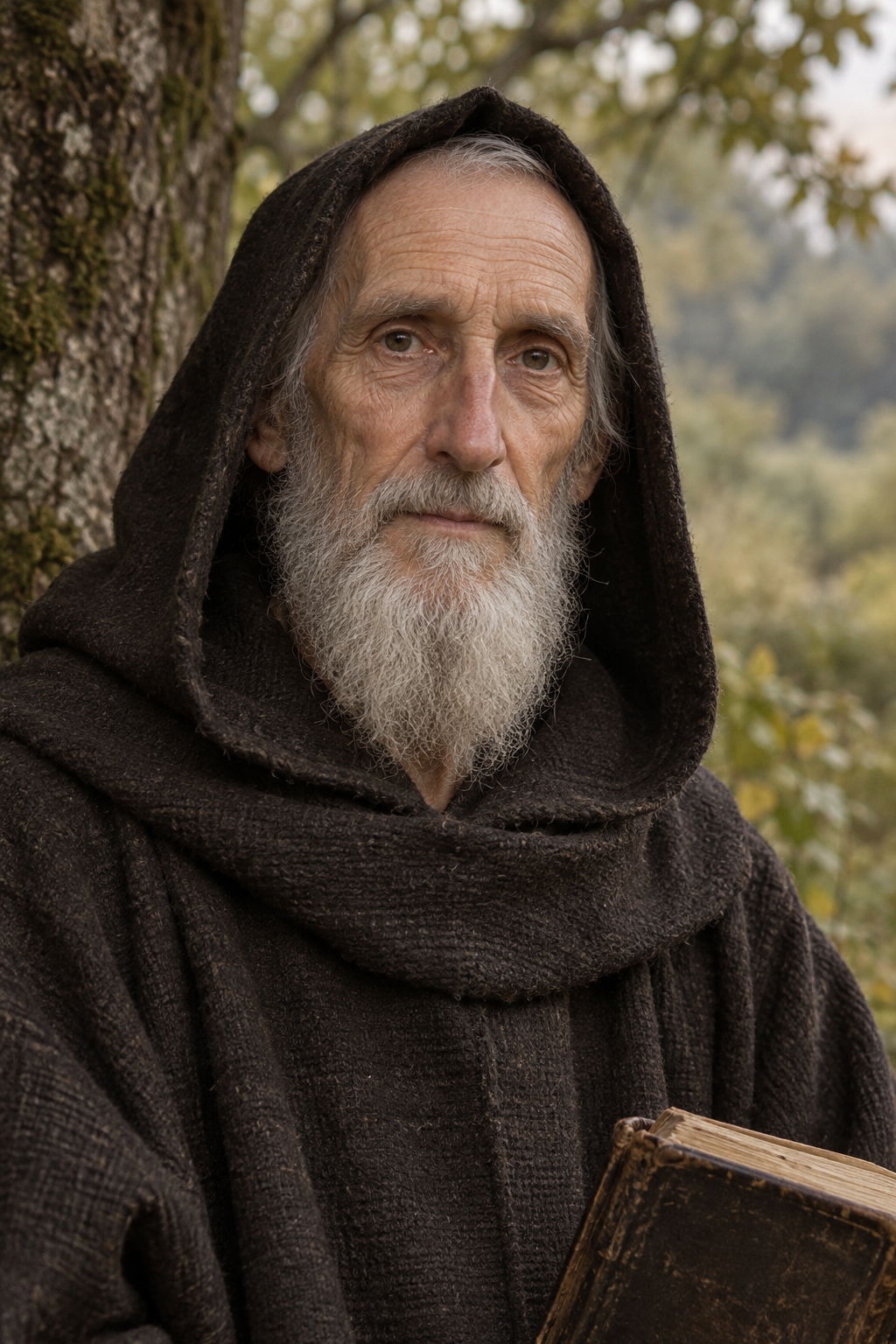
About Aibert
Aibert’s retreat near Crespin became a place where people came to confess their sins and ask for spiritual help. The diocese of Cambrai remembers him as a hermit who gave up a military career, became a priest and spent his final years in solitude.
He was born at Espain, near Tournai, around 1060. The Belgian national biography names his parents as Albalde, a man of arms, and Elvide. It describes a childhood inclination toward withdrawal and penitence, followed by a deliberate decision to leave his former life. His first companion was John, a monk of Crespin who had permission from his superiors to live in a small separate cell.
A received story gives a song an important place in that decision. A poor travelling singer came to his father’s home and sang about Theobald of Provins, whose hermit life Aibert then wanted to imitate. He joined John near the monastery, and the church account remembers the two living with severe simplicity, eating wild plants and rarely using a fire.
His vocation also took him beyond that first cell. The historian Jeroen Deploige recounts a journey to Vallombrosa in Tuscany before Aibert became a Benedictine at Crespin. In this account he spent about twenty-five years in the community before returning to his original desire for a hermit’s life. The Belgian national biography also recalls a pilgrimage to Rome before his admission to the monastery. According to Lefebvre, John and Aibert remained in their first retreat for twenty years before joining the abbot on the pilgrimage to Rome; that duration belongs to the received account.
The responsibilities he accepted at Crespin were practical as well as devotional. Alban Butler’s account says that he took the monastic habit under Abbot Rainer and served as provost and cellarer. That same narrative remembers him sleeping on the ground and reciting the psalms before the community’s night prayer. The author presents his work in office as compatible with continued prayer and penitence, rather than as an interruption of them.
Later, with Abbot Lambert’s permission, Aibert returned to a separate cell while remaining attached to the monastery. Butler describes the place as a wilderness and remembers a restricted diet of bread and herbs. This was a return to solitude, but people increasingly came to him for guidance.
Bishop Burchard of Cambrai ordained him first as a deacon and then as a priest. Deploige explains the decision in connection with his growing popularity among laypeople. The Life therefore preserves a hermit whose ministry was connected to church authority even when his chosen dwelling was apart from the community. The bishop also provided a chapel at the cell, where the received account says Aibert could hear confessions and administer the Eucharist. Deploige dates Robert of Ostrevent’s writing of the Life to the 1140s, preserving the narrative of these ties between the recluse and the wider church.
His later reputation extended beyond ordinary visitors. Charles Lefebvre’s Bibliotheca Sanctorum account lists bishops, archdeacons, abbots, learned people and nobles among those who visited him. It also reports privileges from Popes Paschal II and Innocent II, and a popular devotion so eager that people took pieces of his clothing as relics.
Prayer remained central to the way he was remembered. The Norwegian church biography reports two daily celebrations of Mass, one for the living and another for the dead. It also connects him with repeated Marian prayer, while noting that this practice belongs to the historical discussion of the rosary’s development.
The chronicle of Anchin gives a more complicated picture of the crowds around his cell. Its entry for 1134 says that Aibert’s chapel was completed and blessed by the bishop of Cambrai, attracting visitors from many places. It also recalls opposition from the archbishop of Reims and other church leaders toward the many people who were seeking to see him. They sent Absalon, abbot of Saint-Amand, and Parvinus, abbot of the Holy Sepulchre, to examine whether his holiness matched his reputation. According to the chronicler, the investigators found him holy and returned praising God. The same chronicle places his death in 1135, on Easter, during his twenty-fifth year of reclusion. This differs from the later biography that places his death around 1140, leaving the exact chronology unsettled.
The received biographies place his death on 7 April, usually around 1140. The Belgian national biography says that the abbots of Crespin and Saint-Amand buried him in his cell and that his body was later transferred to Crespin. It identifies his biographer as Robert, archdeacon of Ostrevent, who had known him well.
Lefebvre traces later care for the remains through new reliquaries in 1303 and 1464. His account says they were hidden for two years during religious conflict and placed in a chapel in 1568. These are later accounts of his cult, distinct from the events of the early Life.
The diocese of Cambrai still provides liturgical material for his memorial, preserving the memory of a solitary priest whose cell became a place of confession and spiritual care.
Wondering how to weigh the stories and sources? Learn how to read a saint biography.