Biography
Albert Joubert
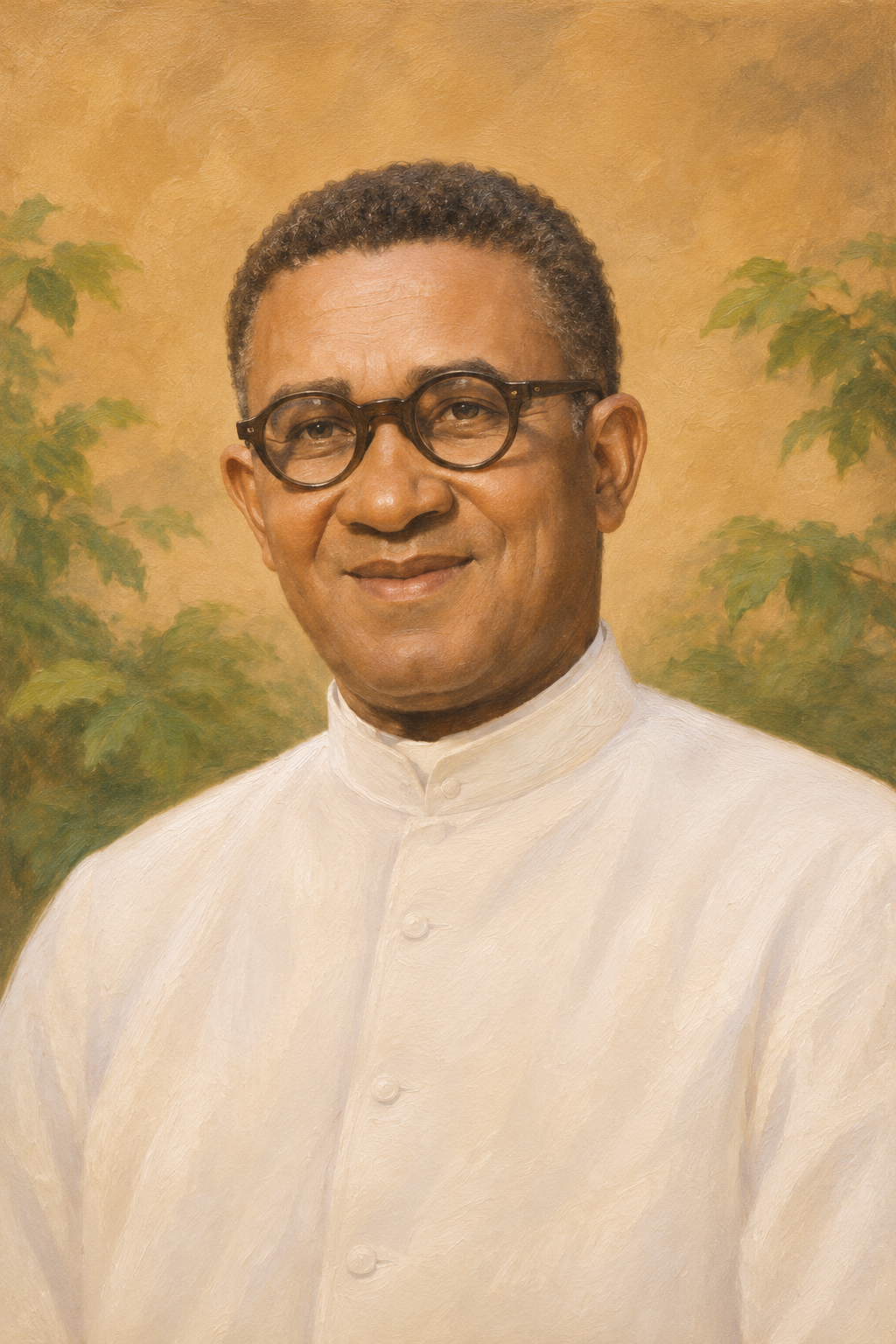
About Albert Joubert
Albert Joubert served Congolese communities as a diocesan priest, teacher and school director. His assignments included Kasongo, Kala, Lusaka, Moyo, Kabambare, Kibangula and Mungombe. He was ordained on 6 October 1935 and spent nearly three decades in these varied responsibilities. His place within the Church changed as new jurisdictions were formed: he belonged successively to the clergy of the Haut-Congo vicariate, Kasongo and Uvira. These changes reflected the development of the local Church as well as his own appointments.
Albert was born at Saint-Louis de Mrumbi in 1908. Reproductions of his father’s diary and the baptism register support 21 November as his birth date and baptism the following day.
His father, Léopold-Louis Joubert, was French, and his mother, Agnès Atakaye, was Congolese. He was the ninth of their ten children.
The surviving record includes Albert’s own request for admission to the major seminary in 1925. After probation at Lusaka, he asked permission to continue his preparation and promised attention to his studies and obedience to his superiors. Reports from his teachers noted his ability in music and practical work, while some also criticized his sensitivity and independence. They supported his admission without presenting him as already beyond correction. During his later preparation for ordination he taught at Lusaka. Martin Kiwele, one of his former pupils, recalled his clear teaching and patience in helping the class prepare to advance. This recollection, recorded many decades afterward, gives a personal view of his work as a teacher.
In 1964 he was at Kibanga. Arrested with Thomas Maliyabwana, he was taken to Fizi and later released. Thomas returned to Kibanga before escaping to Burundi; Albert remained at Fizi with Giovanni Didonè. Researcher Faustino Turco treats his reasons cautiously, suggesting both the protection available there and the need to help Didonè. The evidence does not establish a single private motive for that decision.
Joubert and Didonè were killed at Fizi on 28 November 1964.
Giuseppe Dovigo’s later account interprets Joubert’s life through fraternity. It emphasizes his willingness to serve in different communities and to share life with priests from different backgrounds. Dovigo connects this openness with Joubert’s own family, while presenting it as a Christian commitment rather than merely a consequence of ancestry. His account also challenges a remembrance focused only on prominent construction projects: Joubert’s significance lay in service, relationships and the responsibilities entrusted to him. This is a later spiritual reading of his life, not a record of words Joubert used to describe himself.
Recovering that life required work beyond the records of his Italian companions. Guglielmo Camera, who prepared a biography for the cause, explained that he initially lacked adequate documentation about Joubert. Living in Italy, he needed help from someone able to research in Congo. Turco accepted that task and consulted archives in several dioceses with the cooperation of their bishops. Camera acknowledged that this research made his own biography possible. In his introduction he presented Joubert as a model of fraternity across ethnic and cultural divisions, especially in his companionship with Didonè. The distinction between the archival evidence and this interpretation remains important to a careful account.
Joubert was beatified on 18 August 2024.
Louis Birabaluge, a Congolese Xaverian present at the ceremony, later described his own changing response to the cause. He had initially questioned whether the deaths should be understood as martyrdom. Translating a biography and reading the missionaries’ writings helped him understand the choices behind their service. His reflection did not invite others to seek violent death. He acknowledged his fear of that prospect and focused instead on forms of faithfulness possible in ordinary life: learning a language, sharing meals, visiting sick people and remaining attentive to a community. His account shows how the remembrance of Joubert and his companions entered the reflection of a later generation of Congolese missionaries.
Commemoration also developed in places connected with Joubert’s family and ministry. A parish in the Pays d’Ancenis took the name of Blessed Albert and his companions. Its explanation points to his father’s roots at Saint-Herblon and his grandparents’ home at Mésanger. This family connection gives the French parish a particular link with a priest whose own life was spent in Congo.
In June 2026, the Church at Kasongo received his relics for veneration in its cathedral. Reporting the ceremony, Antoine Grâce Matenda explained that the bishop connected this honor with Joubert’s service in the region. The relics were placed in a cathedral pillar where people could see and venerate them. The report also records the bishop’s concern that they be protected from desecration. This local remembrance returned attention to communities that Joubert had served before his final months at Fizi. The ceremony took place on the day the Church commemorated the Ugandan martyrs, linking these local memories.
The Xaverian calendar commemorates Blessed Albert Joubert and his companions on 28 November.
Wondering how to weigh the stories and sources? Learn how to read a saint biography.