Biography
Alberto Hurtado Cruchaga
About Alberto Hurtado Cruchaga
Alberto Hurtado Cruchaga was born at Viña del Mar, Chile, on January 22, 1901. The says he lost his father at the age of four and that his mother had to sell the family's modest property to pay debts. Alberto and his brother then lived with relatives and moved from one house to another.
This early instability should shape the biography. The source explicitly says he experienced from childhood what it meant to be poor, without a home, and at the mercy of others. That does not need sentimental expansion. It explains why his later concern for homeless people was not abstract social theory but a memory-informed Christian response.
A scholarship allowed him to attend the Jesuit college in Santiago. There he joined the Marian Congregation and began visiting poor neighborhoods on Sunday afternoons. After secondary studies he wished to become a Jesuit, but delayed in order to support his mother and younger brother. He worked while studying law at the Catholic University.
After military service and graduation, Hurtado entered the Society of Jesus at Chillán on August 14, 1923. His formation took him to Córdoba, Spain, Belgium, and Leuven. The Dicastery profile says he was ordained a priest at Leuven on August 24, 1933, and later earned a doctorate in pedagogy and psychology.
The international formation route is worth naming because it explains the educational and social vocabulary of his later ministry. Hurtado was not only a charitable organizer. He was trained as a Jesuit priest, educator, and thinker, and the official source connects his academic formation with the teaching, writing, and lay formation he undertook after returning to Chile.
He returned to Chile in January 1936. His apostolate widened through teaching religion at Colegio San Ignacio, pedagogy at the Catholic University of Santiago, seminary teaching, retreats, spiritual direction, and the formation of lay people. The profile should present him as a Jesuit educator and spiritual director before moving to his better-known charitable foundation.
The student apostolate also matters. The Dicastery profile says he directed the Marian Congregation of students and involved them in catechesis among the poor. This gives a bridge between his early Sunday visits to poor neighborhoods and his mature public initiatives. Hurtado formed collaborators, not only projects, and that theme should carry through the biography.
In 1941 Hurtado's book about whether Chile was a Catholic country stirred public discussion, according to the official biography. The page can mention his social and educational writing without reproducing polemics or adding unsupported interpretation. The safe point is that his priestly work included public reflection on Christian social responsibility.
That public reflection should be worded carefully. The source presents him as active in many fields, but the profile does not need to adjudicate every controversy or summarize Chilean politics. It can say that he wrote about education and Christian social order, and that his pastoral charity included a strong sense of social justice rooted in Catholic teaching.
In October 1944, while giving retreats, Hurtado appealed to listeners to think of the poor of the city, especially children wandering the streets of Santiago. The response led to Hogar de Cristo. The Dicastery describes it as a work that gave homeless people not only a place to live but a true domestic hearth.
The public page should not use current Hogar de Cristo statistics unless they are freshly verified in a separate source. For this packet, the historical fact is enough: Hurtado opened houses first for children, then for women, then for men, with lay collaborators and benefactors. Later forms included rehabilitation and craft education, all described as inspired by Christian values.
His final years also included organized social action. In 1947 he founded the Chilean Trade Union Association, ASICH, to promote unionism inspired by Catholic social teaching. Between 1947 and 1950 he wrote books on unions, social humanism, and Christian social order. In 1951 he began Mensaje, the Chilean Jesuit review devoted to explaining Church teaching.
These final initiatives show why the profile should not reduce him to one charitable institution. Hogar de Cristo, ASICH, social writing, and Mensaje all belong to the same priestly concern: that Christian faith should become concrete in homes, work, civic responsibility, and the formation of conscience. The page can hold those together without adding unsourced modern outcomes.
Cancer of the pancreas brought his life to an end within months. The Dicastery source says he died on August 18, 1952, after spending his life manifesting Christ's love to the poor. It also records the August 13 liturgical memorial, beatification by John Paul II on October 16, 1994, and canonization by Benedict XVI on October 23, 2005.
The existing record's blank death place should remain blank until separately verified. The source supports Chilean context and the date of death, but this packet does not add a precise place. That restraint fits the whole profile: strong on sourced life events, careful with fields the official page does not state clearly.
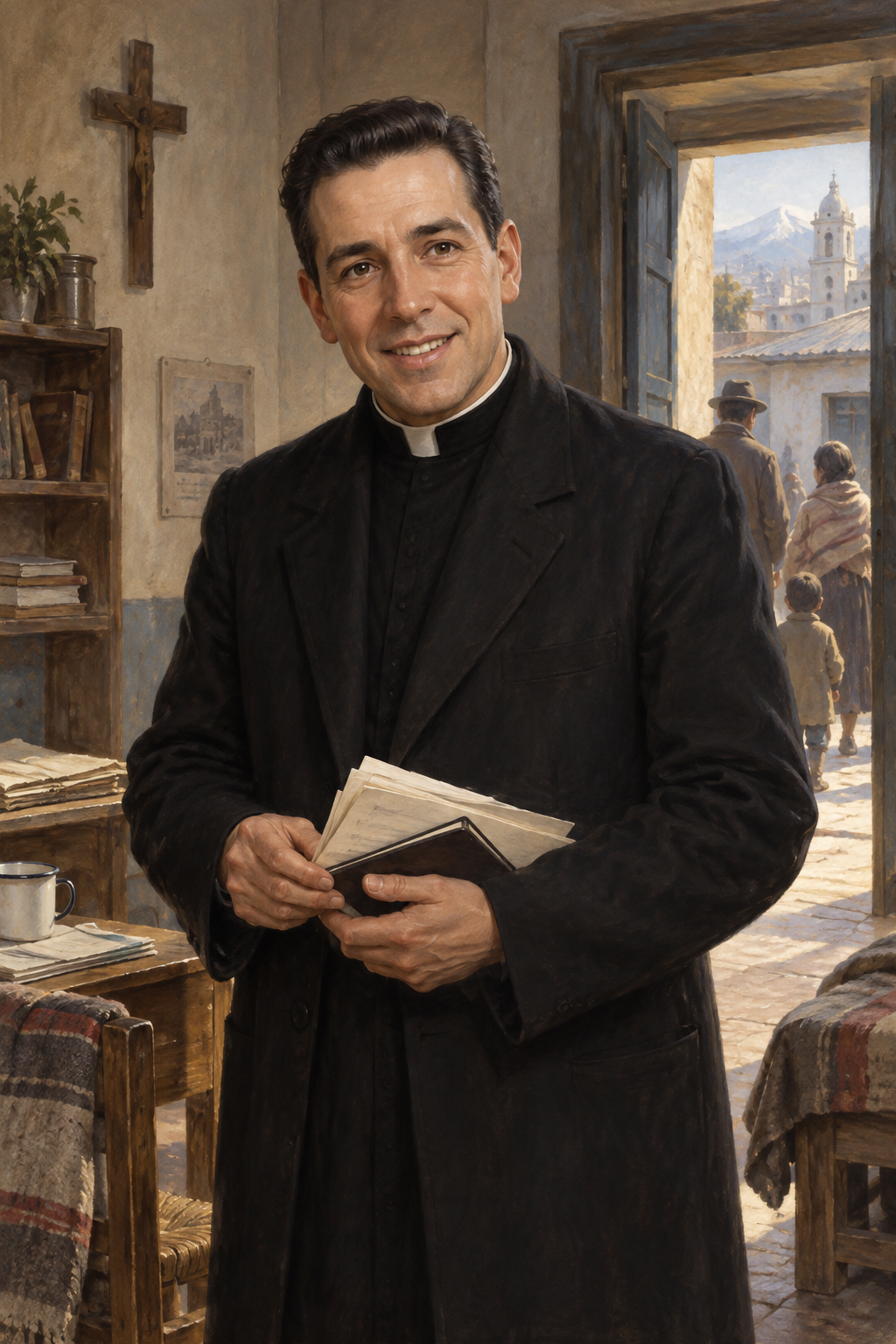
Artwork should show a Chilean Jesuit priest with papers or a notebook in a simple shelter or study setting. A doorway suggesting welcome is appropriate, but modern branding, current institutional logos, contemporary vehicles, or sentimental poverty spectacle would overstate the historical evidence and shift attention away from Hurtado's priestly social charity.
Wondering how to weigh the stories and sources? Learn how to read a saint biography.