Biography
Alonso de Orozco
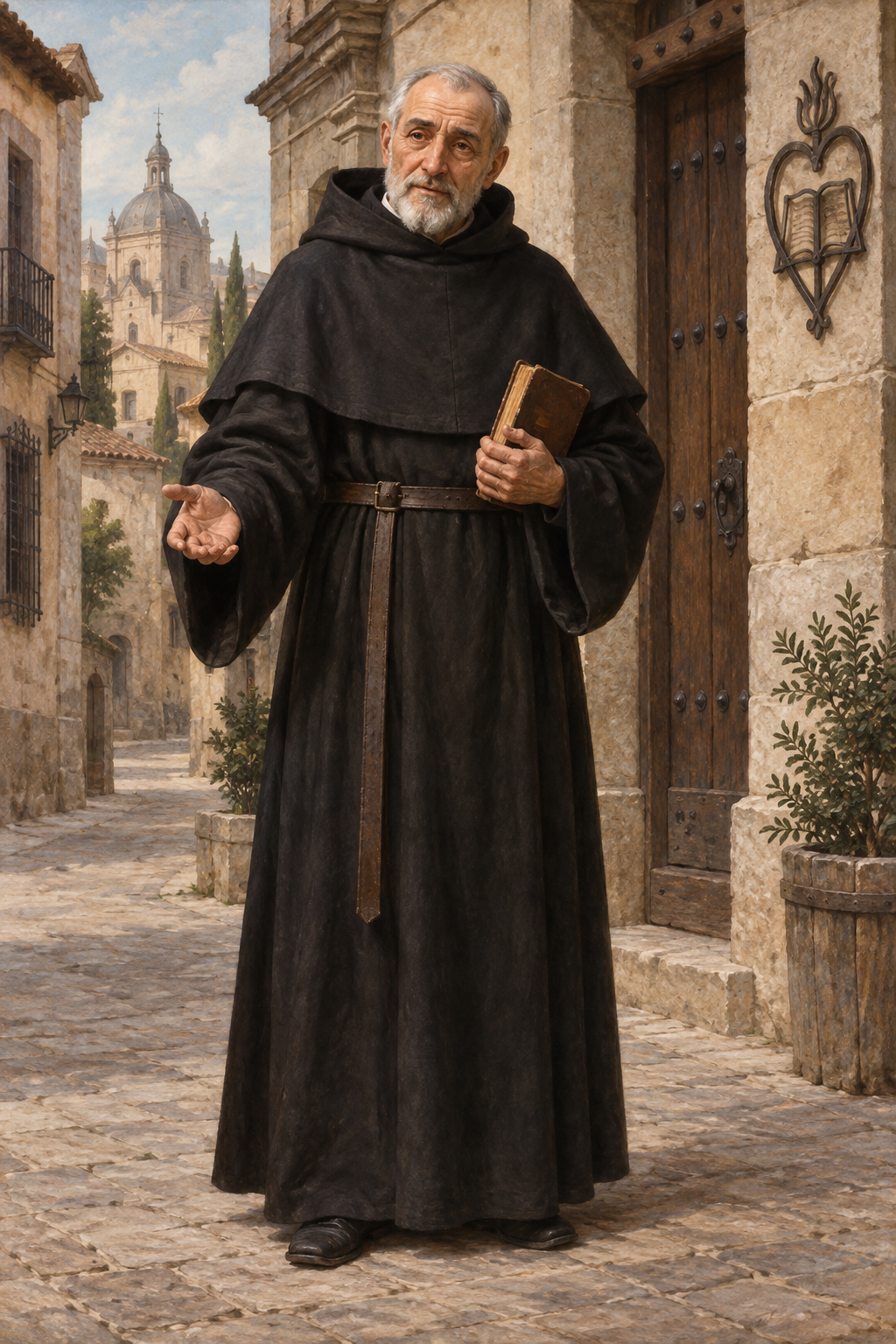
About Alonso de Orozco
Alonso de Orozco was born on 17 October 1500 in Oropesa, where his father Hernando was responsible for the castle. His mother was María de Mena. The Spanish national archive identifies him as an Augustinian friar and royal preacher, but his later court position was not the beginning of his education. The family moved to Talavera while he was young, and he served in a local church. He then sang in the cathedral choir at Toledo before going to Salamanca for university study. The sequence matters: music, liturgy and formal learning preceded the books and sermons by which many later readers knew him.
At Salamanca, Orozco studied arts and law while his brother Francisco also lived in the city. Historian Miguel Ángel Orcasitas Gómez draws on Orozco's autobiographical *Confesiones de este pecador* to explain what can be known about the family and early vocation. The source is valuable as his own later recollection, yet it is not a diary written by the boy in Oropesa. He describes a path from education toward religious life rather than a sudden abandonment of learning. Salamanca's academic setting and the Augustinian convent stood near one another in that story. Orozco would later use both the discipline of study and the language of prayer in his ministry.
The Augustinian order recalls that the preaching of Thomas of Villanova drew Alonso and Francisco toward the community. Both entered the novitiate in 1522. Alonso professed on 9 June 1523; Francisco was prevented by illness and died soon afterward. This was a personal loss early in Alonso's religious life. Later accounts give the brother's death a spiritual meaning, but vocation was lived inside a family and a community. Orozco remained in the order, eventually taking responsibility for preaching and houses whose members depended on him.
Ordained a priest in 1527, he served as a preacher and in leadership roles. An Augustinian study recounts an attempted voyage to Mexico that ended when illness stopped him before reaching the Americas. Sources give 1547, 1548 or 1549 for the voyage, so the exact year is left out here. The failed journey changed the geography of his ministry. Instead of narrating a mission he did not carry out, the evidence follows his subsequent work in Spanish communities. His experience also cautions against treating a proposed destination as proof of service in that place.
In 1554 Charles V named Orozco royal preacher while he was prior at Valladolid. He followed the court to Madrid in 1561 and lived at the Augustinian house of San Felipe el Real. The Augustinian Recollect study describes the court role as both a constraint and an opportunity. Appointment gave him a public audience and access to powerful households, but it did not remove him from religious community. Preaching and counsel to individuals were part of the same office. Later praise of his humility should be read alongside the real influence attached to a royal appointment.
The Augustinian memorial depicts Orozco as a friar who kept a simple life while serving at court. It says he sought out poor residents, sick people and prisoners. These visits connect his preaching to situations far from the royal household. His writings also aimed at ordinary readers: the memorial notes his use of Castilian for instruction on prayer and contemplation, alongside Latin works. This choice made some spiritual teaching available beyond a narrow learned audience. His religious commitments were therefore expressed in speech, print and personal visits, rather than in a single courtly role.
The Madrid archdiocese's 2002 account identifies the houses associated with Orozco's foundation work: communities of Augustinian women and the Colegio de la Encarnación, also known as the college of Doña María de Aragón. The latter site later became the Spanish Senate building. A foundation is more than a name in a list; it required land, patrons, residents and a continuing purpose. The diocesan text presents these institutions alongside his visits to people in need. Its retrospective praise is an interpretation written at the time of canonization, while the named communities and sites are concrete parts of his Madrid career.
His output as an author can be checked through surviving book records. The Biblioteca Virtual Miguel de Cervantes catalogs a collected volume printed in Valladolid in 1554 and another in Alcalá de Henares in 1570. It also records Latin sermons printed in 1568 and 1573. These entries establish circulation in different years and cities without requiring an uncertain lifetime count of books. Some titles focus on prayer and the Augustinian tradition; others are organized for preaching on feasts. The presence of both Castilian and Latin volumes shows the range of readers he addressed. It also lets the manuscripts and editions, rather than later admiration alone, anchor his literary reputation.
Orozco died in Madrid on 19 September 1591 at the Colegio de la Encarnación. The Spanish Augustinians associate the college with his work and identify its present building with the Senate. Death at a community he had helped establish locates the last phase of his life, although the buildings changed later. Accounts of crowds after his death describe the public reputation he had acquired. Such accounts are evidence of reception, not proof of every claim attached to him. His books and communities outlived their founder and gave later generations ways to remember the royal preacher apart from the court.
Leo XIII beatified Orozco on 15 January 1882, and John Paul II canonized him on 19 May 2002. His Catholic memorial is 19 September.
Wondering how to weigh the stories and sources? Learn how to read a saint biography.