Biography
Alcuin of York
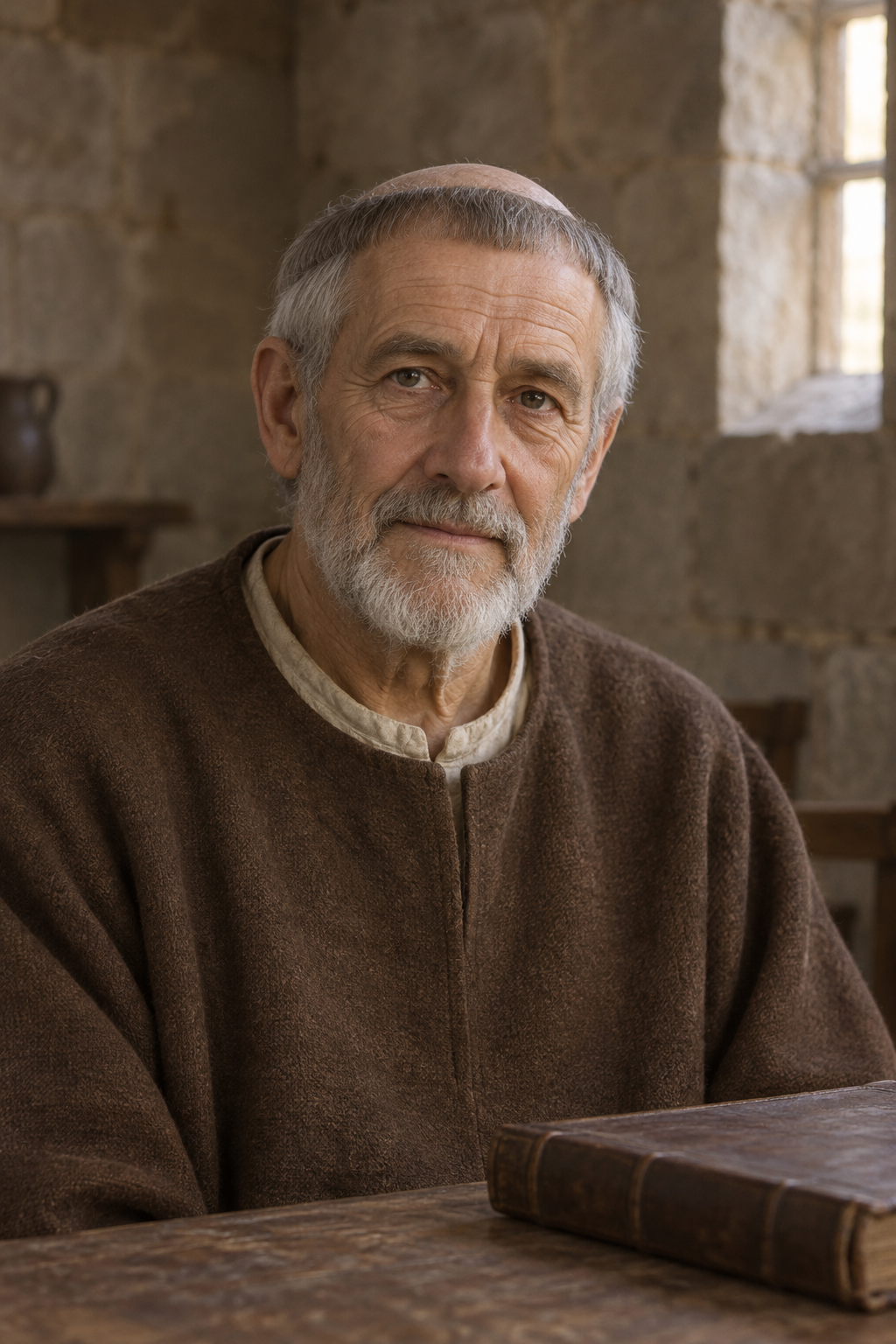
About Alcuin of York
Alcuin of York was a deacon, teacher and writer whose work connected the learning of Northumbria with Charlemagne’s court and the monastery of Saint Martin at Tours. Born about 735, he studied at York and later taught there. A meeting with Charlemagne at Parma brought him into the king’s circle. He moved to the Frankish court in the early 780s, teaching the royal household and participating in its wider educational work. His influence came through teaching, correspondence and the books he helped others study.
His clerical identity needs some care. He was a deacon, but whether he later became a priest is uncertain. His appointment as an abbot does not settle the disputed question of whether he had taken monastic vows. He became abbot at Tours in 796 and died there on 19 May 804. These distinctions preserve what is known without turning every office he held into evidence for a religious profession.
York’s library helped shape the world in which he learned to teach. In a poem about York, Alcuin named authors whose writings belonged to the collection. Mary Garrison’s account of the library emphasizes a significant limit: no surviving book can be proved to have come from it. Its contents and importance can be studied through the written evidence, but the books themselves cannot simply be pointed out in a modern collection. The loss of the library leaves room for research rather than a complete reconstruction.
The same institutional account describes his continuing work at Tours, where teaching and writing accompanied the production of large, single-volume Bibles. It associates this work with the encouragement of Caroline minuscule, a clearer form of writing. Alcuin’s contribution belonged to a wider effort involving Charlemagne and other people; the history does not depend on attributing every innovation to one scholar.
His surviving correspondence also shows a teacher addressing public troubles. In the published excerpt of a letter to the people of Kent dated 797, he warns about attacks by pagan raiders and divisions among the English. He urges his readers to restore their displaced bishop, Adelhard, and to seek peace through obedience, prayer and fasting. He treats failures in church and political life as connected, and looks to Gildas’s account of the Britons as a warning.
That letter reveals the boundaries of his outlook as well as his concern. Alcuin laments uncertainty about royal descent, criticizes teachers for worldly conduct and presents obedience to the bishop as necessary to communal well-being. His religious interpretation of invasion expresses the judgment of an eighth-century churchman. It should not be mistaken for independent proof of every fault he assigns to his contemporaries. The appeal nevertheless records his effort to answer danger with a call for unity and reform.
The British Library’s catalogue describes one material witness to this correspondence: Royal MS 8 E XV, a parchment book containing a collection of 66 letters. It dates the manuscript to the third quarter of the ninth century and identifies its writing as Caroline minuscule. The book therefore belongs to the transmission of Alcuin’s work after his death. It is not described as his autograph. Its catalogue records the collection’s contents and later history, making a concrete link between his letters and the work of successive readers and copyists.
Alcuin’s teaching extended beyond the acquisition of books. G. d’Onofrio’s study describes writings on grammar, spelling, rhetoric and dialectic, alongside biblical and theological work. It places this activity within the Carolingian effort to build a shared Christian culture. His teaching joined the study of language with the practice of virtue, and his religious thinking drew substantially on Augustine. Scholarship and spiritual formation were connected parts of his educational purpose.
Later books also require careful attribution. The same study distinguishes the splendid Bibles later called Alcuin’s from manuscripts made during his lifetime, and notes that the surviving monumental examples belong to later production. It also describes two ninth-century portraits made after his death. Those images witness his remembered place as a teacher; they do not preserve a secure likeness. His influence on later book culture can be acknowledged without treating every beautiful manuscript, or every portrait carrying his name, as something he personally made.
His Catholic remembrance has a local character. Nominis calls him Blessed and explains his inclusion among the blessed through the acceptance of popular veneration. It lists 19 May as a local feast. This supports a record of that observance without inventing a formal beatification date or a universal calendar entry.
Nominis also remembers his willingness to challenge Charlemagne over forced conversion. Its account presents his objection as a distinction between drawing someone toward faith and compelling baptism. Read alongside his close service to the royal court, this remembrance gives his life a particular moral tension: learning and friendship with a ruler could also provide occasions to speak against the ruler’s methods.
Wondering how to weigh the stories and sources? Learn how to read a saint biography.