Biography
Alexander Crummell
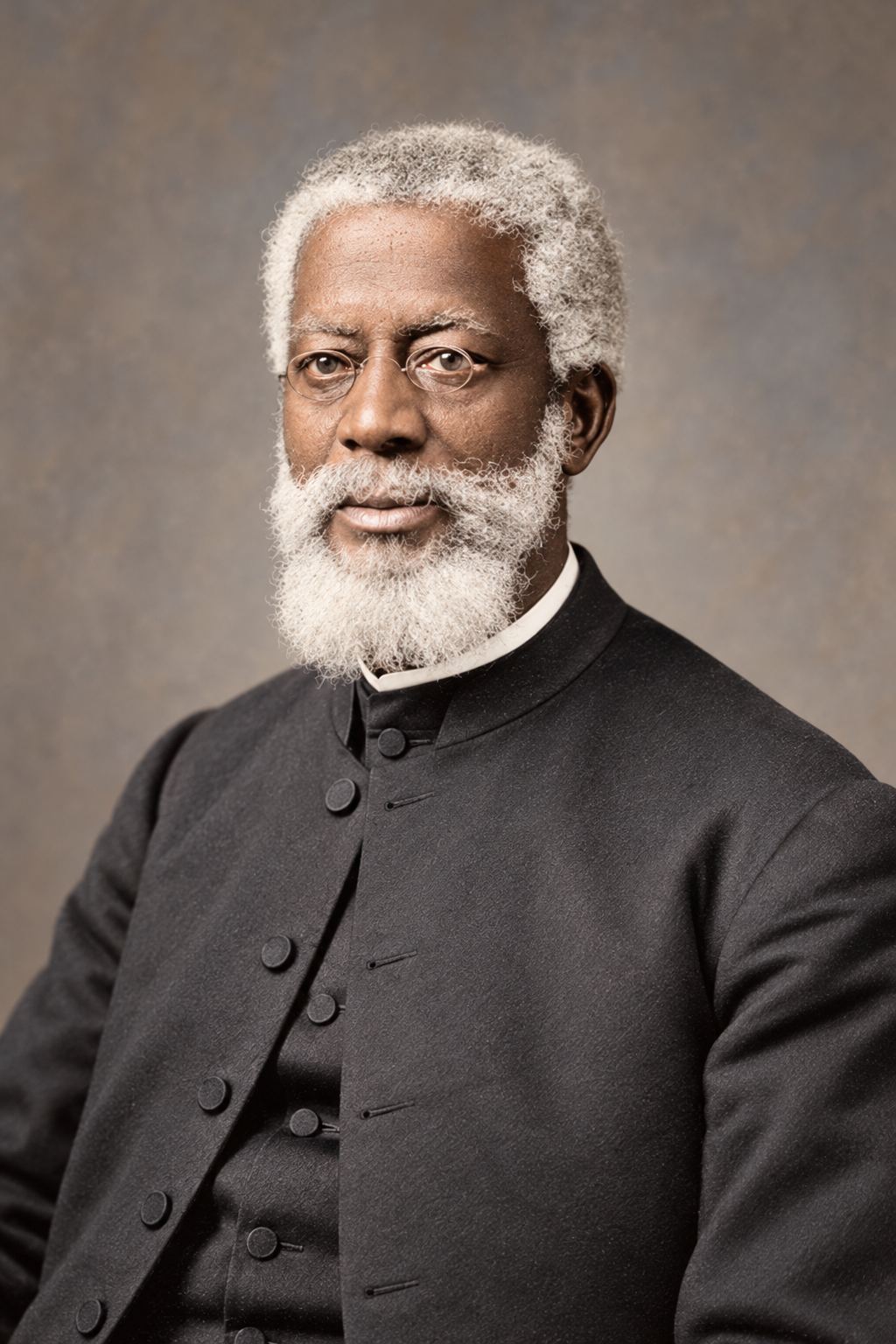
About Alexander Crummell
Alexander Crummell served as a priest, teacher, and advocate for Black leadership on both sides of the Atlantic. He challenged racial exclusion within the Episcopal Church and strengthened Black congregations. He also promoted Black emigration to Liberia, envisioning a Christian republic where education and church discipline would support national renewal.
Born in New York City on March 3, 1819, Crummell came from a family whose maternal ancestors had lived free in New York for generations. His father, Boston, had been born in West Africa. His schooling exposed him to both opportunity and violent resistance. In 1835 he attended Noyes Academy in Canaan, New Hampshire, where students of different races studied together. A hostile crowd destroyed the schoolhouse, and the young Black students were forced to leave. Crummell subsequently studied at the Oneida Institute in New York.
When he sought theological training, General Theological Seminary refused him admission because of his race. He continued his preparation in Massachusetts and was ordained deacon in 1842 and priest in 1844. His ministry in Philadelphia included advocacy for equal suffrage and the abolition of slavery. Yet exclusion from church governance remained a barrier within the institution he served.
His public advocacy had begun well before these later institutions. At the Albany convention of 1840, he drafted a petition seeking the removal of restrictions on Black voting rights in New York. At the national convention in Troy seven years later, he joined James McCune Smith in recommending colleges for Black students.
In 1847 Crummell traveled to England to raise money for his New York congregation. Introductions brought opportunities to preach and meet supporters, but illness interrupted his work. Friends encouraged him to study at Cambridge. The university records place his matriculation in 1849, despite a later recollection in which he gave a different year. He completed his degree at Queens’ College in 1853. His studies were repeatedly disrupted by poor health, and the college’s historian cautions against assuming that Cambridge alone explains his intellectual achievements.
He then spent many years in Liberia, working as a priest, missionary, teacher, and lecturer. His public addresses concerned the country’s moral and national life. Crummell urged a program of education, industry, honesty, and disciplined conduct. His understanding of social change was deeply Christian and reflected the moral expectations of his Victorian setting. By 1873 he was back in the United States, where Washington became the center of his later ministry.
In Washington, Crummell took responsibility for St. Mary’s Chapel, whose Black congregation sought independence from the white parish to which it belonged. Its new church became St. Luke’s. Crummell selected a Gothic style recalling churches he had seen in England, and architect Calvin T. S. Brent designed the sanctuary. He led the first service in the unfinished church on Thanksgiving Day in 1879. The congregation gave his teaching a lasting local home.
Crummell also developed an argument for civil rights that did not depend on public sympathy. As the Stanford Encyclopedia of Philosophy explains, he regarded rights as rooted in a shared human nature and existing before their recognition by governments. White approval could change; human rights could not safely rest upon it. His argument therefore insisted on the rational and moral capacities shared by Black people and other members of society. This gave his opposition to exclusion a foundation beyond appeals to temporary goodwill. He also argued that indignation at exclusion revealed a shared moral awareness: Black people responded to injustice as other human beings did.
In his final years, the American Negro Academy offered another setting for these concerns. His inaugural address of March 1897 argued that literature, art, science, and philosophy were essential to collective advancement. Money, property, and occupational success could not meet every human need. His vision was hierarchical: he assigned trained scholars a guiding role over the wider population. Yet he also demanded generosity from those scholars, urging them to recognize talent promptly and put learning at the service of others.
His address later that year challenged attempts to confine Black education to manual work. He argued that a people who had already labored for generations needed opportunities to think, create, and understand the value of their labor. He celebrated the work of scholars, writers, and artists, including W. E. B. Du Bois, Paul Laurence Dunbar, and Henry Ossawa Tanner. The Academy, in his account, had a responsibility to encourage capacities that the surrounding society too often refused to acknowledge.
After leaving St. Luke’s in 1895, Crummell taught at Howard University and helped establish the Academy in 1897. He died in Red Bank, New Jersey, on September 10, 1898. His papers, preserved at the Schomburg Center, include correspondence and sermons from his work in America, Britain, and Liberia.
The Episcopal Church commemorates him on September 10. General Theological Seminary, which had once denied him admission, now marks that observance in its own account of his life.
Wondering how to weigh the stories and sources? Learn how to read a saint biography.