Biography
Alexei Kabalyuk
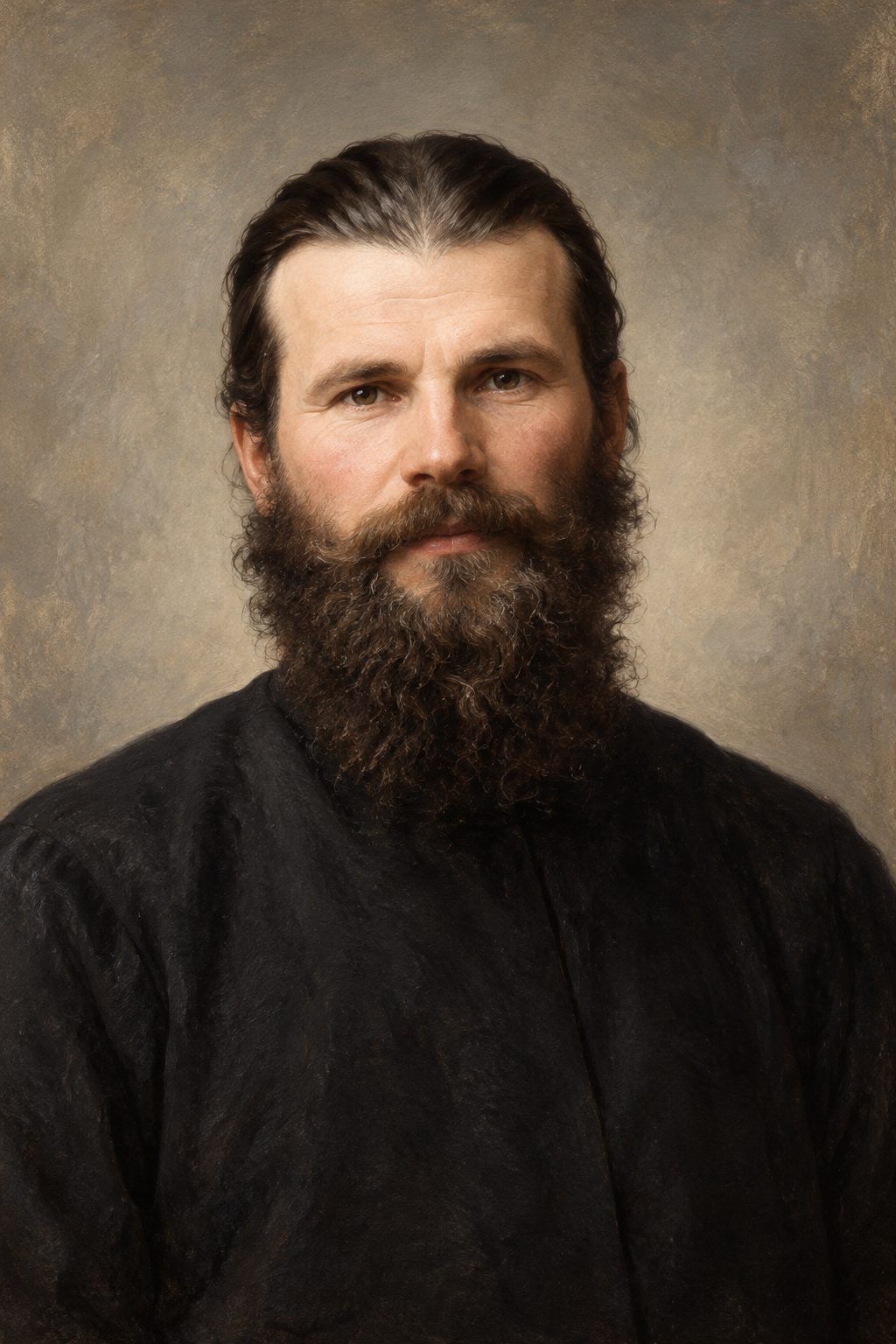
About Alexei Kabalyuk
Alexei Kabalyuk grew up in a Greek Catholic family in the Rusyn village of Yasinia. He had grown up in a household of nine children and worked on the family property after school. Military service took him to Košice before his monastic life began. After his father died, he inherited part of the family holdings, but continued making journeys to monasteries.
As a young man, he visited monasteries and considered a monastic vocation. During a pilgrimage to Mount Athos in 1908, he entered the Orthodox Church. He became a monk at Yablochino in 1910, taking the name Alexis, and was ordained a priest that year. Returning to the Carpathian villages, he preached and celebrated services for people who were becoming Orthodox. A diocesan account describes him supporting himself as a wood-turner while traveling between communities.
His work brought him into conflict with the Hungarian authorities. After leaving for Russia in 1912, he traveled to the United States and received a parish among Rusyn immigrants in 1913. He returned to Austria-Hungary that same year.
A diocesan history identifies a 1912 photograph of him with officers of a mutual-aid society in Wilkes-Barre, Pennsylvania. This places his American stay within the organized life of the immigrant community.
Danilets’s later archival study gives a more precise account of the American journey. Drawing on passenger records, it places his embarkation at Liepāja on October 29, 1912, and his arrival in New York aboard the steamship Russia on November 13. The study connects the voyage with Archbishop Platon, whom Kabalyuk had met in Moscow. This chronology places his arrival before the parish assignment mentioned in the encyclopedia, rather than treating the two dates as competing accounts of a single event.
The same study cites Kabalyuk’s recollection that he spent about six months in America. He remembered receiving permission to visit Carpatho-Rusyn parishes, speak with immigrants, preach and conduct services. His stay therefore included contact with several communities, not simply residence at one parish. News from home continued to reach him through letters. In his later recollection, reports that prisoners were awaiting trial because the principal defendant was absent prompted his return and voluntary surrender to the authorities. That explanation records how he remembered his decision; it is not an independent account of his motives.
Kabalyuk was named first in an indictment issued in July 1913. Historian Yuri Danilets’s study of the document shows how officials treated the spread of Orthodoxy as a political threat. Prosecutors accused the defendants of inciting religious and national hostility and connected their religious activities with Russian influence. Correspondence, prayer books and other printed material were among the evidence cited against Kabalyuk. The indictment also alleged financial support from Russian political figures. These were prosecution allegations; their appearance in the file does not independently establish their truth. Danilets distinguishes the initial investigation of 188 people from the 94 eventually charged. The case brought religious practice, national identity and loyalty to the state into the same courtroom.
Kabalyuk was sentenced to imprisonment and a fine in March 1914. After his years in custody, he returned to Transcarpathia in 1919. In Khust he reopened a house of prayer and established boarding accommodation for Orthodox pupils. He became superior of Saint Nicholas Monastery in Iza in 1921 and later served as an archimandrite. In December 1944 he joined a delegation to Moscow seeking the transfer of his diocese from Serbian to Moscow jurisdiction.
In 1923 he returned to Yasinia with three monks, prayed at his mother’s grave and attended the founding meeting of an Orthodox community. Letters preserved in the regional archive record opposition to the visit from the Greek Catholic authorities. Later, at Domboky, he helped organize donations for a women’s monastery and contributed his own money to its construction.
A contemporary report in the 1935 calendar of an American Orthodox brotherhood describes the boarding house in practical terms. Kabalyuk initially accommodated boys arriving from villages to study at the Khust gymnasium. Space was limited, and another room was added in 1925. The report describes gradual enlargement, from eight pupils in the first year to forty-two in the preceding year. Its figures are those of a sympathetic institutional account, rather than a separately audited school register.
The account describes three sleeping rooms, a large study room, a kitchen and accommodation for staff. An educated supervisor cared for the pupils, who also attended church. It reported that more than two hundred boys had passed through the house over a decade, including students who continued at universities, Orthodox seminaries in Serbia and teacher-training institutions. Kabalyuk’s educational work thus concerned lodging, supervision and routes into further study, as well as worship. The report also says that he continued overseeing the house after it came under diocesan administration.
Kabalyuk died on December 2, 1947. The Orthodox Church in America’s account explicitly pairs that date with November 19 in the other calendar.
In July 2001, the Ukrainian Orthodox Church’s Holy Synod authorized his local recognition as a saint. The decision approved an icon and liturgical texts and assigned his commemoration to November 19/December 2. The Orthodox Church in America displays December 2 as his feast.
Wondering how to weigh the stories and sources? Learn how to read a saint biography.