Biography
Alfonso Maria Fusco
About Alfonso Maria Fusco
Alfonso Maria Fusco was born in Angri, in the Diocese of Nocera Inferiore-Sarno, on March 23, 1839. The says his first education came through his parents and the priest who had baptized him. As a child he was enrolled among the small clergy of the collegiate church of Saint John the Baptist in Angri.
In 1850 Alfonso entered the diocesan seminary. The official profile says that already then he began to mature a desire to devote himself to poor and abandoned children. That early purpose should shape the biography, because his later foundation was not an accidental add-on to parish life. It grew from a long pastoral concern.
This continuity helps keep the profile from becoming a list of offices. Fusco's seminary years, parish work, school, oratory, missions, and foundation all point in the same direction: forming young people in faith and dignity. The public page should make that throughline visible, while still keeping the exact chronology anchored to the official source.
He was ordained a priest on May 29, 1863. Soon afterward he was appointed coadjutor of the collegiate church of Angri, where he served through confession, preaching, religious instruction for children and young people, and liturgical life. The source emphasizes ordinary priestly work before it describes any institutional achievement.
Fusco also opened a free school in his own house for children. Inspired by Saint John Bosco, with whom the source says he corresponded, he opened an oratory under the protection of Saint Aloysius Gonzaga. The young people he educated there were known as "luigini," a detail that should be explained as part of his local youth ministry.
The free school and oratory show how his ministry moved from sacramental service to daily formation. They also explain why the later Baptistine foundation should not be isolated from Angri's ordinary parish life. Fusco was already teaching and gathering young people before he had sisters or an institution to carry the work forward.
His charity was practical in times of crisis. During the 1866 cholera outbreak in Campania, the Dicastery profile says he devoted himself to caring for the sick and was himself struck by the illness, though spared from death. This event belongs in the profile as a concrete sign of pastoral risk, not as dramatic embellishment.
In 1868 he became sacristan of the collegiate church, and the next year he entered the congregation of the Nocerini missionary priests. He followed them in rural missions with spiritual fruit for those who heard and approached him. The profile can use this to show that his ministry extended beyond classroom and oratory settings.
The rural missions should be described in broad terms unless further sources are added. The Dicastery profile supports the fact of his participation and their spiritual fruit, but it does not require the page to invent particular villages, sermons, or conversions. The slow-vetted record should stay close to the source: preaching, confession, catechesis, and mission service.
The official source describes him as a true priest, shepherd of souls, friend of the little and the poor, simple, poor, obedient, and persevering. Those character descriptions should be paraphrased sparingly. The safer editorial path is to let the specific works show the virtues: confession, catechesis, school, oratory, cholera service, missions, and foundation.
After attempts and difficulties, his long desire took institutional form in 1878. With Maddalena Caputo and four other young women, he founded the Congregation of the Sisters of Saint John the Baptist. The Dicastery says the purpose was the education and instruction of orphaned and needy girls. This is a central fact for the final page.
The congregation soon expanded beyond Angri, while encountering difficulties and opposition. The source says Fusco bore the burdens through prayer, patience, fortitude, and trust in divine help. On August 2, 1888, the ordinary of Nocera approved the rules of the congregation. He remained father, guide, and support to the sisters.
That rule approval gives the profile a concrete later milestone without needing current global claims. It shows that the work moved from a local beginning into a recognized religious institute. The page can mention expansion beyond Angri, but should avoid modern statistics, present-day locations, or institutional claims unless a fresh source is added for those details.
Fusco died at Angri on February 6, 1910, and the Dicastery profile says his body rests there with the veneration of the religious family born from his heart. The existing date and place of death are therefore supported. The page can also note the February 6 memorial, beatification by John Paul II on October 7, 2001, and canonization by Pope Francis on October 16, 2016.
The public profile should present him as a priest whose educational mission grew from pastoral charity. He served Angri's parish life, taught children, formed youth, cared for the sick, preached missions, and founded a congregation for girls who needed protection and formation. That sequence is more accurate than reducing him to a founder title.
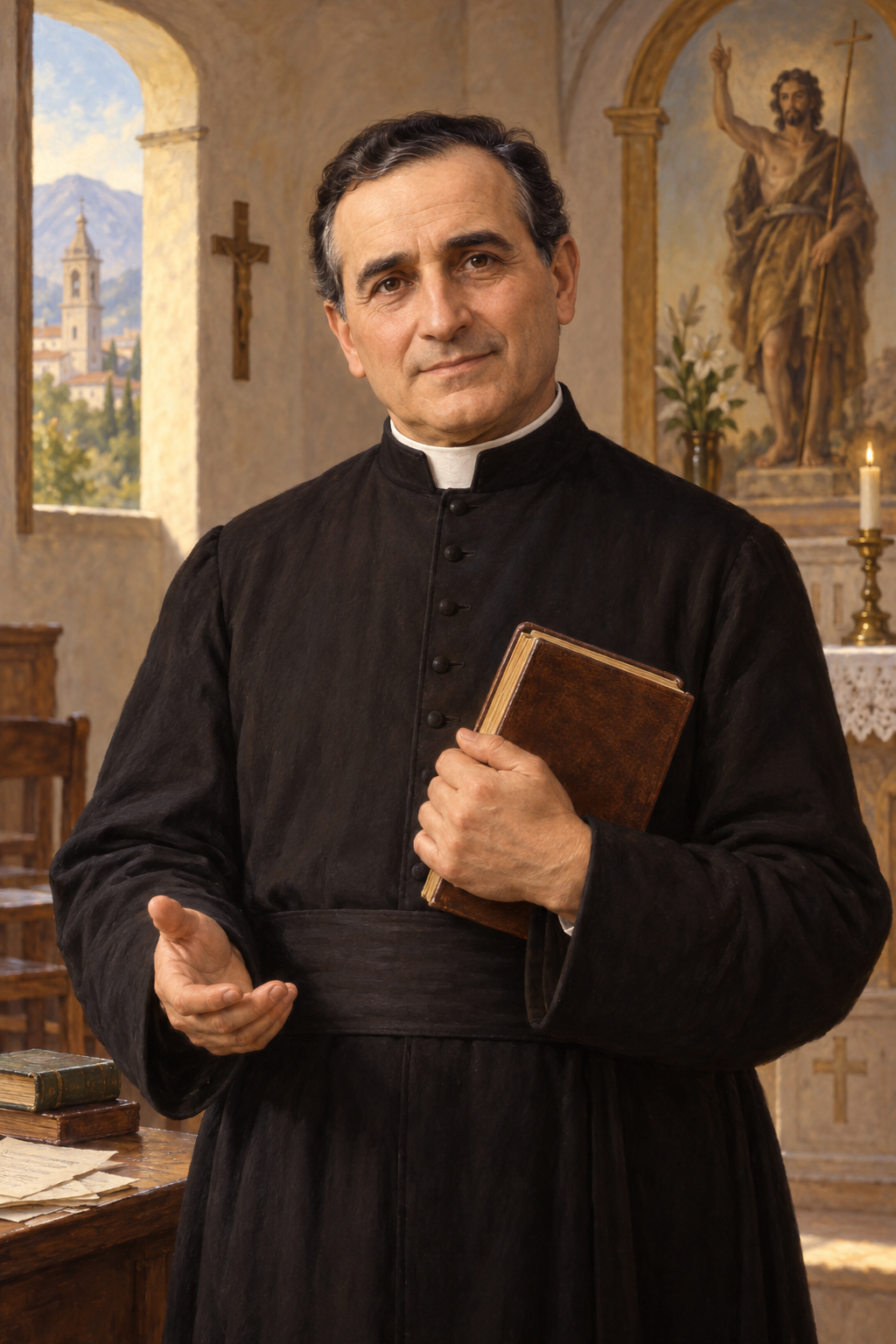
Artwork should be a restrained priest-founder portrait: black cassock, book or catechism papers, simple Angri chapel-school or oratory setting, and perhaps a Saint John the Baptist cue. It should avoid modern classrooms, crowds of children, ornate bishop imagery, and any claim of historical likeness.
Wondering how to weigh the stories and sources? Learn how to read a saint biography.