Biography
Ambrose Barlow
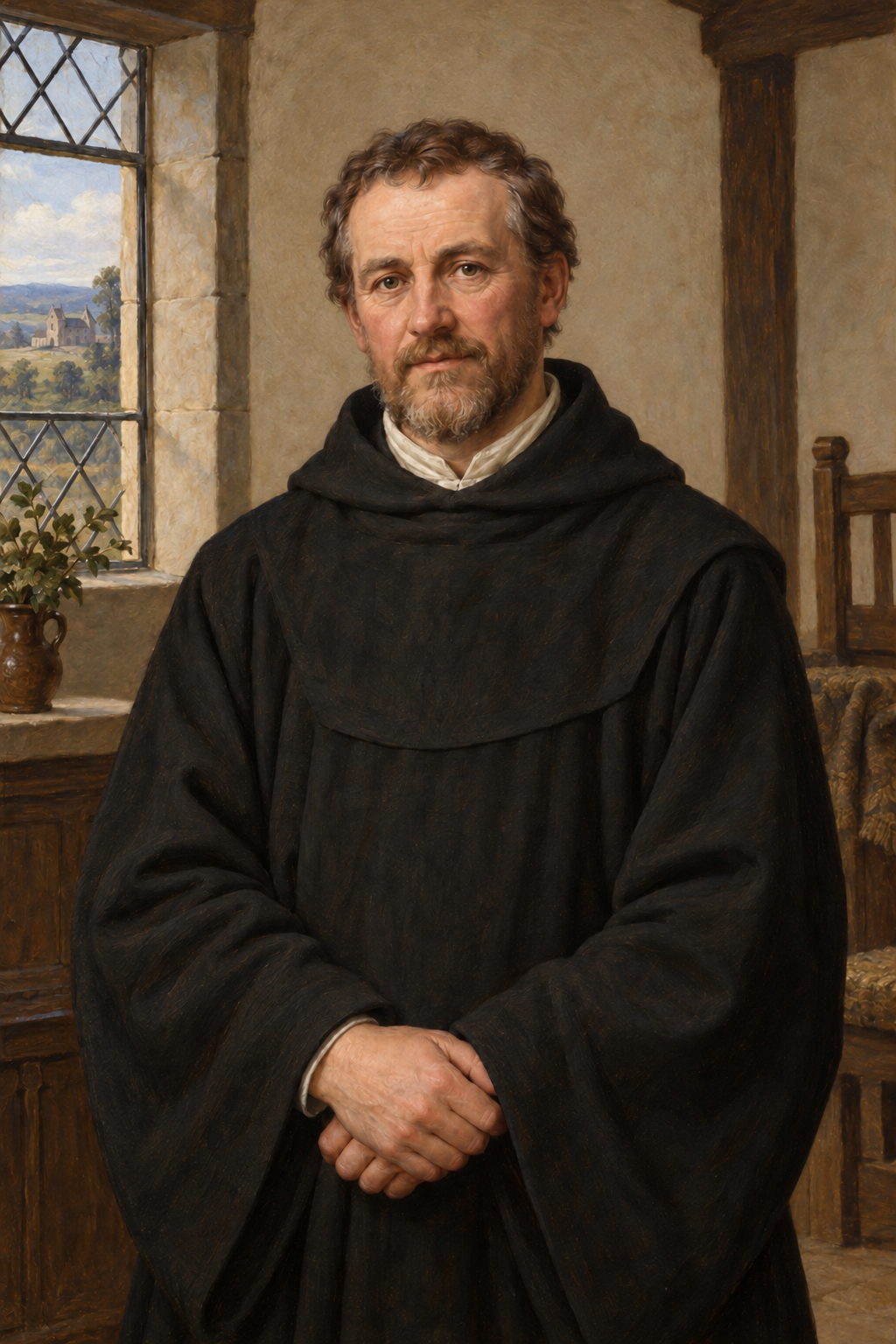
About Ambrose Barlow
Ambrose Barlow was an English Benedictine priest who served Catholics in Lancashire and was executed at Lancaster on 10 September 1641. Bede Camm’s account names him Edward Ambrose Barlow, records his baptism at Didsbury on 30 November 1585, and identifies his father as Sir Alexander Barlow.
He studied at Douai and Valladolid, then returned to Douai, where his brother Rudesind was a professed monk. Camm dates Ambrose’s religious profession to 1616 and his ordination to 1617. Back in England, his ministry was associated particularly with Wardley Hall and Morleys Hall near Leigh.
On Easter Sunday 1641 he was arrested while preaching at Morleys Hall. After months in Lancaster Castle he was tried and condemned, having acknowledged that he was a priest. Camm’s account places the execution on 10 September and explains that his biography draws on accounts associated with his brother and a pupil.
Paul VI canonized him on 25 October 1970.
Wardley Hall preserves a skull traditionally attributed to Barlow. The Diocese of Salford discusses a competing identification with Roger Downes and explains why the Barlow attribution is favored. It also states clearly that the evidence does not prove the identity. The forensic findings it reports are compatible with a man of Barlow’s age and stature whose head had been violently severed after death. Compatibility and longstanding veneration do not establish certainty.
His remembrance also belongs to the life of the Benedictine community. In a 2019 account, Downside Abbey describes portraits of its martyr-monks around the monastery and an annual Mass of thanksgiving. Its recollection of their sacrifice leads the monks to consider their own duty of faithfulness. This is a continuing communal remembrance of Barlow and John Roberts.
At Hall Green in Birmingham, a parish church bears Barlow’s name. Its parish history records the opening of the completed church on his feast day, 10 September 1981. The National Portrait Gallery also preserves an early to mid seventeenth-century engraving of him by John Payne. Both church dedication and surviving portraiture offer tangible settings in which his memory has been kept.
Wondering how to weigh the stories and sources? Learn how to read a saint biography.