Biography
Andrea Bobola
About Andrea Bobola
Bobola was born in 1591; sources disagree whether his birthplace was Sandomir or Strachocina.
In 1611 he entered the Society of Jesus at Vilnius. That decision began years of study and formation before his work as a priest. The surviving record does not reveal a private moment that prompted it. An older encyclopedia confirms his entrance and later ordination while reporting competing birth years. His family's connection to Catholic life is clearer than the geography of his birth.
Bobola studied with the Jesuits and was ordained on 12 March 1622. Motta and Rai identify the date from Jesuit archives, along with his later service at St Casimir's church in Vilnius. His 1630 profession of the fourth vow survives in a manuscript, a direct trace of his institutional life. These records establish a sequence of formation, ordination and responsibility. They do not supply a diary of his thoughts, all journeys or the exact words he spoke to people he met. His documented commitments are substantial without such additions.
The Jesuit order's liturgical account places Bobola in ministries at Nesvizh and Vilnius after ordination, and in Bobruisk from 1630. Its short chronology gives a useful outline of his movement between houses. These assignments joined preaching to the ordinary work of a community: teaching, worship and local pastoral care. They also required living among people whose Christian traditions and loyalties were not all the same. A calendar text celebrates his later martyrdom, but his life was much longer than its final day. The less dramatic years of training and sustained service deserve attention in their own right.
A reference biography describes his pastoral work in Vilnius and the surrounding countryside, as well as a period of reduced activity because of illness. It places him at Janów near Pinsk by the end of his life. Claims that whole villages entered communion with Rome through his preaching belong to a tradition of missionary biography and should not be treated as a count verified by contemporary registers. The source also prints 10 May for his death, unlike the Jesuit death register and current Dicastery listing, which give 16 May. The discrepancy counsels care with both its dates and its more sweeping accounts of success.
Bobola's eastern mission unfolded in a Commonwealth where Latin Catholics, Eastern Catholics, Orthodox Christians and Jewish communities lived under unequal political arrangements. The uprising led by Bohdan Khmelnytsky began in 1648 against Polish magnates and involved Cossack autonomy and Orthodox rights. Its violence also devastated Jewish communities. These were intertwined political, social and religious events, not a simple contest between one church and another. Bobola's preaching among Orthodox Christians took place inside that conflict. Describing only Catholic suffering would hide both the Orthodox grievances that helped drive revolt and the Jewish victims of its attacks.
An earlier Italian encyclopedia says Bobola professed solemn vows in 1630 and worked as a preacher while invading armies and religious controversy affected the region. Its author gave 1590, or alternatively 1592, for his birth year, and recorded a feast day different from the present one. The entry remains useful for its career outline and for showing that historical reference works did not agree on his dates. A responsible account retains the source's uncertainty instead of manufacturing an exact birthplace or birthday. The broad institutional sequence is better supported than colorful anecdotes about encounters on the road.
On 16 May 1657, Cossack fighters captured and killed Bobola at Janów. A Pinsk Jesuit house list of the dead records the date and violent death in a few words. His body was carried to Pinsk and buried there. The brief register does not contain a long interrogation, a final speech or the precise sequence of injuries found in later retellings. Its spareness is important evidence: the killing can be stated directly without presenting later narration as an eyewitness transcript. He was among several Jesuits killed during the fighting, though his memory eventually traveled much farther than most of theirs.
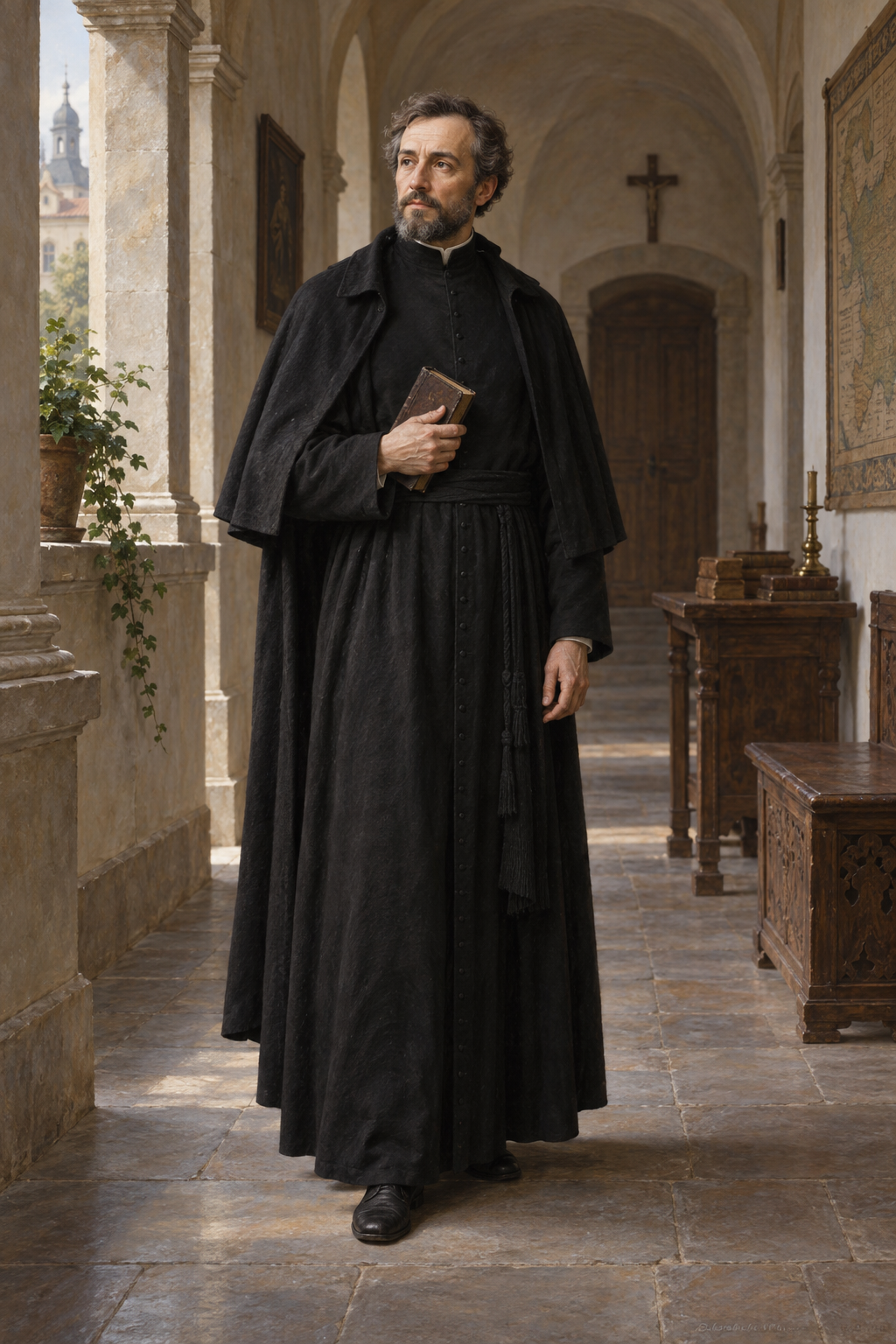
Motta and Rai show how Bobola's martyrdom story developed during later inquiries. Testimony gathered decades after his death expanded the brief death notice; successive versions added details. Their study also explains that the familiar image of Bobola is a later devotional construction, not an authenticated portrait from life. This distinction separates a documented killing from descriptions shaped by later needs and conventions. New artwork should suggest the priest at work rather than claim to reconstruct his torture or face.
The Pinsk community renewed attention to his grave around 1702. Jesuit accounts describe a rector's reported dream, the search for a coffin and later examinations of the remains. The reported apparition and miraculous preservation are beliefs within the history of devotion; they are not independently established events. The remains later reached Moscow and Rome before returning to Poland. Their journey shows how communities guarded and represented his memory. It does not establish details of his seventeenth-century daily life.
Pius IX beatified Bobola on 30 October 1853, and Pius XI canonized him on 17 April 1938. His memorial is 16 May. Accounts of his last hours are substantially later than his death.
Wondering how to weigh the stories and sources? Learn how to read a saint biography.