Biography
Ambrósio Francisco Ferro
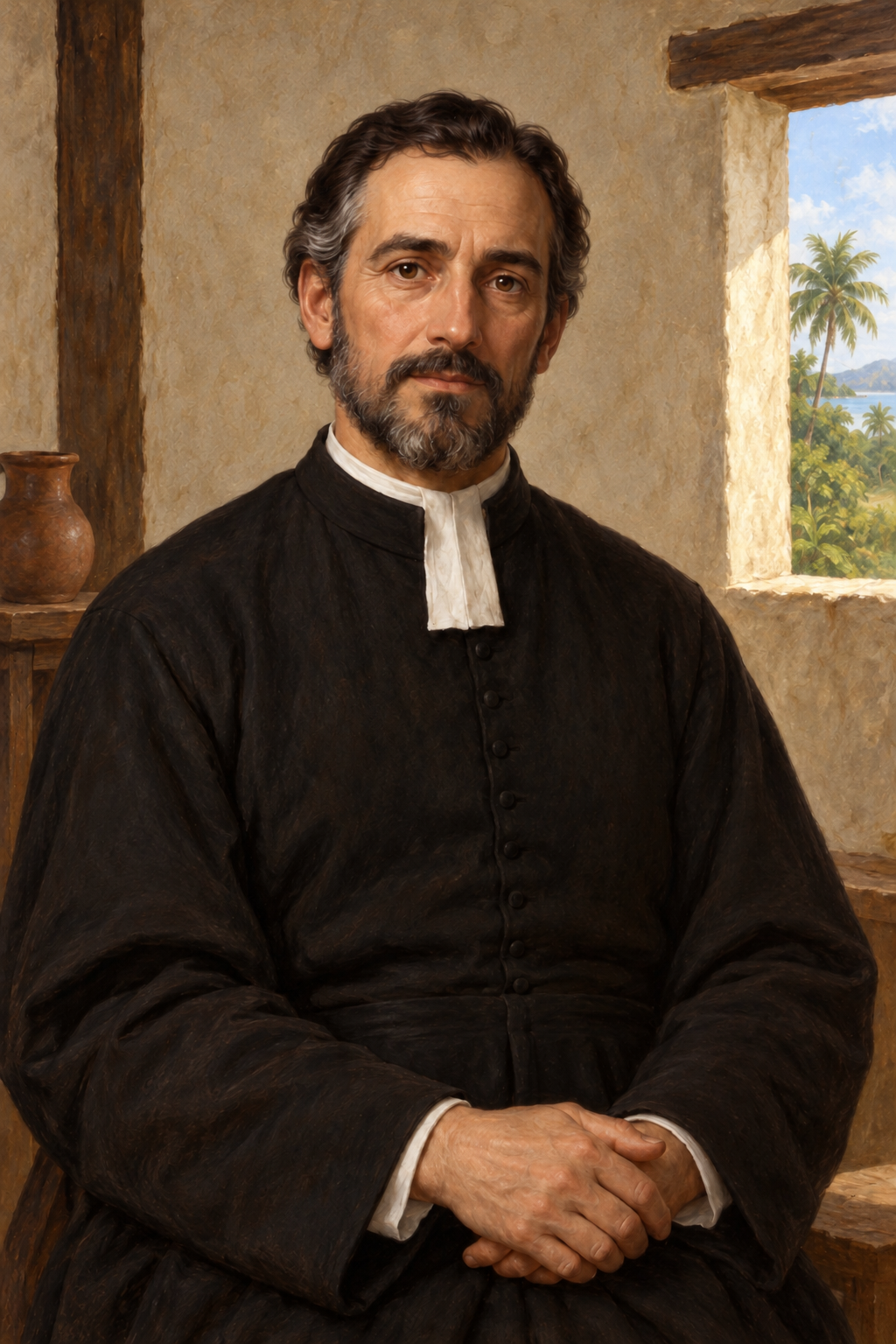
About Ambrósio Francisco Ferro
Ambrósio Francisco Ferro was a Portuguese diocesan priest in Natal. A Catholic account records him as chaplain in Rio Grande in 1636. It infers Azorean origin from his sister’s identification, without establishing his birthplace.
The same account recalls his refuge at Fortaleza dos Reis Magos after the Cunhaú massacre, followed by his removal to the Uruaçu riverbank and killing.
Pope Francis’s canonization letter distinguishes two killings in 1645: Cunhaú on 16 July and Uruaçu on 3 October. Ferro belongs to the second group. The letter identifies him as a diocesan priest and parish pastor, alongside lay people and members of families. Its recognition of martyrdom is the Church’s judgment that they died because of their Catholic faith.
The history also belongs to a colonial conflict. In a study published by the Federal University of Rio Grande do Norte’s Revista do CERES, João Batista Sabino Neto examines the religious memory surrounding the killings. He argues that commercial rivalry, territorial conflict and alliances between Dutch forces and Indigenous peoples complicate explanations based solely on religious hatred. His argument concerns the historical setting and the development of remembrance.
Francis canonized Ferro and his companions on 15 October 2017. The letter records their beatification by John Paul II on 5 March 2000 and explains that the canonization proceeded with a dispensation from investigation of an individual miracle. The declaration names the thirty people recognized from the two groups; it does not identify every victim of the killings.
The 2017 canonization brought pilgrims from the Natal region to Rome with their archbishop, Jaime Vieira Rocha, according to Agência Ecclesia’s report. The Catholic Church in Norway’s notice commemorates the group on 3 October. Ferro is remembered within a community’s shared witness, while his childhood, education and the details of his earlier priestly life remain largely inaccessible in these accounts.
Wondering how to weigh the stories and sources? Learn how to read a saint biography.