Biography
Amphilochios of Patmos
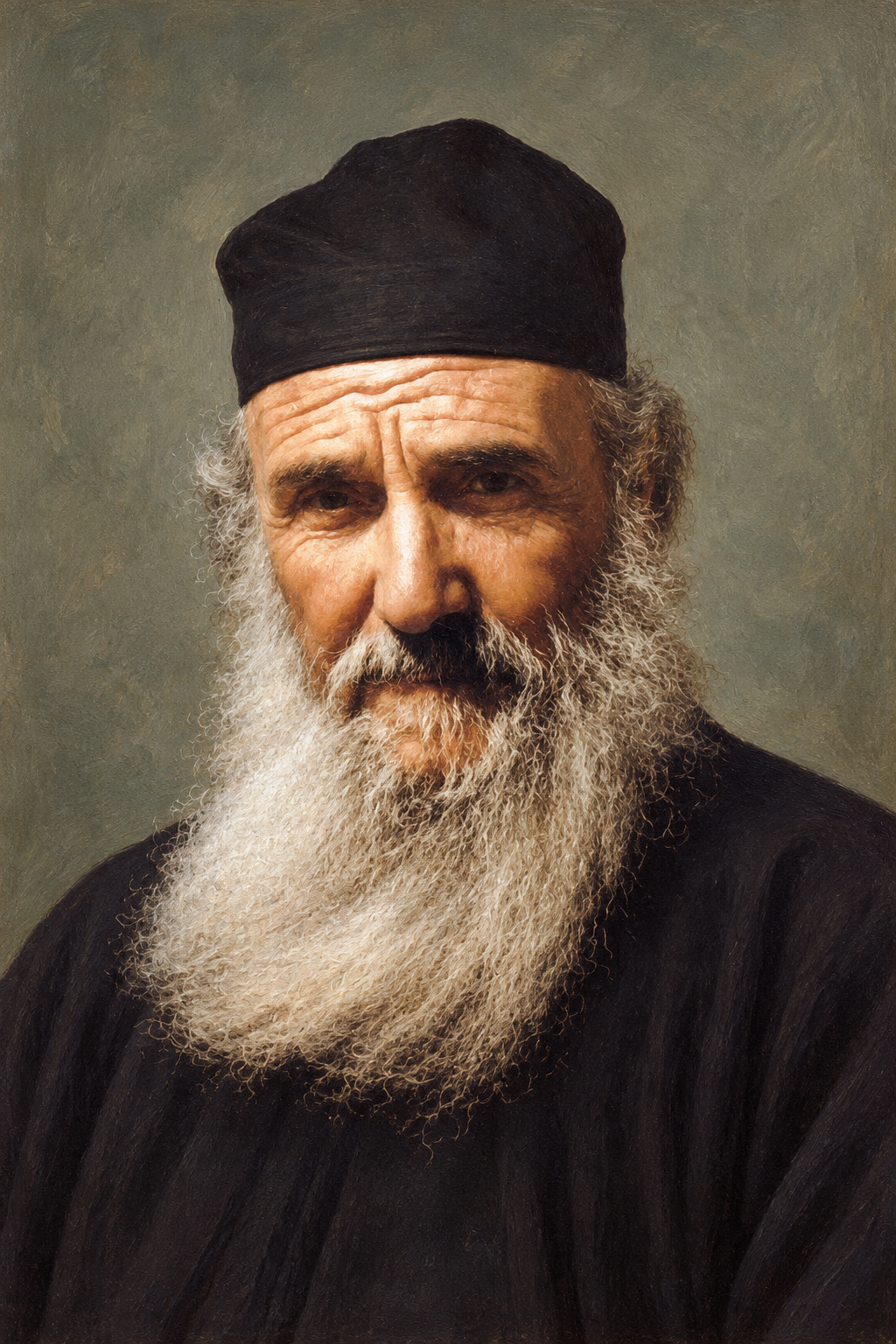
About Amphilochios of Patmos
Amphilochios Makris was a monk and priest from Patmos, born Athanasios in 1889. He entered the island’s Monastery of John the Theologian and received the name Amphilochios in 1906. Ordained in 1919, he later served the monastery and the Cave of the Apocalypse. In 1935 the community elected him abbot. His work also included founding the women’s Monastery of the Annunciation.
The American Carpatho-Russian Orthodox Diocese’s account describes his service on nearby islands, where he heard confessions and celebrated the liturgy. It presents the Annunciation community as part of his desire to strengthen religious life on Patmos. His interests also extended to practical care: the same account records his help to nuns on Rhodes who established an orphanage and a home for pregnant women in 1947.
His ministry took place under Italian rule in the Dodecanese. The Saint Catherine parish biography describes his efforts to preserve Greek education and his exile from Patmos, followed by his return in 1939. It remembers him continuing to support the nuns and charitable institutions. The precise chronology of his exile differs between church biographies, so those details are not treated as settled here.
The teacher Maria Petroutsou left a more personal recollection of this educational work, quoted by Georgios Militsis. She remembered becoming so distressed by the demands placed on her in the public school that she wanted to resign. Amphilochios urged her to stay, asking what would happen to the Greek children if she left them without a teacher of their own community. Petroutsou also described taking children into the countryside and visiting the Annunciation monastery, where the abbess Eustochia taught songs and church hymns. Her testimony gives the broader account of cultural resistance a human setting: a teacher struggling with her responsibilities, a priest encouraging her, and children learning through visits and shared activities. It remains her retrospective account, rather than a complete administrative history of education under Italian rule.
The Annunciation community grew around an older place of prayer. The regional guide describes a sixteenth-century hermitage and a nearby chapel of Saint Luke, built in 1613. The Monastery of John the Theologian made the site available to Amphilochios for the women’s community in 1937. Later buildings and the larger Annunciation church surround the older chapel. The guide records the sisters’ work in gardening, beekeeping, sewing and embroidery, including the local stitch called spitha. These details describe the community’s continuing life and the inherited setting of his foundation; they are not all activities personally established or performed by Amphilochios.
Kallistos Ware, who knew him on Patmos, remembered another aspect of his guidance: affection for trees. In a published recollection quoted by the Metropolis of Nea Ionia, Ware recalls Amphilochios urging the community to love them. This is a personal memory of the elder’s teaching, linking spiritual attention with care for the living world. It does not establish a formal patronage of nature or of environmental work.
His surviving correspondence shows guidance offered across distance. Six published letters from 1957–1962 address Dimitrios Archontonis, later Patriarch Bartholomew. In January 1958, before meeting him personally, Amphilochios welcomed the young student into his spiritual family and assured him that their bond did not depend on living in the same place. He encouraged reading the Fathers and approved a proposed study of Ephraim the Syrian. He also hoped other students would investigate monastic traditions in different regions and prepare for service beyond the pursuit of church office. The December 1959 letter combines this encouragement with harsh polemic: it blames materialism and Jewish organizations for spiritual darkness. That anti-Jewish generalization belongs to the letter and is not endorsed here. Read together, the letters preserve affectionate support for a young correspondent, concern for theological study, and prejudices that should not be erased from the historical account. In 1962 he wrote again, wishing Bartholomew strength to finish military service and continue his dedication to the Church.
Ware’s recollection also emphasizes gentleness, humor and joy. He remembers Amphilochios opposing cruelty in spiritual direction and asking that the nuns not be treated with excessive severity. Before Ware returned to Oxford as a newly ordained priest, Amphilochios advised him about living as an Orthodox Christian in a minority setting. He encouraged fidelity without aggression toward other Christians and without fear of isolation. The counsel is preserved as Ware’s personal memory of his teacher, expressing an approach to pastoral relationships that he continued to value. It also gives a concrete example of Amphilochios addressing someone whose work would take him far from Patmos.
Amphilochios died on April 16, 1970. The Ecumenical Patriarchate added him to its calendar of saints on August 29, 2018. His church biography also preserves reports that he anticipated his death and experienced visions; these belong to the testimony of his religious community, rather than independently demonstrated events.
His Eastern Orthodox feast is April 16, the anniversary of his death.
Wondering how to weigh the stories and sources? Learn how to read a saint biography.