Biography
Andrea Avellino
About Andrea Avellino
Lancellotto Avellino was born in 1521 at Castronuovo, near Potenza, to Giovanni Avellino and Margherita Apelli. An uncle who served as archpriest encouraged his studies at nearby Senise. He began catechetical work while young and was ordained in 1545. In 1547 he went to Naples to study law. The city connected a provincial priest to a university, an archdiocese and newer religious communities. No source establishes an exact birthday or a childhood intention to join the Theatines.
After studying law, Avellino pleaded cases in the ecclesiastical court. A reference account says regret over a false statement in an argument led him to leave legal practice. He had taken spiritual exercises with the Jesuit Diego Laínez in 1548. Later, when assigned to reform the convent of San Arcangelo at Baiano, opposition became violent and he was injured. The Theatine house at San Paolo Maggiore received him during recovery. These were steps in an evolving commitment, not one instantaneous conversion.
He entered the Theatines in 1556 and professed vows on 25 January 1558, taking the name Andrea. The order describes additional promises to resist his own will and keep seeking spiritual growth. These vows describe practice, not proof that he achieved perfection each day. As confessor, teacher and spiritual director, he worked with several social groups. The Theatine account names Giovanni Marinoni as his novice master and Paolo Burali as a fellow member. The community gave Avellino a structure for later preaching and guidance.
Andrea Vanni's study places Avellino within a changing Theatine order. From 1560 he trained novices at San Paolo Maggiore; he later led the Naples house and helped establish theological study for younger members. Vanni argues that the order broadened its work and strengthened ties to local patrons. Avellino's teaching and governance contributed to that process. Offices, curricula and community relationships belong in his biography alongside personal devotion. Reform required institutions able to transmit practices to new members.
In 1570 Avellino went to a Theatine house in Milan, where Charles Borromeo sought support for diocesan reform. He later served at Piacenza, directing a seminary and advising a community of women who had left earlier circumstances. Andreu's dictionary describes correspondence with Borromeo and with members of several prominent families. Letters were a means of pastoral contact across the distances between cities. They also reveal that a spiritual director moved in political and social networks; he was not confined to a quiet room giving private counsel. His Milan and Piacenza years connected the Theatine project to broader Catholic reform after Trent.
Vanni traces a change in the order's public role. Theatine expansion northward relied on bishops, noble families and local governments. Avellino's work in Milan and Piacenza involved governing houses as well as hearing confessions. Returning to Naples in the early 1580s, he again held leadership posts and offered spiritual direction. The study describes his importance to the order's evolving identity, including how it later told its origins. This interpretation of institutional evidence is distinct from later miracle narratives. His letters and decisions mattered beyond the people who met him personally.
At Naples, Avellino directed Theatine houses and corresponded with laypeople. A reference entry estimates thousands of letters, though no exact surviving total is needed to show the scale of his work. Some letters were published after his death, alongside other writings. They show an adviser translating prayer and discipline into guidance for particular lives. His return to Naples brought continuing leadership, not retirement. His death in 1608 came while beginning Mass at San Paolo Maggiore, a setting central to later devotional memory.
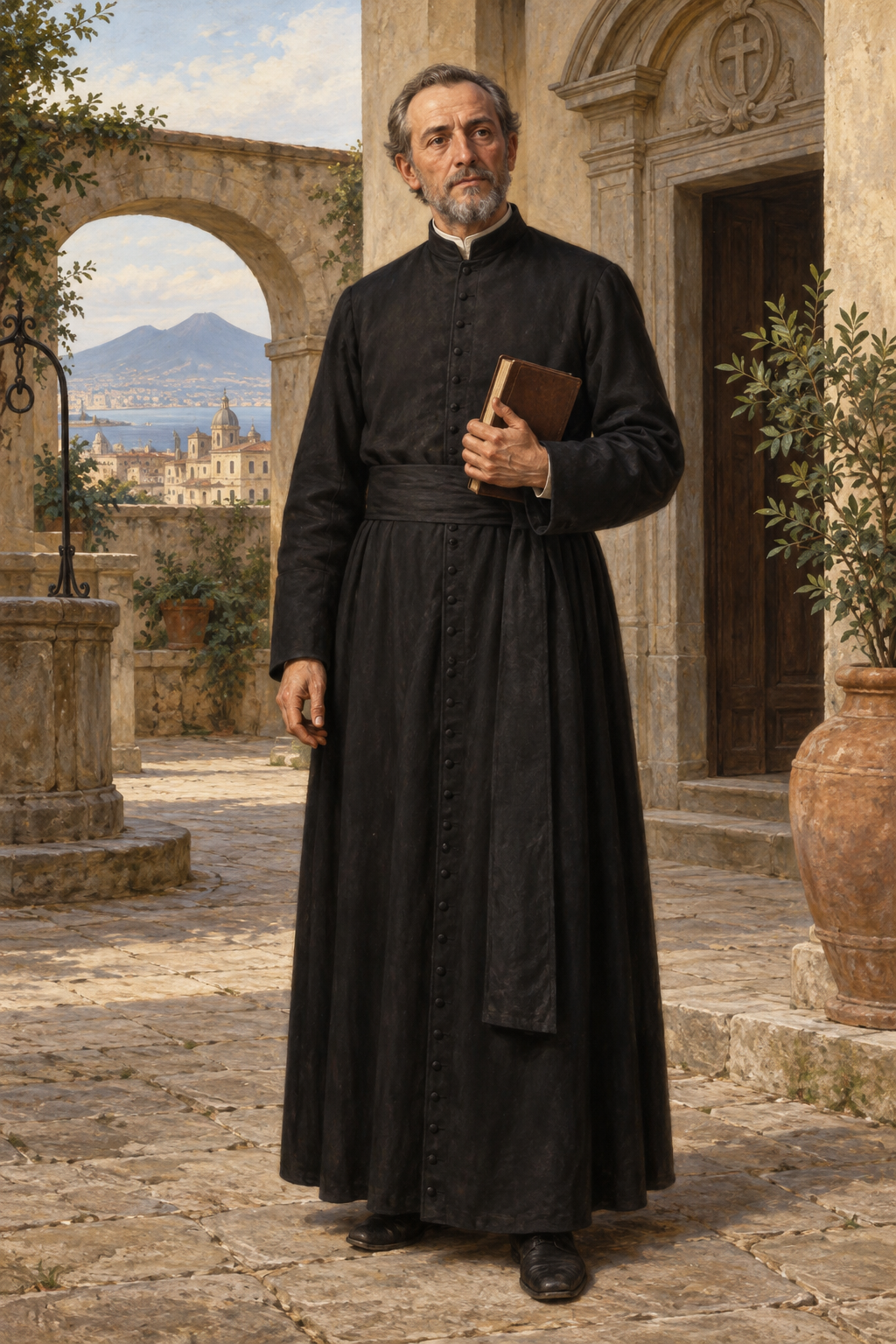
In Castronuovo, a reliquary bust preserves a later image of its native saint. A local art study describes its carved wooden body, gilded details and a small case for a relic. It notes uncertainty over the object's maker and date, and compares facial features with other works rather than declaring a direct likeness. The bust's procession through local streets is evidence of devotion continuing long after Avellino lived there. Its visual language—book, flowers, decorated clothing—belongs to the history of veneration. An original contemporary portrait is not established by this object. It should inform neither exact facial features nor invented scenes in new artwork.
A Theatine chapel in Rome displays a painting of Avellino stricken as he began Mass on 10 November 1608. The chapel history attributes the canvas to Giovanni Lanfranco and says a later artist added an upper scene of angels. Its page associates the painting with a 1625 beatification, a date that disagrees with the Dicastery's 1624 record. The painting documents how worshippers imagined his death, while the historical account distinguishes his collapse from his death later that day. He came to be invoked against sudden death. This patronage is a practice of devotion and does not imply that every story surrounding the painting is literal eyewitness evidence.
Urban VIII beatified Avellino on 14 October 1624, and Clement XI canonized him on 22 May 1712. Another reference differs on the beatification day. His memorial is 10 November.
Wondering how to weigh the stories and sources? Learn how to read a saint biography.