Biography
Andrea Uberto Fournet
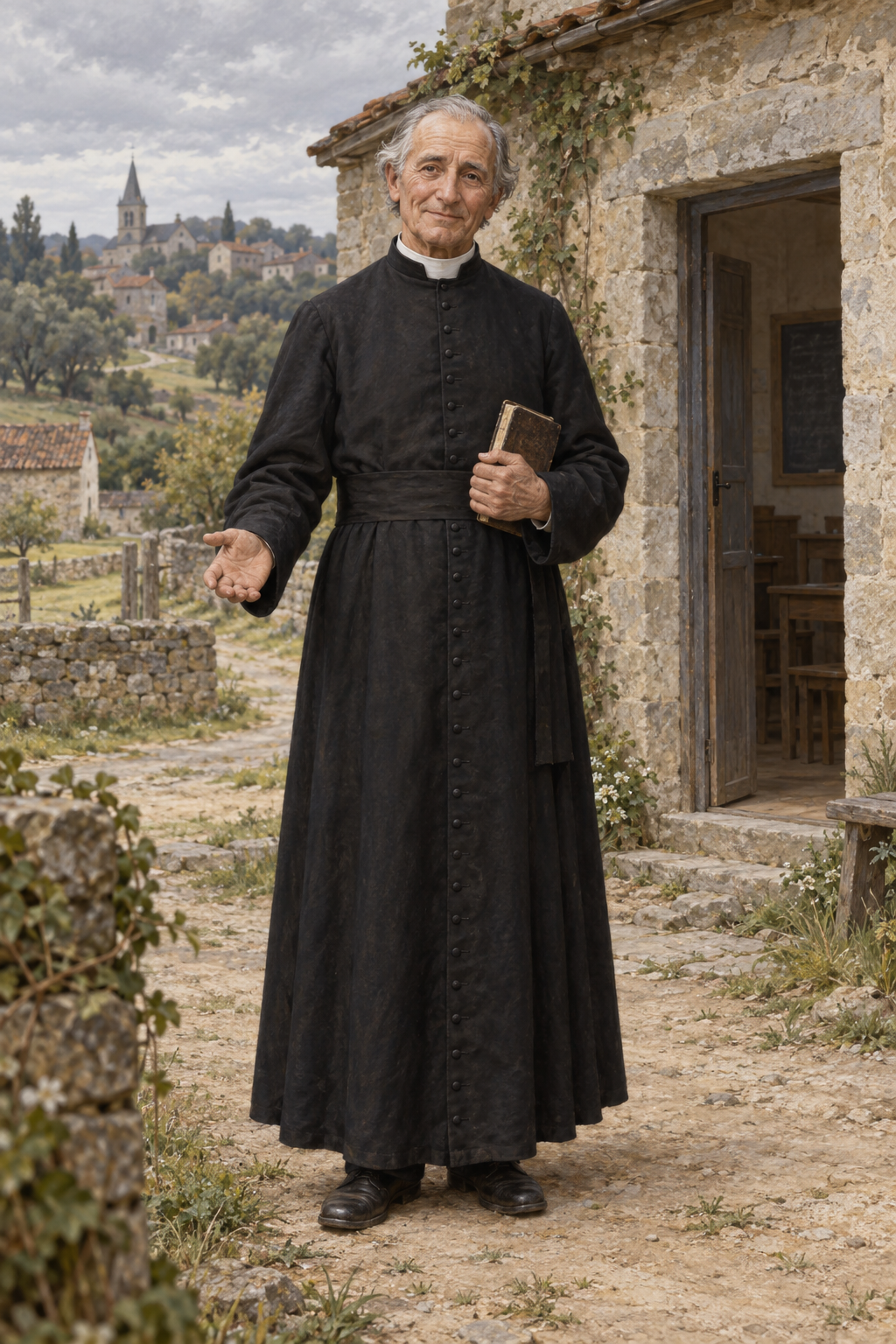
About Andrea Uberto Fournet
André-Hubert Fournet was born on 6 December 1752 at Pérusse, a village in the parish of Maillé. A diocesan study identifies his parents as Pierre Fournet de Thoiré and Florence Chasseloup and places several priests in the wider family. Childhood accounts describe a lively boy who preferred play to study. Some details come through a short notice published in 1835, one year after his death, so they are near to his lifetime but shaped by remembrance. Saying only Poitiers or Maillé obscures the smaller village named by the diocesan study. His later life remained centered on rural communities of the region.
Fournet studied at Poitiers before entering the priesthood. A reference biography describes a relative's influence on his choice.
A congregation-hosted reflection tells of a beggar confronting Fournet about a well-stocked table and a refusal of alms. The episode explains a change from social display to attention to people with little. Its reported conversation is later spiritual storytelling rather than a transcript. The historical point is that the parish priest's manner of life changed and his concern extended beyond people of his own standing. The reflection calls this a movement toward genuine encounter. That interpretation belongs to the Daughters of the Cross tradition, whose work in education and care later embodied the same concern.
During the French Revolution, Fournet refused the civil clergy oath and went into exile in Spain. The Dicastery says he returned secretly and ministered while persecution continued.
Armel de Sagazan's historical study follows Fournet's years as a displaced priest and his return to Maillé. The priest used temporary locations while he could not serve openly. In the study, his work after the Revolution also includes encouraging the formation of younger clergy. This is often missed when his biography focuses only on the future women's congregation. He visited families, taught promising candidates and kept ties with clergy and the bishop. The study draws on later recollections and correspondence; its value is in showing how education, pastoral care and rebuilding institutions occupied the same life. The clandestine years were a period of adaptation, not a separate heroic episode detached from subsequent work.
Fournet met Jeanne-Élisabeth Bichier des Âges amid clandestine ministry at Les Marsyllis. A reflection hosted by their congregation dates their meeting to 1797 and the Daughters of the Cross foundation to 1807. Later retellings dwell on their first exchange in the barn, but durable work matters more than uncertain dialogue. Together they shaped a community to educate children and care for people in need. Bichier brought her own initiative and leadership; Fournet was her spiritual adviser and a cofounder, not the only agent of the institute.
The Daughters of the Cross's account of their origins shows the practical challenges behind a foundation. Sisters moved among villages, taught children and helped sick residents. The community took root at Béthines by 1808, and small groups served other settlements around Maillé. Expansion required houses and a place to train members. Marie Pichot, once a novice at the earlier Fontevrist priory of La Puye, helped make that property available when the new congregation needed a larger center. Her part in the story is a reminder that the institute was built by several women as well as its two recognized founders. Its growth was sustained through local relationships and labor.
Jean-Paul Russeil's study of Fournet's spirituality draws on his letters and the congregation's first constitutions. It describes his attention to organization and to the women carrying out the work, not only ideals of charity. The historian explicitly notes Bichier's role in shaping the congregation's governing text and Fournet's respect for her judgment. That evidence helps keep the partnership visible. The letters also show continued concern for people entering religious life and for the needs of rural parishes. A community dedicated to teaching and nursing needed schedules, governance, training and support. The record of written direction makes those daily demands visible behind the later stories of individual encounters.
In 1820 Fournet left parish office and moved to La Puye, where the congregation's center had been established. His new role concerned the growing community rather than a single parish. He had suggested that Bichier form a religious institute to care for sick people and educate poor children. At La Puye he could direct its growth. His move shows how the work expanded beyond its first village while remaining linked to the needs he had seen as a parish priest.
Fournet died at La Puye on 13 May 1834. A congregation-hosted study gives the day and an encyclopedia independently confirms the town. The Dicastery's brief biography instead says 18 May, while its memorial is 13 May. Recording the conflict protects the exact date from a silent transcription of the erroneous value.
Pius XI beatified Fournet on 16 May 1926 and canonized him on 4 June 1933, according to the Dicastery. Two later French studies give 6 June for canonization; his memorial is 13 May.
Wondering how to weigh the stories and sources? Learn how to read a saint biography.