Biography
Anthimos of Chios
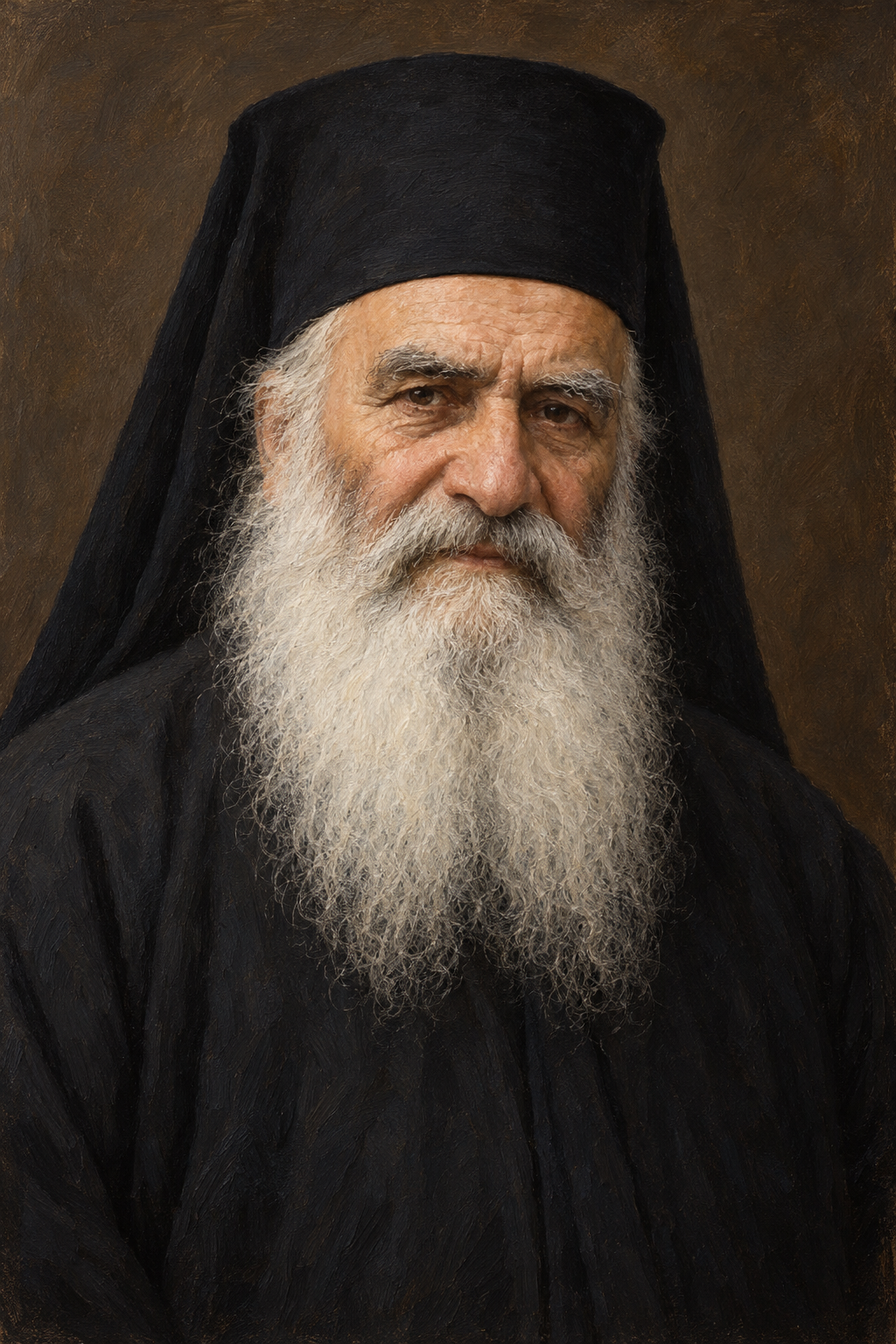
About Anthimos of Chios
Anthimos of Chios was born Argyrios Bagianos in 1869. A visit to have his family’s icon repaired brought him into contact with the monk Pachomios, who guided his monastic formation. When illness forced him home, he continued his religious life while working as a shoemaker to help his parents. After ordination, he served the hospital for people with leprosy on Chios. He ate with the patients, spoke with them, and celebrated the sacraments.
His care also extended to women displaced from Asia Minor. The island’s travel guide identifies him as the founder of Panagia Voitheia monastery in 1930, established to shelter nuns expelled from their former communities. The monastery stands near Chios town, on the road toward Karyes and Nea Moni. A high wall encloses it, and its main church is dedicated to the Virgin Mary.
Anthimos’s recorded teaching turns repeatedly to the motives behind ordinary conduct. A person might remain silent while inwardly angry, or help someone while complaining. He asked his listeners to examine these hidden responses as well as their outward actions. His counsel joined prayer with patience, humility and restraint in judging others. He did not present exhausting fasts and long vigils as the only measure of religious seriousness; humility mattered more than the appearance of strenuous practice. Prayer, in these sayings, belongs to everyday life as regularly as food does. Confession is described in the language of renewed baptism, expressing his belief in the possibility of repentance and a fresh beginning. His devotion to the Virgin Mary also runs through the teaching. These are the instructions of an Orthodox spiritual father addressing people within that tradition, with attention to the small habits through which they lived together.
The sisters helped preserve this teaching. In her study of Anthimos’s self-reproach, Nonna Papadimitriou describes talks given after Compline and in the church or refectory. The nun Bryaini, later an abbess, took notes and prepared carefully written, decorated manuscript copies. The monastery began publishing the collected teaching in 2000; the three-volume edition was completed in 2007 under the care of the philologist Antonios Charokopos, a former pupil of Anthimos. The printed books therefore preserve words transmitted through listeners and editors, rather than writings prepared by Anthimos for publication. Papadimitriou examines his repeated expressions of personal unworthiness as a practice of humility. Her interpretation places those expressions alongside his pastoral effectiveness, without treating them as a literal assessment that he could offer nothing to others. The study helps readers understand why severe language about himself appears in teaching remembered with affection by his community.
The manuscript record also shows the sisters taking an active part in transmitting their teacher’s words.
A different voice survives in a letter written by Nicephorus, himself a patient and monk at the Chios hospital. Addressing the abbess of Panagia Voitheia from Athens in July 1961, he recalled Anthimos’s ministry after the priest’s death. Nicephorus distinguished the period he remembered from events before his own arrival: he entered the hospital in 1914 and did not claim firsthand knowledge of the earlier years. He then recounted episodes that he understood as healings and deliverances through Anthimos’s prayers. The letter sometimes identifies people by name and sometimes acknowledges gaps in his memory. Its importance here is as the testimony of someone who lived in the community Anthimos served. It records the gratitude and religious conviction of a patient who became his disciple. The reported healings remain attributed devotional accounts; the letter does not establish medical diagnoses, causes of recovery or guarantees for other people who seek the saint’s intercession.
He closed by offering to write again if he remembered further episodes. He also recalled what he believed to be Anthimos’s foreknowledge, adding that his teacher avoided making the gift public because he did not seek praise.
Anthimos died on February 15, 1960. Theologian Alexandros Christodoulou describes him as a modern protector of people with leprosy, reflecting the devotional memory of his hospital ministry. The Church of Constantinople recognized him as a saint in 1992. His annual commemoration is February 15, preserving his name in the Orthodox calendar alongside the communities and people associated with his care.
Formal recognition followed a process recorded by the local church. Metropolitan Dionysios submitted the request to the Church of Greece in October 1991, and its synod forwarded the matter to the Ecumenical Patriarchate that December. The Chios account identifies a patriarchal and synodal act dated August 14, 1992. It also records the first official episcopal celebration at Panagia Voitheia on February 15, 1993, with Dionysios presiding. This institutional account distinguishes the decision to recognize Anthimos from the community’s first official celebration of his feast afterward. The monastery he founded thus became a setting for the public observance of his memory, as well as the home of the sisters who had preserved his teaching.
Wondering how to weigh the stories and sources? Learn how to read a saint biography.