Biography
Antoine Daniel
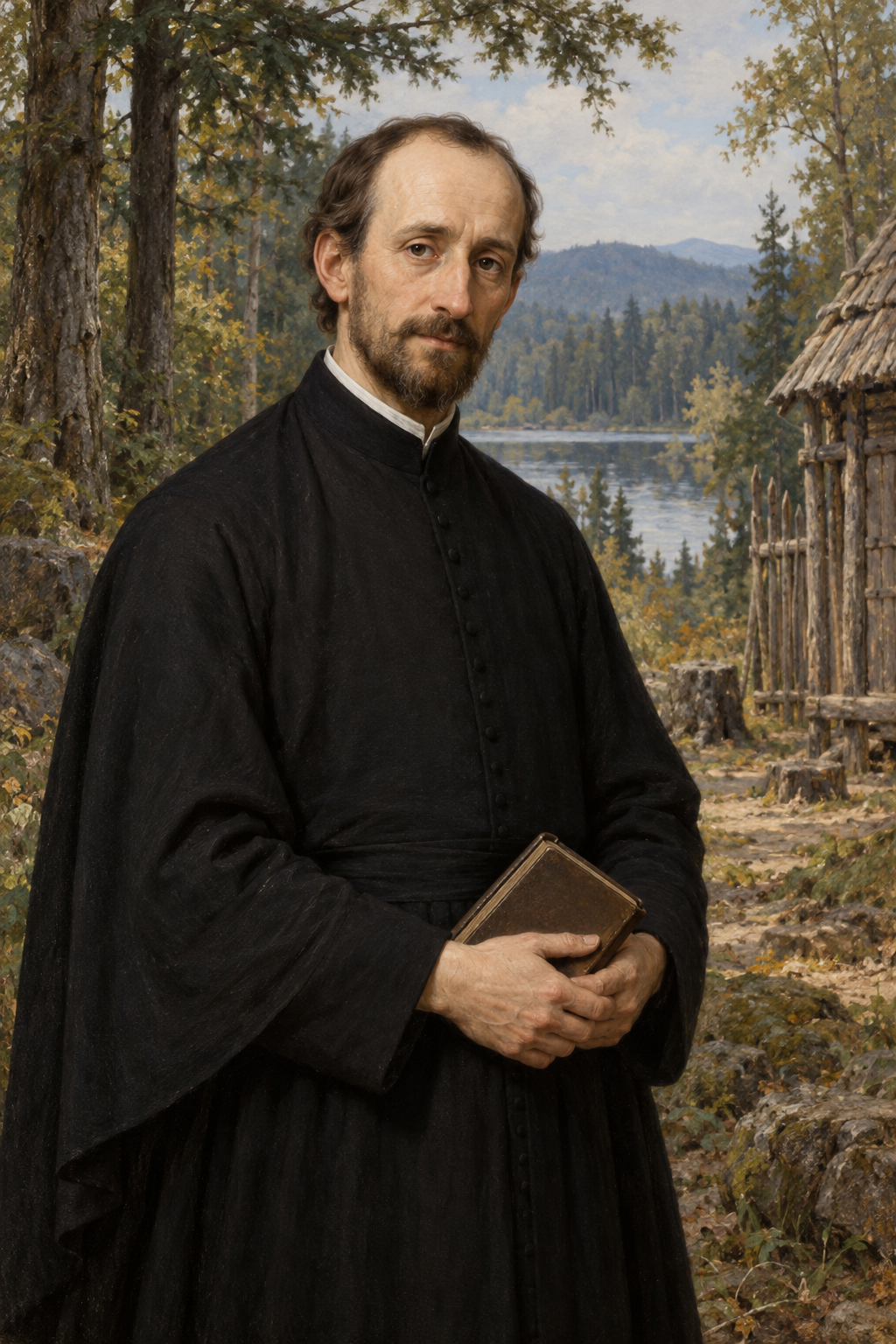
About Antoine Daniel
Antoine Daniel was a Jesuit priest and teacher from Dieppe. Before entering the Society of Jesus at Rouen in 1621, he had begun legal studies. His formation included teaching at Rouen and studying theology in Paris. Later he taught and served at the college in Eu.
His birth year is less certain than many short biographies suggest. Fernand Potvin compares early records that have supported dates between 1598 and 1601. He also cautions that Daniel’s role in preparing the Wendat visitor Amantacha for baptism cannot be established from the evidence he found. The encounter belongs to the setting of Daniel’s vocation, but its precise influence remains uncertain.
Potvin also distinguishes evidence from reconstruction in Daniel’s earlier life. He sets the family within Dieppe’s maritime connections and discusses the careers of Daniel’s brothers, including the captain Charles. Yet he does not claim that this setting proves how the missionary vocation began. Even the commonly given ordination year rests on a reconstruction from training and appointment records. These qualifications leave room to remember a real vocation without supplying conversations, motives or precise dates that the documents do not preserve.
Daniel reached Cape Breton in 1632 and Quebec the following year. In 1634 he travelled inland with Jean de Brébeuf to work among the Wendat, called Hurons in the mission reports. He later returned to Quebec to direct an experimental seminary for Wendat boys. The European educational scheme proved unsuitable, and he resumed mission work in 1638.
Brébeuf’s report of 1635 gives a closer view of this work. Daniel had to change canoes during the difficult journey inland. Learning the language demanded sustained effort: Brébeuf praised Daniel’s vocabulary while noting the difficulty of speaking fluently. The missionaries themselves depended on the people among whom they lived for language learning and travel.
Teaching could begin with music. Brébeuf describes Daniel leading a verse of the Lord’s Prayer in the Wendat language, followed by the gathered listeners repeating it. Children participated eagerly, and elders could raise questions and explain their own beliefs. This was a missionary account of an encounter with a living community, whose members listened, questioned and responded.
The seminary’s beginnings appear in Paul Le Jeune’s report of 1636. Daniel arrived at Trois-Rivières exhausted, carrying letters and news from the inland mission. The school project required more than a willing teacher. The Jesuits lacked adequate accommodation, food and clothing, and families had serious concerns about sending their children far from home. Le Jeune describes mothers and grandmothers refusing the journey, fathers reconsidering and councils discussing the proposal. Some young people eventually agreed to remain. The report shows a difficult negotiation involving family relationships, long-distance travel and the uncertain resources of the new school.
The project also had political purposes. Le Jeune explicitly hoped that children living with the French would help secure the missionaries’ safety and strengthen commercial ties. His account uses the language of hostages for that hoped-for protection. This stated intention should remain visible alongside the religious teaching Daniel hoped to offer. It helps explain why a biography cannot simply describe the school as a generous educational success. The surviving narrative gives the missionaries’ perspective on negotiations; the parents’ words and decisions reach us through that account, rather than through a record written by the families themselves.
After the seminary experiment, Daniel continued active mission work for ten years. Pouliot’s account emphasizes his persistence as a teacher and priest, connecting the earlier classroom work with the ministry that occupied the remainder of his life.
On 4 July 1648, attackers reached the village of Saint-Joseph II, Teanaostaiaë, as Daniel finished Mass. Ragueneau’s report says that he baptized people, visited older and sick residents and returned to the chapel. When escape became urgent, he encouraged others to flee and went towards the attackers himself. He was struck by arrows and gunfire, and his body was thrown into the burning church.
The report also records the suffering of the wider community: people were killed or taken captive, and survivors sought refuge at Sainte-Marie. Ragueneau understood Daniel’s actions as pastoral self-giving. That interpretation is part of the mission’s religious memory; it does not make the writer an eyewitness to every reported act or establish the supernatural appearances he later describes.
Potvin’s comparison distinguishes several contemporary accounts, including three written by Ragueneau. Their number does not mean that they are independent witnesses. He notes that Marie de l’Incarnation’s account drew on Ragueneau, while suggesting that some differences might reflect further information. Careful reading preserves both Daniel’s remembered courage and the limits of the surviving testimony.
Daniel was canonized with the other Canadian martyrs on 29 June 1930. Their shared feast is celebrated on 26 September in Canada and on 19 October in the universal Catholic calendar. These commemorations preserve his place within a group, while the surviving accounts also remember his particular work as a teacher and priest.
Wondering how to weigh the stories and sources? Learn how to read a saint biography.