Biography
Antonio González
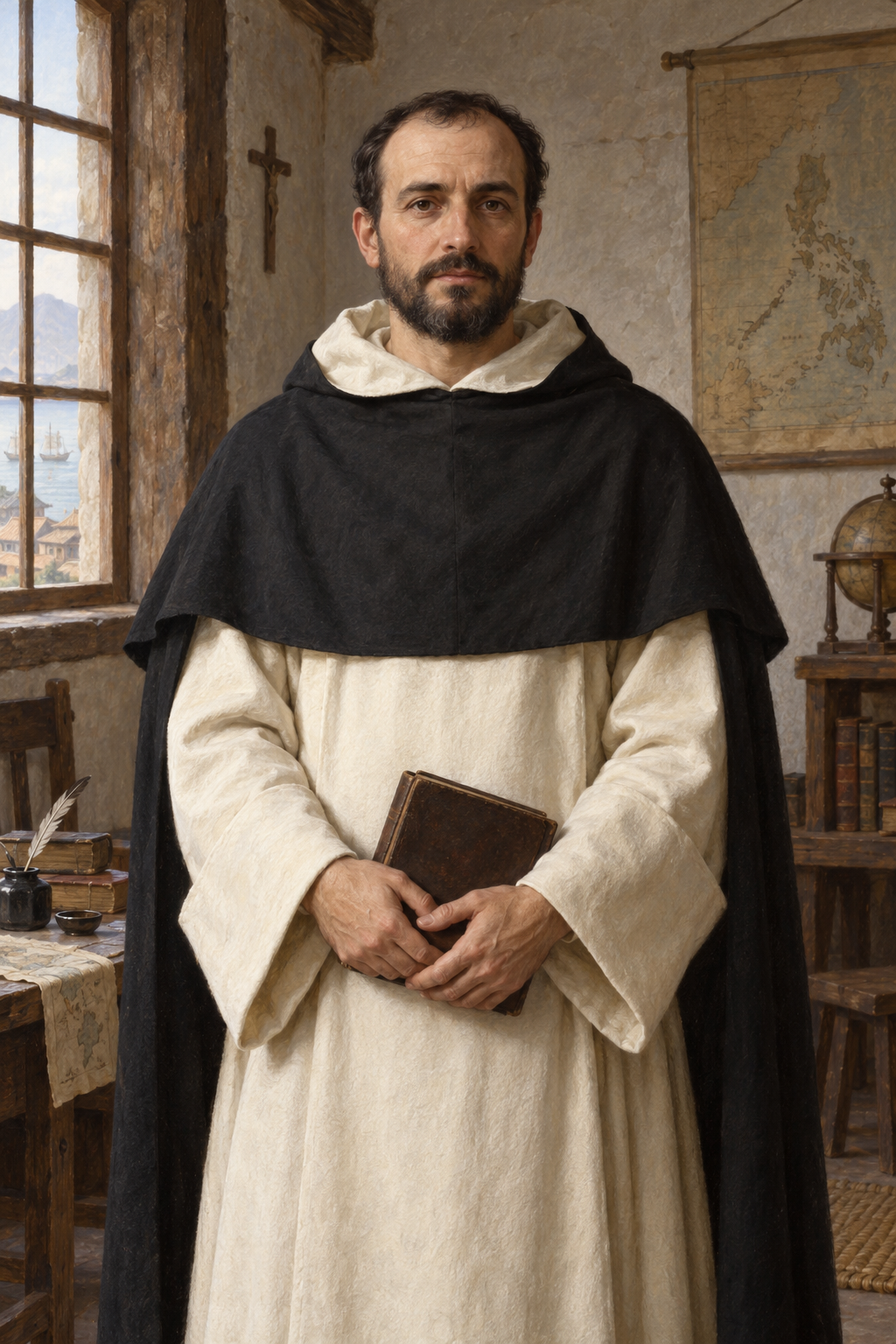
About Antonio González
Antonio González was a Dominican priest from León. He taught theology before joining a mission intended to reach Christians in Japan.
The early account describes his studies at León and work with students at Piedrahita. In Manila, he taught while preparing for the Japanese mission.
The group traveled through the Lequios islands. The narrator explicitly admits uncertainty about their activities there. Their later arrival as prisoners at Nagasaki does not establish that every reported episode of preaching or conversion during confinement occurred.
Already ill, Antonio endured torture and died in custody on 24September1637. The account describes him encouraging his companions before his death. Its language expresses the author’s religious understanding of martyrdom; it is a reported narrative, rather than a verbatim transcript of the prisoners’ words.
The account through which these events are known has its own history. In his introduction to the 1977 bilingual edition, Quintín M. García identifies its author as Domingo González, a different Dominican from Antonio. The original booklet was printed in Manila in 1638 at the College of Santo Tomás, with Luis Beltrán named as printer. García explains that the scarcity of surviving copies made republication useful. The nearness of its publication to the deaths gives the narrative historical importance, while leaving the historian to assess how its author obtained individual reports. García explicitly credits Benito Vargas with the translation of the Spanish documents into English.
García also draws attention to an imbalance in the narrative: the priests occupy its foreground, although two lay companions shared the journey and imprisonment. His introduction supplements their stories with later documentary testimony and a letter describing the reception of the news in Manila. Its particular purpose was to restore Lorenzo Ruiz to wider Filipino remembrance. That editorial purpose helps explain why Antonio appears both as a subject of the older report and as a companion in a modern presentation centred on another martyr. The two perspectives illuminate different aspects of the same group’s remembrance.
John PaulII beatified the group in Manila in 1981. His homily named Antonio as the head of the mission and placed him beside Lorenzo Ruiz, a married layman from Manila. The pope presented their witness within a wider community of priests, religious and lay collaborators drawn from Europe and Asia. This was a retrospective interpretation of their shared Christian witness, rather than new contemporary evidence about every detail of Antonio’s death.
The setting of the beatification reinforced this shared remembrance. Addressing the gathering at Luneta Park, John Paul II related its thanksgiving to Manila’s earlier reception of news from Japan. He greeted churches connected with the martyrs through birth, ministry or death and described their unity across those different places. His interpretation linked baptismal commitment and ordained ministry without giving priests an exclusive place in Christian witness. The homily also addressed teachers and students, presenting theological learning as preparation for service and evangelization. For a priest remembered as a teacher, this placed the educational part of his story within the meaning given to the celebration, rather than allowing the circumstances of his death to eclipse it. Four Dominican honorees taught at Santo Tomás; another studied there, according to the homily.
The group was canonized on18October1987. At that ceremony, John PaulII emphasized the participation of lay people alongside Dominican missionaries. Antonio’s remembrance thus belongs to a shared history of faith across different languages and places, including the teaching institution at Manila associated with members of the group.
The canonization had another contemporary setting: World Mission Day and a synod considering the place of lay people in the Church. Catechists were among those addressed. The homily treated the new saints as an example for communities in which clergy and lay people worked together, and it recalled the Dominican Province of the Holy Rosary during its fourth centenary. Its closing appeal turned to the Gospel’s promise of love and peace, using Isaiah’s vision of weapons transformed into farming tools. In this presentation, honouring people killed for their faith was meant to encourage Christian service rather than further violence. The pope also distinguished the exceptional circumstances of martyrdom from the daily responsibility to live the faith. These emphases belong to the interpretation offered at the 1987 ceremony, not to words independently recorded from Antonio himself. Its opening also grounded the missionary task in Christ’s continuing presence with his followers.
The Dominican calendar in Spain commemorates the group on 28 September. Its individual biography also reports 24 September for Antonio, so the two observances require distinct calendar descriptions.
The calendar source identifies its own scope: it follows the Vatican calendar with variations for the Spanish bishops and the Dominican calendar in Spain. Its September commemoration is therefore evidence of a particular Catholic observance. Keeping that setting visible helps distinguish a shared liturgical memorial from the date on which Antonio individually died.
Wondering how to weigh the stories and sources? Learn how to read a saint biography.