Biography
Aquilinus of Milan
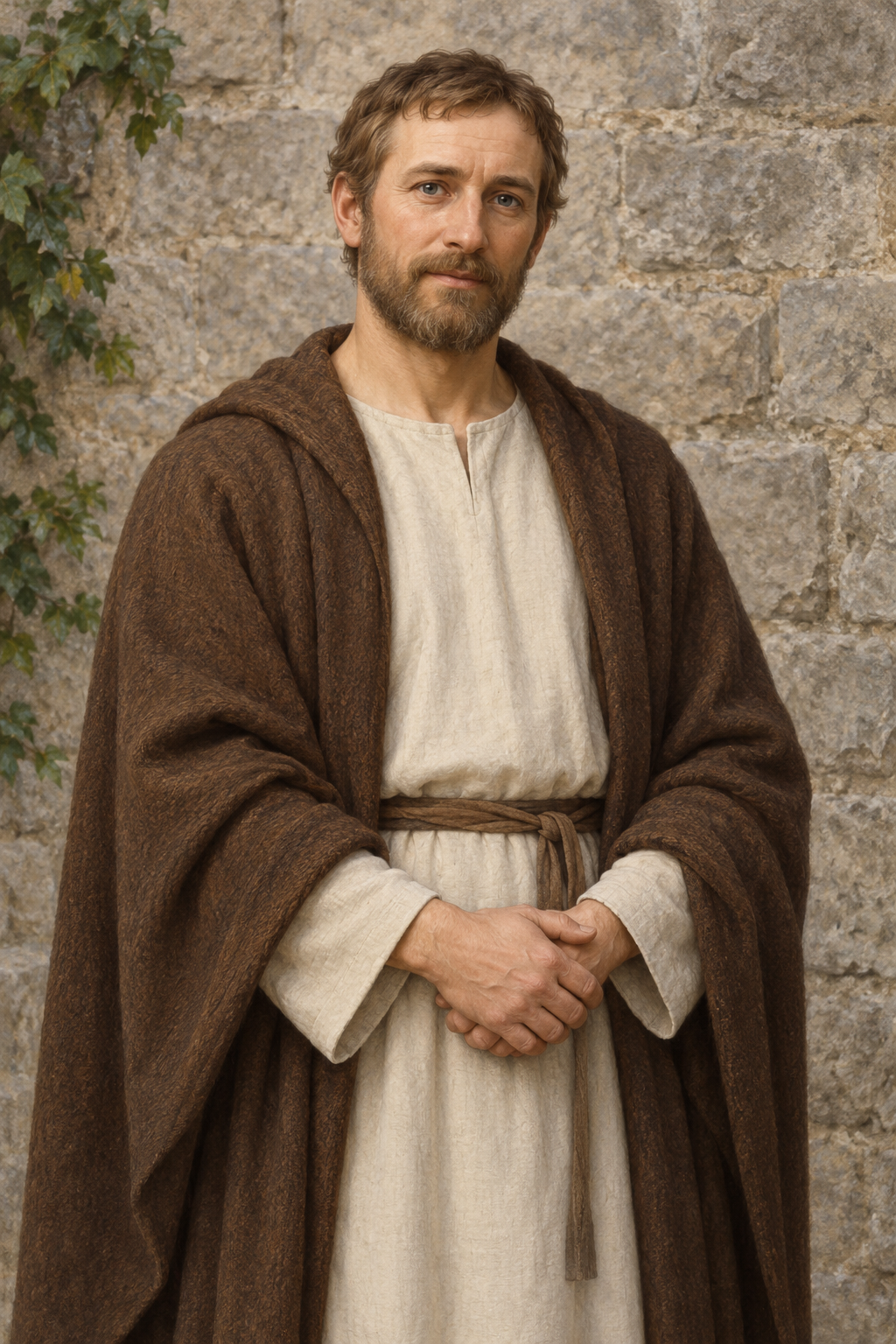
About Aquilinus of Milan
Aquilinus of Milan is venerated as a priest and martyr, with a feast on 29 January. The French Catholic directory Nominis calls him Aquilin and expressly leaves his date uncertain. His place in Milanese devotion is more clearly preserved than the chronology of his life.
The traditional account places his birth at Herbipolis, or Würzburg, and sends him to Cologne to study and join the clergy. It describes generosity to people in need and repeated refusal of episcopal office, followed by journeys through Paris and Pavia to Milan. There he is said to have lived with the canons of San Lorenzo, opposed teachings described as Arian, and been killed for that opposition. A dense fog prevents his attackers from concealing the body, and believers carry it to San Lorenzo for burial. This is a devotional narrative, including miraculous elements, rather than a contemporary record of his movements or death.
The uncertainty was already apparent to the editors of the Acta Sanctorum. Their introduction distinguishes the sources they had seen from works known only through other writers. They present lessons from a regular-canons’ office printed in Venice in 1634 and report an Italian life published by Josephus Milano in 1606, without claiming to have examined that entire work themselves. Their discussion also preserves competing attempts to place Aquilinus in widely separated periods. These proposals cannot supply a dependable birth or death year. The record therefore needs to be read as a history of transmitted accounts, whose dates of publication are known more readily than the date of the person they describe.
Treccani’s encyclopedia describes the story as a relatively recent legend and points to a difficulty within its religious setting. The attackers have been called Arians and Manichaeans, terms that do not straightforwardly establish one period. If the latter label refers to medieval Cathars, the encyclopedia suggests an eleventh- or twelfth-century setting. That is a conditional interpretation, rather than a fixed date. It helps explain why a confident year repeated in later notices is insufficient evidence by itself. Neither the identities of the attackers nor the precise circumstances of the killing should be reconstructed beyond the limits of the tradition.
The history of his images offers another caution. In an account quoted by the Acta editors, Gabriel Pennottus describes roughly twenty-four pictures associated with Aquilinus’s life, martyrdom, burial, and miracles in the chapel at San Lorenzo. He also discusses the clothing of the canons represented there, comparing it with the dress of regular canons he knew. These observations show how religious communities understood the saint through visual tradition. Pennottus’s argument that the paintings were many centuries old should not be accepted as a secure date for them or for Aquilinus himself. An image can document a community’s representation of a saint without preserving his actual appearance. Pennottus notes grey tunics in the pictures and compares them with the white clothing worn by some regular canons of his own time. He also discusses their tonsure. These details record how he interpreted the figures’ religious identity; they do not prove Aquilinus’s membership in a particular order during his lifetime.
A more concrete glimpse of devotion survives in Ferdinando Fontana’s Antologia Meneghina, published in 1900. Fontana describes the porters’ offering of a leather skin filled with oil to Aquilinus at San Lorenzo on 29 January. The procession began near an image of Mary in Via della Palla and passed through the city toward the church, where priests received it. A band led the way; the society’s marshal carried his staff, and its president carried a banner bearing Aquilinus and Mary. A porter followed with the oil skin in a decorated basket. Fontana describes this as a surviving ceremony. His account provides evidence for the remembered association between the saint, an occupational community, and a public act of worship. It does not require accepting the legendary discovery of the saint’s body as an independently verified event.
That association remains visible in the Duomo’s own presentation of Aquilinus. The Veneranda Fabbrica lists him as patron of porters and identifies the figure on spire G66 in the south transept. Its record says that the present sculpture reproduces an original made by Antonio Rusca during the nineteenth century. The sculpted saint is bearded, draped in a garment falling from his left shoulder, and shown with joined hands and an upward gaze. This is evidence for a later artistic representation and the place assigned to him among the cathedral’s saints. The sculpture’s posture and costume express devotion rather than a securely known moment in Aquilinus’s life.
Aquilinus’s remembrance thus reaches beyond the uncertain biography into liturgy, images, and the practices of working people. Nominis continues to record his priestly and martyr titles and his January feast while acknowledging the chronological gap. A responsible account can preserve that veneration without choosing an unsupported year.
Wondering how to weigh the stories and sources? Learn how to read a saint biography.