Biography
Arcangelo Tadini
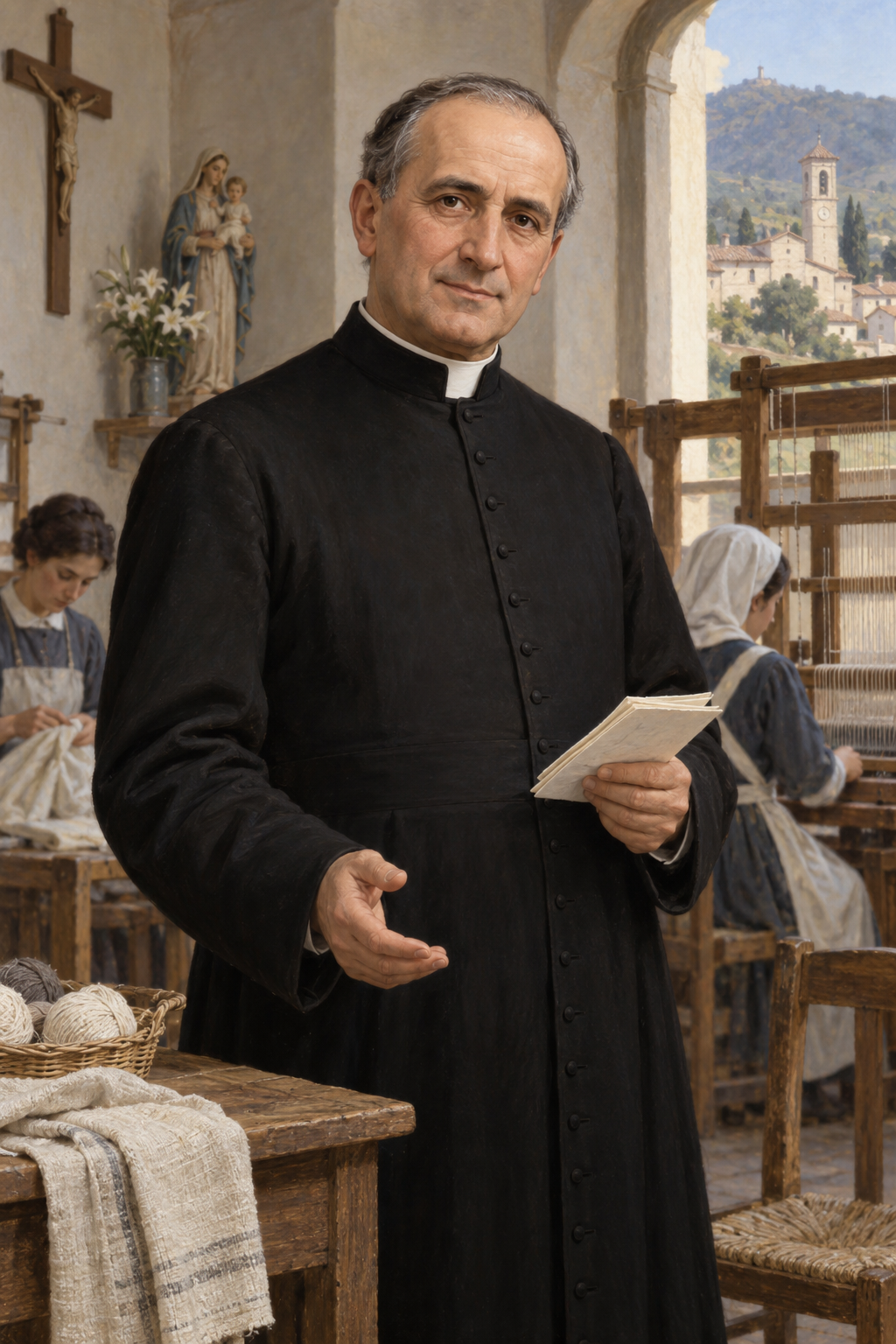
About Arcangelo Tadini
Arcangelo Tadini was born at Verolanuova, in the province of Brescia, on October 12, 1846. The describes him as a Brescian priest whose life joined faith, pastoral tenderness, and concern for workers. He completed his elementary studies in his native town and then studied at Lovere.
In 1864 Tadini entered the seminary of Brescia. He was ordained a priest in 1870. The official profile places his first assignments at Lodrino from 1871 to 1873 and then at the sanctuary of Santa Maria della Noce, a district of Brescia. These early posts should be treated as preparation for the long parish ministry that followed.
In 1885 Tadini began serving at Botticino Sera as vicar-cooperator. Two years later he became pastor there, and the source says he remained until 1912, the year of his death. The exact place of death should remain unresolved unless a cleaner source is added before sealing.
The Botticino years form the heart of the profile. The official biography says he loved his parishioners as children and spared himself nothing. He began a Schola Cantorum, a band, confraternities, the Franciscan Third Order, and the Daughters of Saint Angela, while also restoring the church and caring for the liturgy.
Those parish initiatives matter because they show a priest attentive to the whole texture of local life. Music, catechesis, associations, sacraments, and care for workers were not competing programs. In the official account, they belong to one pastoral imagination formed by worship and daily contact with his people.
His preaching and catechesis were pastoral rather than decorative. The source says he prepared homilies with both the word of God and the spiritual path of his people in view. That detail helps explain why later social work belonged inside his priesthood rather than beside it as a separate interest.
Tadini's attention turned especially toward the hardships of early industrialization. The profile names factories, spinning mills, and fields as places where workers suffered and where the Church was called to respond. This should be phrased historically, without importing later labor-policy language that the source does not use.
For workers he began an Association of Mutual Aid. For young women in the town who lived with uncertainty and injustice, he built a spinning mill to provide work. These details can support a concrete profile: Tadini did not only speak about dignity, but organized structures where people could work and be formed.
In 1900 he founded the Congregation of the Sisters Workers of the Holy House of Nazareth. The official profile says these consecrated women were to be workers with workers, educating young women not from a platform but by working beside them and showing the dignity of earning bread through honest labor.
That model caused scandal in its time, when factories were often viewed as dangerous or morally suspect places. Tadini entrusted the sisters with the example of Jesus, Mary, and Joseph in the hidden work of Nazareth. The final page should keep that spirituality connected to ordinary work, not romanticized as nostalgia.
The Nazareth image gave religious meaning to humble labor. The source connects the sisters' work with a household where Jesus, Mary, and Joseph lived quietly and simply. That support lets the biography speak about sanctified work without claiming that every workplace condition was solved by the new congregation.
The profile says Tadini received slander and misunderstanding, including from within the Church, because his work anticipated later ways of meeting the world of labor. The safest wording is that he saw the workplace as a place needing Gospel leaven and personal encounter, not simply as a hostile world to oppose.
This point also guards against a flat portrait of Tadini as only a benevolent manager. The official profile presents him as a pastor willing to risk misunderstanding for a new form of consecrated life that met young workers inside their ordinary conditions, with dignity, discipline, and faith.
Tadini knew that his work was ahead of its time, but the source presents his confidence as faith that the work belonged to God. He died while the dream of his life was still incomplete. The official page records his beatification by John Paul II on October 3, 1999, and canonization by Benedict XVI on April 26, 2009.
His profile should therefore emphasize parish ministry, sacramental care, workers' dignity, and the education of young women through shared labor. It should avoid current congregation statistics, broad political claims, or a factory scene detached from the actual Botticino parish context.
Artwork should show an Italian parish priest in a black cassock with papers or a book in a modest parish or workshop setting. A loom, thread, or workbench can refer to the spinning mill and sisters' labor, but the image should avoid modern machinery, smokestacks, crowd scenes, rendered text, and any claim to historical portrait likeness.
Wondering how to weigh the stories and sources? Learn how to read a saint biography.