Biography
Aredius
About Aredius
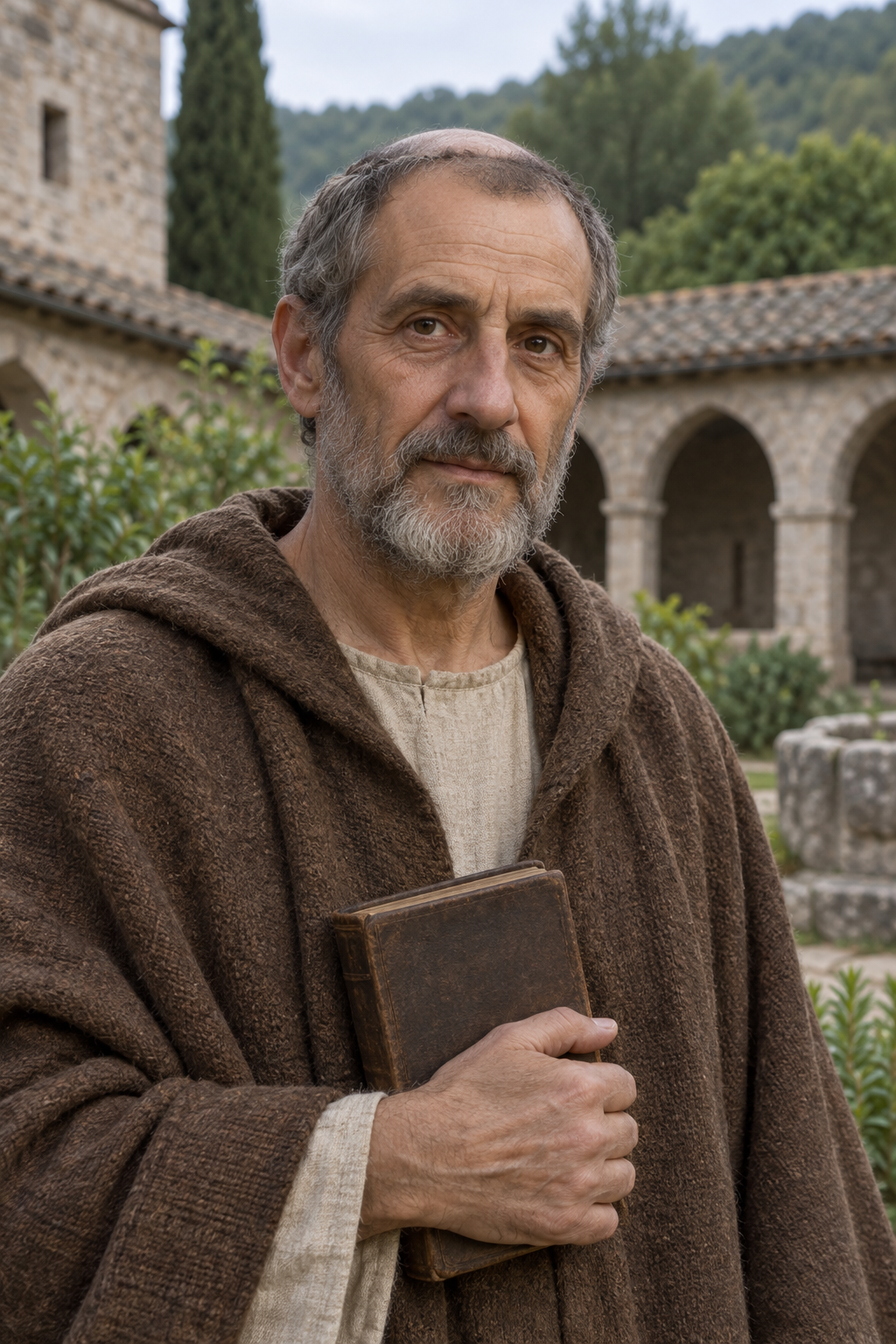
Aredius, also remembered as Saint Yrieix, founded a monastic community in the Limousin region of Gaul. Gregory of Tours knew him personally and preserved an account of his life. His work joined church building, monastic leadership, and devotion to the saints.
Gregory’s Life of the Fathers gives a direct glimpse of his formation. In introducing Nicetius of Trier, Gregory identifies Aredius as the abbot from whom he heard the information that follows. He says that Nicetius had brought Aredius up and admitted him to clerical orders. Aredius therefore appears as both a pupil and a witness to his teacher’s life. Gregory’s acknowledgment makes the personal connection unusually clear. It also explains how memories of the Trier bishop reached the writer in Tours.
Another work records Aredius’s involvement with relics and church building. At the opening of chapter 40 of the Miracles of Julian, Gregory calls him a priest from Limoges. When Aredius came to see him, Gregory asked carefully about his life, his actions, and Julian’s miracles. The passage adds that Aredius had built a basilica in the martyr’s honor and furnished it with relics. It places his devotion within a concrete work of building and furnishing a church, while showing him as an informant rather than simply the subject of a distant legend.
His mother Pelagia shared in the arrangements for the community’s future. A copied excerpt of their joint testament names both donors and identifies Aredius as a priest. It assigns a share of property to Saint Martin and another share to the monks at Attanum, under Martin’s protection. The document also commends an oratory dedicated to Saint Medard and its possessions to those monks. These provisions connect spiritual patronage with the practical task of preserving a religious house and its property.
The same excerpt describes a community that included free people and people drawn from the donors’ enslaved household. This wording preserves a difficult feature of its social setting. The foundation did not stand apart from the unequal relationships of the estate. Pelagia’s subscription appears alongside those of witnesses, while Aredius’s subscription says that he wrote and reread the testament. The surviving copied text records those declarations; it does not preserve their original handwriting.
Aredius also belonged to a circle of correspondence and prayer. In poem V 19, Venantius Fortunatus sends greetings because he cannot see the abbot in person. He asks Aredius to remember him in prayer, sends greetings to his mother, and asks for a reply when the messenger returns. Agnes and Radegund join the greeting. The short poem gives the relationship an everyday form: a letter takes the place of a visit, a messenger carries the answer, and mutual prayer sustains the exchange. It preserves a voice addressed to Aredius during his lifetime.
Gregory records his final visit to Tours and his return to his cell. His account says that Aredius then became ill with dysentery.
The New Catholic Encyclopedia gives his death as 25 August 591. Nominis continues to list that date as his local Catholic feast.
His memory grew through later biographies. Catherine Faure’s study distinguishes Gregory’s contemporary account from the longer and shorter lives that followed it. She proposes successive stages of enlargement, in which miracles and passages borrowed from the life of Eligius helped shape the founder’s image. Some proposed dates remain hypotheses. These texts also served the later institution, whose changing relationships with Tours and the bishop of Limoges affected how its founder was remembered.
Faure also corrects a consequential reading of his bequests. The Saint Hilary associated with the testament concerns the local oratory at Attanum, rather than the establishment in Poitiers identified by a later biographer. The distinction preserves the local setting of Aredius’s foundation and shows why a later account cannot always supply a missing detail in a contemporary source. His early arrangements and their subsequent interpretation belong to different moments in the community’s history.
Material evidence preserves another stage of this remembrance. The Metropolitan Museum holds a reliquary bust of Saint Yrieix made around 1220–1240, with a later grille. Silver and gilded silver, crystal, gems, and glass surround the sculpted head. The original metal covering concealed a carved wooden core. The museum explains that the reliquary once contained the skull venerated as the saint’s and would have been carried in procession before being placed on an altar.
In the museum’s audio account, curator Barbara Drake Boehm describes a copy kept in the village church with the venerated skull. She also explains how the original silver sheets were mounted on a modern core so that the older wooden sculpture could be displayed separately. The bust represents medieval devotion rather than a likeness established from Aredius’s lifetime. His remembrance survives through the community he founded, the letters and narratives of contemporaries, and the later art through which that community gave his memory a visible presence.
Wondering how to weigh the stories and sources? Learn how to read a saint biography.