Biography
Athanasius Parios
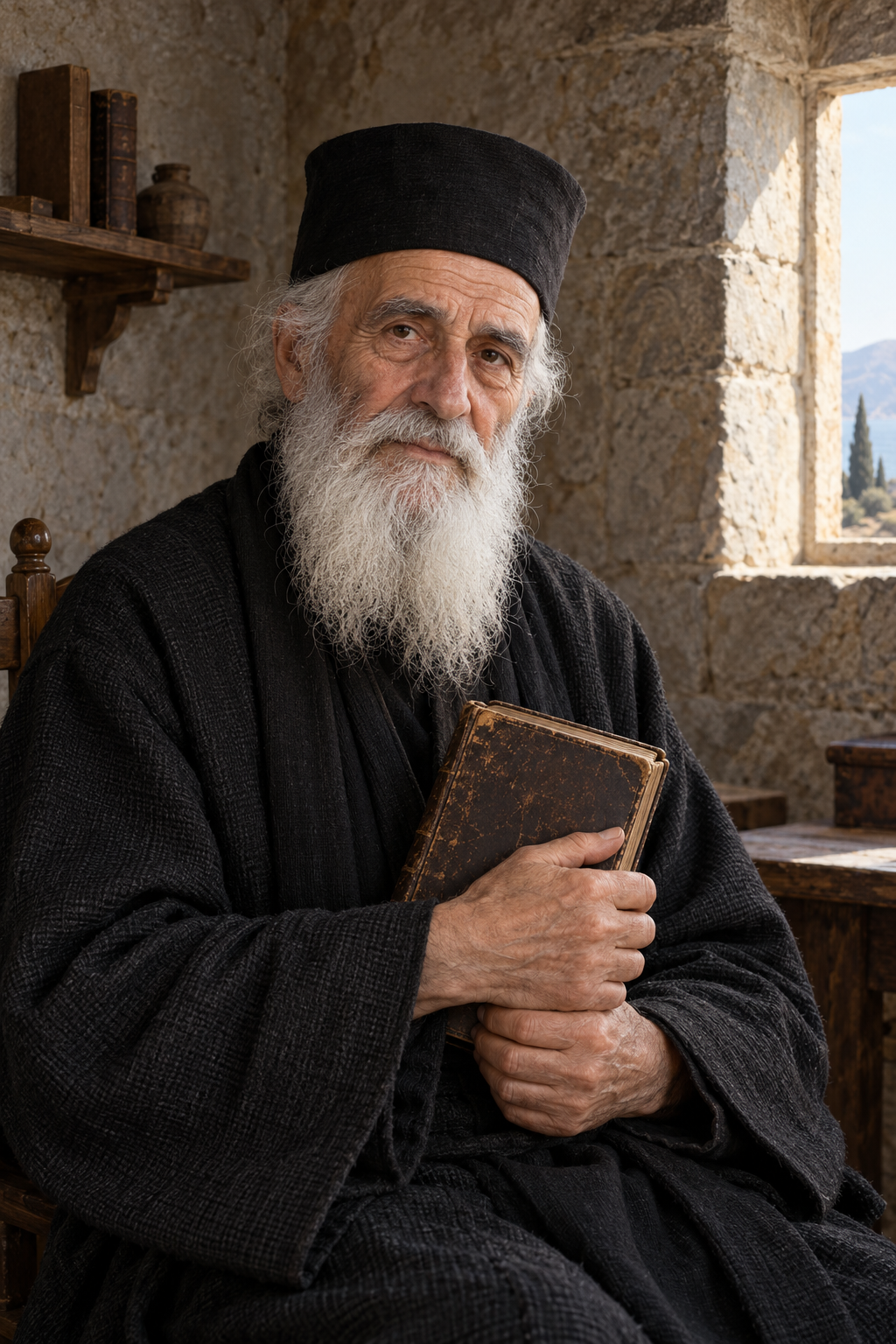
About Athanasius Parios
Athanasius Parios was a Greek teacher and priest whose work joined education, Orthodox theology and vigorous controversy. He came from Kostos on Paros, and his family name was Toulios. His early education began on his home island before he continued his studies in Smyrna in 1745. In 1752 he went to the Athonias Academy on Mount Athos, where his teachers included Eugenius Voulgaris. Later study on Corfu brought him into contact with another prominent teacher, Nikephoros Theotokis.
Modern church accounts place his birth around 1721 or 1722; Meyer’s older encyclopedia gives 1725. His birth date is therefore best treated as approximate.
On Mount Athos, he became associated with the Kollyvades. These monks opposed memorial services for the dead on Sundays, arguing that Sunday should preserve its character as the weekly celebration of the Resurrection. They also advocated frequent Communion and continual inward prayer. The dispute brought Athanasius into conflict with other monks and ecclesiastical authorities. From 1776 until 1781 he was suspended from exercising his priesthood; afterward he was restored. This conflict formed a significant interruption in his religious and teaching life.
Athanasius worked in several centers of Greek education. Theodoros Zisis identifies Thessalonica, Mesolonghi and Chios as places where he taught, alongside his periods on Mount Athos. These movements linked his career to schools and religious communities beyond his native island. Zisis describes his final journey from Thessalonica as an intended return to Paros that ended instead on Chios, where the inhabitants persuaded him to remain as a teacher. His later life thus developed away from the home to which he had hoped to return.
The chronology of his Chios appointment varies. The metropolitan biography places his departure from Thessalonica in 1786 and his direction of the school in 1788–1811. Zisis gives 1786–1811 for his leadership. These accounts agree on his long service there but should not be forced into an exact, uniform timetable.
His published Epitome, issued in Leipzig in 1806, presented a synthesis of Orthodox doctrine. Meyer describes its foundations as Scripture, written tradition and the Church’s conciliar teaching. The work shows the influence of Voulgaris while also developing Athanasius’s own theological positions. His writing was not confined to dogmatic instruction. In his Christian Apology he attacked the French revolutionary understanding of freedom and equality, and he directed another work against Voltaire. That latter book appeared after his death. Meyer also notes that he organized his treatment of Christ’s work around the roles of king, priest, lawgiver and judge.
His opposition to Enlightenment thought has often shaped assessments of his teaching. Yet Yingxue Chen’s doctoral research argues against treating him as simply hostile to mathematics and the natural sciences. The dissertation’s abstract reports positive elements in his writings about science and previously neglected aspects of his mathematical and physical education. It also examines contemporary responses to his grammar and rhetoric textbooks. This is a qualified reassessment of his educational outlook, not a claim that he accepted all the political and religious ideas he opposed.
A separate dispute concerns the Paternal Instruction, a pamphlet published in 1798 that urged Christians to obey Ottoman authority. Marios Hatzopoulos’s study treats its authorship as unresolved, despite its publication under the name of Patriarch Anthimos of Jerusalem. Athanasius should therefore not be confidently identified as its author. His own contribution to the controversy was a reply to Adamantios Korais, entitled Neos Rapsakis. According to the study, supporters of Korais obtained the manuscript before publication and sent it to him, preventing its appearance in print.
Another work shows how Athanasius used accounts of saints in theological controversy. In Heavenly Judgment, he interpreted an explosion on Corfu in 1718 as the intervention of Saint Spyridon against plans for a Catholic altar in the saint’s church. The text presents the disaster as a divine judgment between the Eastern and Western Churches. This is Athanasius’s religious interpretation of the event, not independent proof of its supernatural cause.
His language in that work is uncompromising. He treats the proposed altar as representing Catholic doctrine and papal authority, and argues that its rejection demonstrates the truth of Orthodoxy. The account combines devotion to Spyridon with a forceful attack on another Christian tradition. Describing this argument accurately requires preserving its hostile character while distinguishing the author’s convictions from historical conclusions. The work is evidence for how Athanasius wrote and argued, rather than a neutral account of relations between the churches.
He also contributed to the New Leimonarion, a collection of saints’ lives begun by Macarius of Corinth, and wrote its preface. His literary work included lives of Macarius and Mark the New. Athanasius spent his final days at Saint George’s hermitage at Resta on Chios and died on June 24, 1813. The Orthodox Church recognized him as a saint in 1995. His legacy includes educational and devotional writing alongside controversies that remain essential to understanding his place in Greek Orthodox history.
Wondering how to weigh the stories and sources? Learn how to read a saint biography.