Biography
Baldassare Ravaschieri
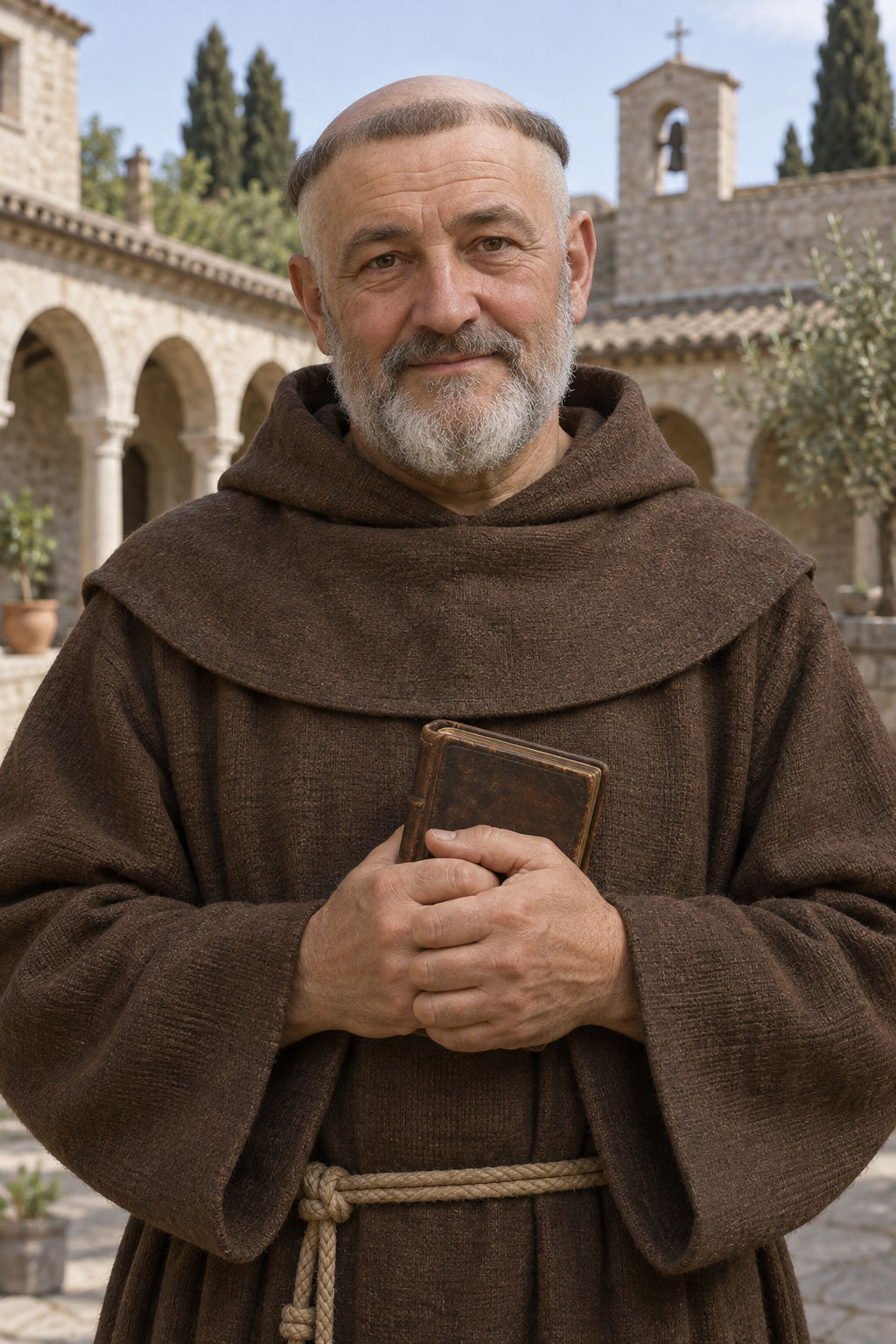
About Baldassare Ravaschieri
Baldassarre Ravaschieri, commonly rendered Baldassare in modern Italian and Balthasar in some English references, was born at Chiavari in 1419. Chiavari then belonged to the Republic of Genoa. He came from the Ravaschieri, an established Ligurian family connected in genealogical tradition with the counts of Lavagna. Serena Spanò’s critical biography notes disagreement even over his father’s identity: a manuscript genealogy names Giorgio di Rubaldino, while later hagiography names Cattaneo. This conflict is a useful warning. Baldassare is historical, but much of his familiar life was assembled by devotional writers long after his death.
Later accounts say that Baldassare lost his father as a child and was educated by aunts named Ginevra and Tobia, described as Franciscan tertiaries. The critical record does not independently establish those household details. His entry into the Observant branch of the Friars Minor is much firmer. That reform movement sought stricter communal practice of the Franciscan rule and expanded rapidly in fifteenth-century Italy. Baldassare became a professed friar and priest. Some devotional lives add advanced academic credentials, but the surviving evidence does not justify calling him a doctor of theology. His secure vocation is that of an Observant Franciscan priest.
Baldassare developed a reputation as a preacher and confessor. Later biographies assign him offices such as guardian at Chiavari and provincial vicar of Genoa, but Spanò treats parts of this administrative career cautiously because the documentation is uneven. These roles may reflect genuine service, yet they should not be stated with the same confidence as his presence in Franciscan records at Binasco. The evidence does support a life shaped by preaching, confession, and community responsibilities. Those ministries required attentive listening as well as public speech, and they placed him within networks of Observant friars moving among Ligurian and Lombard houses.
By 1478 Baldassare was at the Observant convent of Santa Maria in Campo near Binasco, between Milan and Pavia. A convent record for that year identifies a community of twenty-two friars and six professed members. Giovanni Pietro Migliavacca of Binasco served as guardian, while Baldassare served as confessor; he was the only member noted as not native to the area. This archival evidence corrects a heroic but misleading picture of a solitary wonder-worker. Baldassare lived within an organized religious community. His work depended on the worship, labor, care, and governance shared by the friars around him.
Illness limited Baldassare’s mobility during his later years. Sources describe severe gout and eventual paralysis. Although the diagnosis belongs to historical testimony rather than modern clinical assessment, the broad fact of serious physical impairment is well established in his reception. Accounts say that other friars carried him so that he could participate in worship and hear confessions. These details should not turn pain into spectacle or suggest that disability itself was a spiritual accomplishment. They instead show adaptation and interdependence: Baldassare continued a ministry of listening within narrower physical limits, while companions supplied practical access and care.
Tradition connects Baldassare with Bernardino of Feltre, another prominent Observant preacher, and with Veronica of Binasco, an Augustinian sister known for visions and later venerated as blessed. The exact character of these relationships is not equally documented. They are best presented as received associations within the religious world of northern Italy, not as fully recoverable friendships or formal direction. Stories also attribute miracles and prophecy to Baldassare. The best-known says that snow left the place around him dry while he prayed outdoors. Such episodes belong to hagiographic tradition. They can explain later imagery and devotion, but they cannot be used as independently verified events.
Baldassare died at Binasco on October 17, 1492. This date corrects the inherited catalog date of October 25. Devotion began locally soon after his death. A substantial tomb was associated with the sculptor Giovanni Antonio Amadeo, although the surviving fragments and later descriptions do not allow every element of its history to be reconstructed with certainty. The Municipality of Binasco records artistic memory connected with the former convent. When the convent was suppressed in the nineteenth century, remains honored as Baldassare’s were moved, eventually reaching Baselica Bologna near Pavia; Chiavari also retained a relic tradition.
Formal Roman recognition came centuries after the beginning of local devotion. A canonical process opened in 1909. In January 1930 the longstanding cult was confirmed under Pope Pius XI for the Franciscan Order and the dioceses of Genoa and Pavia. Sources differ by one day in describing the decree or conclusion of the process, giving January 7 or January 8. The packet preserves the well-supported year and identifies the act as confirmation of cult rather than pretending that a public beatification ceremony occurred. Catholic references place his liturgical commemoration in October, commonly on October 17, with local calendrical variation requiring jurisdiction-specific records.
Baldassare remains significant as a Franciscan whose later ministry continued amid severe limitation and dependence on his community. The most responsible account is quieter than inherited legend. It does not make him a documented plague worker, civic peacemaker, prophet, or author of surviving sayings. It recognizes instead a preacher and confessor rooted in the Observant movement, securely present at Binasco, remembered for patient ministry, and honored by a durable regional cult. Distinguishing records from later stories does not diminish that memory. It clarifies how communal life, practical care, local art, and formal recognition together carried his name across five centuries.
Wondering how to weigh the stories and sources? Learn how to read a saint biography.