Biography
Barsum the Naked
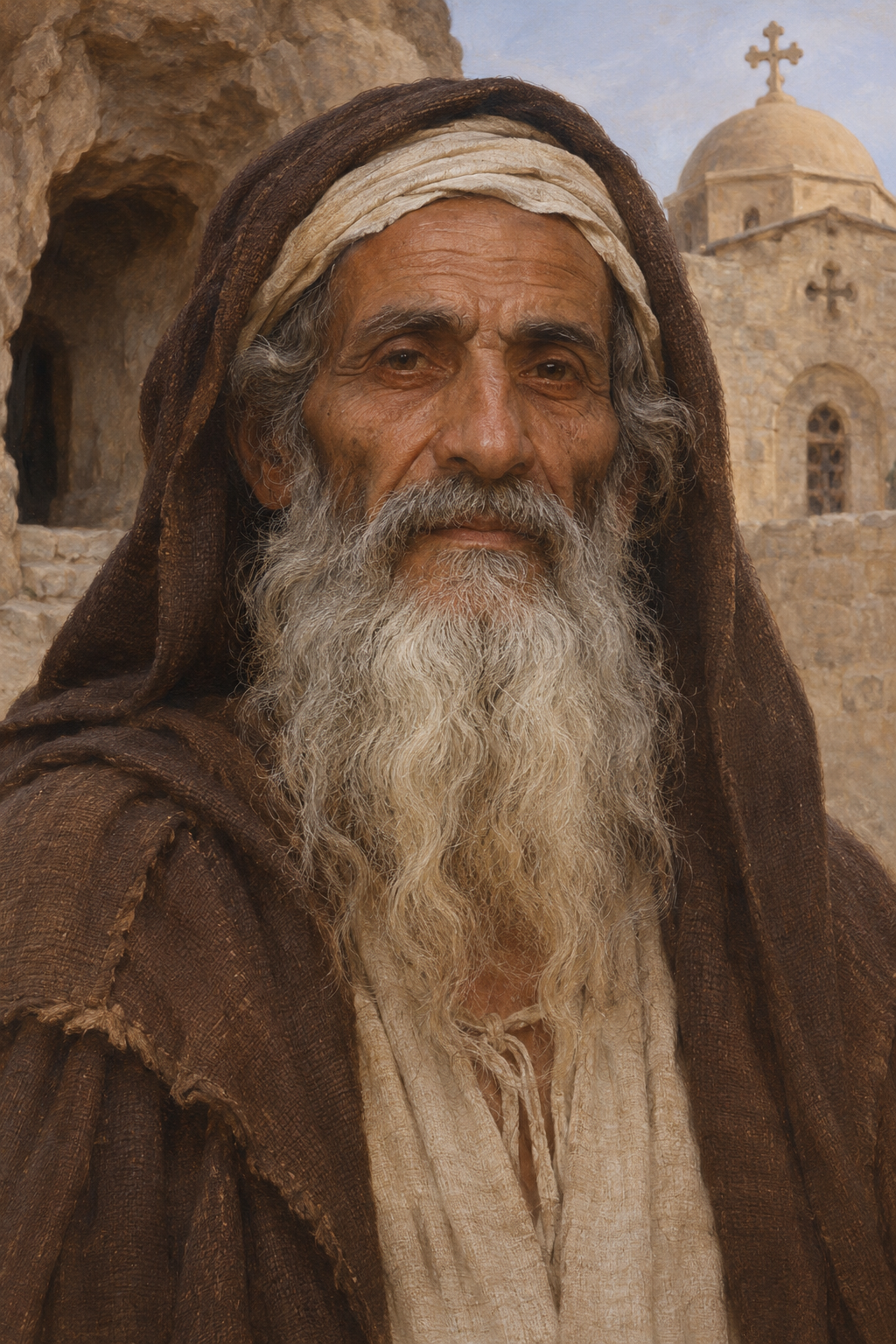
About Barsum the Naked
Barsum was born into a prosperous Cairo family and lost his parents while young. A later account says he declined to sue an uncle who had spent his inheritance.
The sources disagree about his family’s link to Shajar al-Durr’s court: one assigns a secretarial post to Barsum, another to his father. They do not establish his birth year.
A Coptic church history remembers an earlier period of solitude outside Fustat and describes Barsum wearing a goatskin before living at Saint Mercurius’s church. It links his arrest to pressure on Coptic Christians and his refusal to follow a required dress rule. Those details belong to the church’s received account and have not been established by the surviving Coptic funeral fragment.
The title “the Naked” has not meant the same thing in every source. Bishop Martyros records descriptions of a threadbare wool garment and a goatskin belt, as well as an older icon that interprets nakedness spiritually, as freedom from vice. These are competing explanations of a devotional name rather than evidence for a precise outfit. The same study gives “Ibn al-Tebban” as a family name from his mother’s side and explains Barsuma as “son of fasting.”
Bishop Martyros says Barsum was twice beaten and imprisoned for refusing a required turban. After the second release, he moved from Saint Mercurius to Dayr Shahran, where people continued to seek his counsel. The sequence is traditional.
The Sahidic funeral text says Barsum spent sixteen years at the monastery of Saint Mercurius at Shahran. That approximate span accords with a move around 1300; dates for each earlier stage of his life remain uncertain.
The later collection of Barsum’s miracles opens another window onto his reputation. Asuka Tsuji finds that many of its dated stories belong to the 1310s, after he had moved to Shahran. They name Mamluk officials with titles that fit the period, which makes the collection useful for studying the world in which it was written. Yet its purpose was to praise a holy man and encourage his veneration. A correct official’s name cannot by itself verify a reported healing.
In those stories, visitors include monks, merchants, soldiers, administrators, and people with ordinary needs. Tsuji estimates that about a third of the visitors mentioned were Muslim, although some identifications are uncertain. One story concerns a lost herd of camels; others concern illness, counsel, or trouble within a household. Such details show how a Coptic author imagined Barsum’s reach beyond a single community. Tsuji considers it probable that Muslim visitors did come to him, but she warns that the accounts were carefully shaped narratives, not a register of every visit.
The funeral fragment names John, a priest distressed at the loss of Barsum’s teaching, and Abraham, a notary whom it calls his disciple. It also portrays Barsum addressing the community before his death. In the story, John wonders who will teach people after Barsum is gone. The answer he receives is a promise that people will still be able to call on Barsum by name. It is an early expression of the belief behind the visits to his tomb.
The fragment preserves something of the language in which the monks mourned him. Its author has Barsum recite two psalms as death approaches. The first places his fear in the hands of the Lord. The other recalls the goodness of brothers dwelling together. The author then has him make the sign of the cross. These details give the scene a recognizable shape for readers who knew the same psalms by heart. They also bring the men around the dying monk into the account of his final prayer.
Barsum died on August 28, 1317. The people among whom he had spent his last years buried him at the monastery.
A surviving Sahidic Coptic fragment, translated by Anthony Alcock, concentrates on Barsum’s last days and funeral rather than his childhood. The text dates his death to the fifth extra day of Coptic year 1033 and describes monks wrapping his body in woolen garments. It then places Patriarch John VIII, clergy, and people from nearby towns at his burial by the church.
Sherin Sadek El Gendi locates Barsum within the crowded religious life of medieval Cairo rather than a distant desert settlement. Her study traces the monastery at Ma‘sara south of the city and notes that its older church and Barsum’s tomb remained centers of remembrance. She also documents later icons, some with a serpent at his feet and some without one. These paintings show how later Copts pictured the story; they cannot recover his face or the exact appearance of his clothing.
At Shahran his burial gradually changed the monastery’s public identity. Martyros cites the fifteenth-century historian al-Maqrizi, who still knew the older dedication to Mercurius but also described a Lenten feast for Barsum attended by church leaders and lay notables. A commemorative hymn by a priest named Michael was preserved in a Paris manuscript. These later witnesses show that devotion to him was already established within generations of his death; they do not settle the earlier disputes about his birth year or court connections.
Wondering how to weigh the stories and sources? Learn how to read a saint biography.