Biography
Bartolomé Gutiérrez
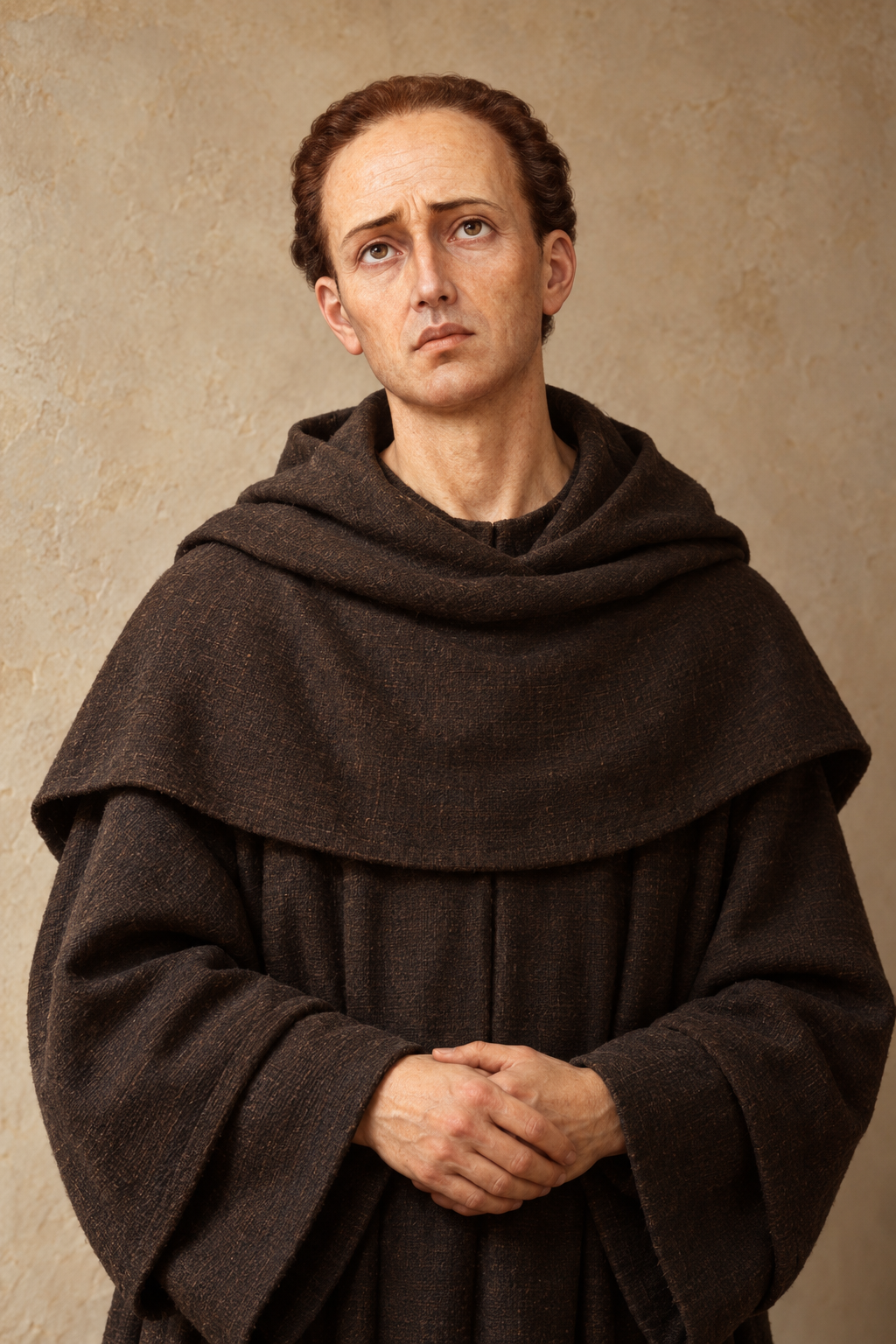
About Bartolomé Gutiérrez
Bartolomé Gutiérrez was born in Mexico City in 1580 and entered Augustinian religious life while still young. His formation included years at Yuriria, where he prepared for missionary work. After ordination, he went to Puebla and joined a group bound for the Philippines. They departed from Acapulco and reached Manila in 1606.
The exact day of his birth is uncertain. Alberto Aranda’s account identifies September 4, 1580 as his baptism at Mexico City’s Sagrario Metropolitano, rather than his birthday.
Later accounts describe him as a novice master in Manila. The Augustinian historian Manuel Merino questioned that familiar claim because he found no appointment in the provincial records, where such offices were normally recorded. His missionary journey is better established: the provincial record Merino cites received him as a priest in 1606.
He traveled to Japan in 1612 and learned the language. By the following year he was serving a Christian community at Usuki. The expulsion of missionaries in 1614 forced him back to Manila, but requests from Japanese Christians helped bring about his return in 1618. He then continued his ministry in hiding for more than a decade.
He supported Christians during a period when missionary work exposed both clergy and those sheltering them to arrest. His ministry included preaching, celebrating the sacraments and encouraging communities under pressure to abandon their faith.
After his capture in 1629, he was imprisoned at Nagasaki and then Omura.
His prison letters to Duarte Correa show how he continued caring for others while depending on help himself. In June 1630, he asked Correa to distribute money to prisoners and their families. He also requested news of people whose welfare concerned him. Another letter arranged a gift for Gracia, a Korean woman, and clothing for Juanica, the daughter of a martyr in her care. He asked Correa to visit the girl and show her affection.
Gutiérrez also made arrangements for books and church vessels entrusted to friends. He wanted one Japanese dictionary given to Domingo Ibáñez de Erquicia in thanks for a breviary. He requested paper to write to Manila and thanked his correspondent for candles and fruit. These requests survive in letters included in the Macao documentation of 1630, published in a scholarly edition by Pablo Panedas.
In July 1630, he wrote to the Franciscan commissary in Japan asking forgiveness for any hurt or bad example he had given. He asked the friars to pray for him at Mass, acknowledging his weakness and hoping to remain faithful through death.
An October letter to his provincial explained that he had admitted a fellow prisoner, Juan de San Agustín, to the Augustinian order under authority previously granted to him. He wanted Juan recognized as a religious brother if he died. The same letter asked that a Marian image be returned to the woman who had provided it for the Japanese mission.
He also described help from a Franciscan who had recovered an Augustinian silver chalice by substituting a less costly vessel belonging to his own order. Gutiérrez urged his provincial to acknowledge and settle that obligation with the Franciscans. Though confined under guard, he remained concerned about the responsibilities others were carrying on his behalf.
A letter written by his fellow prisoner Vicente de San Antonio in July 1632 describes the conditions they endured. Vicente recalled finding Gutiérrez and other priests imprisoned at Nagasaki before their transfer to Omura. He described later being taken with the group to the sulfurous springs near Arima, where the authorities tried to force them to renounce Christianity.
Vicente’s account distinguishes what happened to each prisoner. He said Gutiérrez was already weakened by lack of food and was spared the first days of torture. Hot water was subsequently poured on him, but Vicente reported that the amount did not leave wounds. After their return to Nagasaki, the prisoners continued waiting for the authorities’ decision. This testimony places Gutiérrez’s suffering within the experience of a group whose treatment and physical strength differed.
They were later returned to Nagasaki, where Gutiérrez and his companions were executed by burning in September 1632. Pope Pius IX included him among the blessed martyrs of Japan in 1867.
His memory also remained a concern for the Mexican Church. In 1987, an article by Alberto Aranda, reprinted in the Augustinian OALA bulletin, called for renewed attention to his life and his place in Mexico’s liturgical calendar. It emphasized remembering people associated with Mexico whose Christian witness had taken them far from home.
The Archdiocese of Mexico now lists his commemoration on September 2. Its notice identifies him as an Augustinian priest and blessed martyr, alongside five companions who died in Japan.
An Augustinian liturgical resource remembers him on September 28 with Pedro de Zúñiga and other martyrs. It places the Mexican missionary within a wider community of religious and lay Christians from several countries who died in Japan.
Wondering how to weigh the stories and sources? Learn how to read a saint biography.