Biography
Basil Martysz
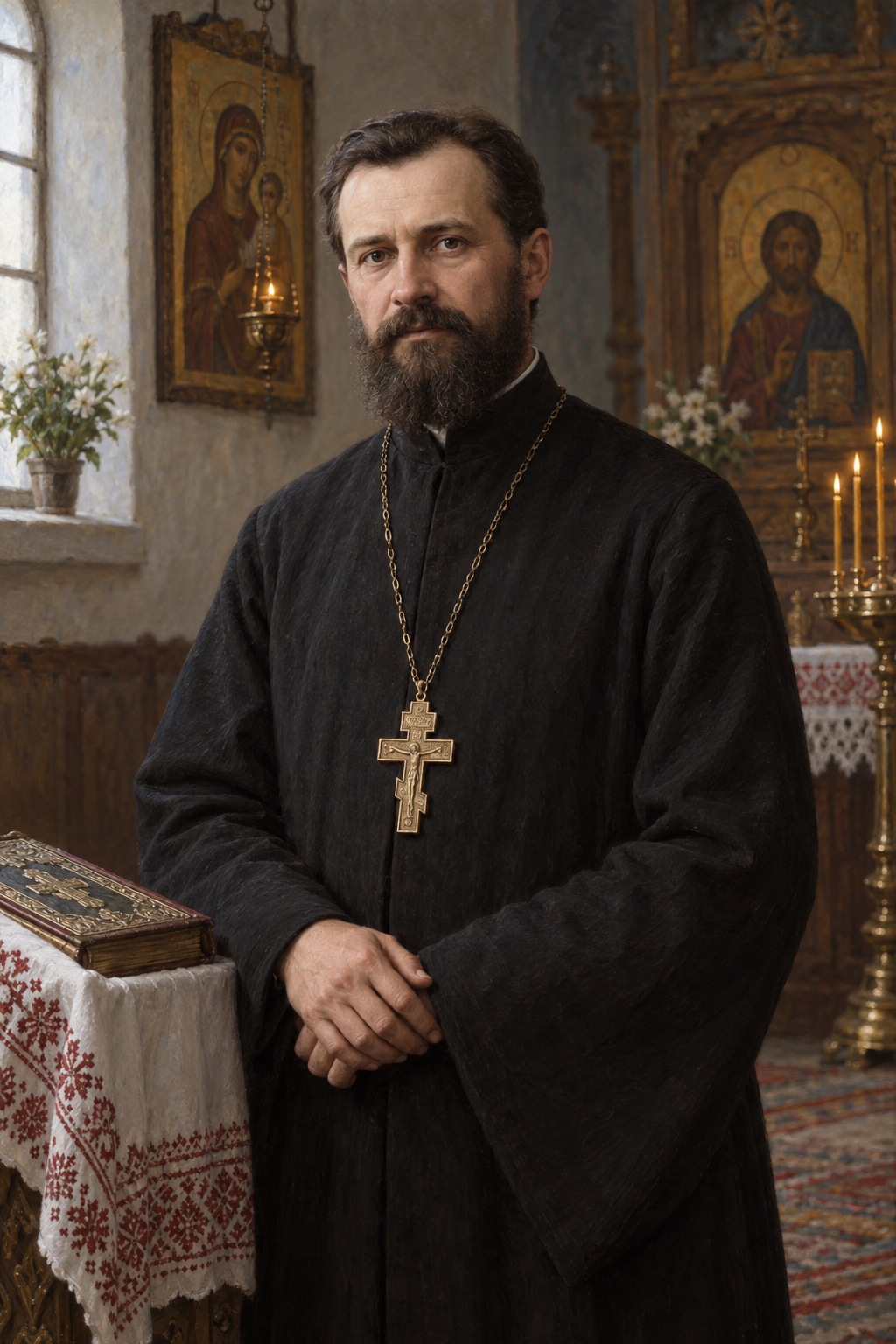
About Basil Martysz
Basil Martysz was born Vasily Martysz on 20 February 1874 in Tertyn, in the Hrubieszow region of Poland. The OCA profile and life identify him as an Orthodox priest and later archpriest. His early life and formation should be recorded only to the precision supported by those sources. [O3]
Martysz served Orthodox communities during a period when borders, governments, and church jurisdictions were changing. The OCA account records pastoral work in North America as well as service in Poland. These assignments should be represented as separate events with their own geographic evidence rather than as one generalized claim about travel. [O3]
His ministry continued after his return to Poland. The official life describes him as a priest who remained with his people through difficult conditions. The record supports priestly vocation and missionary or pastoral service; any exact parish chronology, imprisonment claim, or quotation requires direct linkage to the relevant passage before publication. [O3]
Martysz was killed on 4 May 1945 at Teratyn, Poland. The OCA identifies him as a new martyr and archpriest and commemorates him on 4 May. The death event, martyrdom classification, title, and feast observance should be stored as separate claims, with the OCA life supplying the event and the OCA profile supplying the calendar and title fields. [O3]
His significance lies in steadfast Orthodox pastoral service amid twentieth- century upheaval. A careful profile can honor his martyrdom while leaving unsupported details empty and avoiding the assumption that every later account of regional persecution applies to his personal biography. [O3]
Basil Martysz's record should preserve the context of Orthodox pastoral service in Poland and the suffering described by the official account. The source supports a restrained narrative of ministry, persecution, and death; it does not support invented dialogue or precision about episodes that the profile does not date. [B1][B2]
His significance is not exhausted by a list of hardships. The pastoral record shows a priest serving a community amid political and religious pressure, while the later recognition of his witness belongs to the Church's memory of that period. The final biography will keep those layers distinct and will not turn uncertain devotional details into historical fact. [B1][B2]
Martysz's ministry should be read against the changing religious and political conditions of Poland. The official accounts preserve a priest serving an Orthodox community amid pressure and instability, but they do not provide a complete chronology of every assignment or every act of persecution. The final profile keeps the supported sequence and leaves unsupported precision empty. [B1][B2]
The account of suffering is handled as history rather than spectacle. Where the source states an imprisonment, deprivation, or death circumstance, the record can report it with a citation. It should not add graphic detail, invented dialogue, or motives not stated by the official profiles. This preserves both the dignity of the subject and the reliability of the catalog. [B1][B2]
Martysz's pastoral identity also remains central. He was not only a victim of historical forces; he served a community, carried ecclesial responsibility, and remained associated with Orthodox witness in Poland. The biography therefore connects ministry and persecution without claiming that every later community development was his personal work. [B1][B2]
Later recognition belongs in its own layer of the record. It confirms how the Church remembers Martysz, but it does not turn later devotional language into a contemporary source for his childhood or private life. The accepted packet deliberately omits unsupported quotations, exact numerical claims, and unlocated episodes while preserving the documented pastoral and martyr witness. [B1][B2]
Martysz's pastoral responsibility included the ordinary work of preserving worship, teaching, and community trust during a period when public conditions were unstable. The official profiles do not enumerate every service or explain every private decision, so the biography keeps its claims at the level the sources support. [B1][B2]
The record also distinguishes the experience of a community from the biography of one priest. Martysz can be described as serving people who faced pressure and uncertainty, but the profile should not claim that he personally directed every later institutional response. This distinction protects both historical accuracy and the dignity of those whose stories are not preserved in the short source. [B1][B2]
His recognized witness is presented through ministry, endurance, and death. Later devotional memory is acknowledged as recognition, not used as evidence for invented childhood details, conversations, or exact scenes. The resulting catalog entry remains open to future archival additions while keeping its current claims auditable. [B1][B2]
The final account keeps Martysz's pastoral identity visible alongside the record of suffering. He served a church and a people, and that service gives the later martyr recognition its historical context. The sources do not support assigning him every later institutional development, so the biography avoids that claim. [B1][B2]
Where the official profiles are concise, the catalog remains concise in its certainty. It states the supported dates, places, ministry, and death while leaving unsupported private details empty. This makes the record suitable for future review and prevents devotional expansion from being mistaken for an archival source. [B1][B2]
Wondering how to weigh the stories and sources? Learn how to read a saint biography.